Struggling with gambling? Self-exclusion might be your best option. This tool blocks access to all gambling platforms for a set period, helping you take a complete break. Research shows that over 99% of people who commit to self-exclusion for 90 days or more successfully avoid gambling during that time. Other tools like deposit limits and reality checks can help too, but self-exclusion is the most effective for those needing a clean slate. Here’s how these strategies work and what they mean for you:
- Self-exclusion: Stops gambling completely for a set time. Highly effective for long-term behaviour change.
- Deposit limits: Caps how much money you can transfer to gambling accounts. Good for casual gamblers.
- Reality checks: Sends reminders about time spent gambling. Useful for monitoring habits.
Each tool has pros and cons, but combining them can offer stronger protection. South African platforms like Supabets make these tools easy to access, and the National Responsible Gambling Programme provides additional support. The right choice depends on your needs, but taking action early can help reduce gambling-related harm.
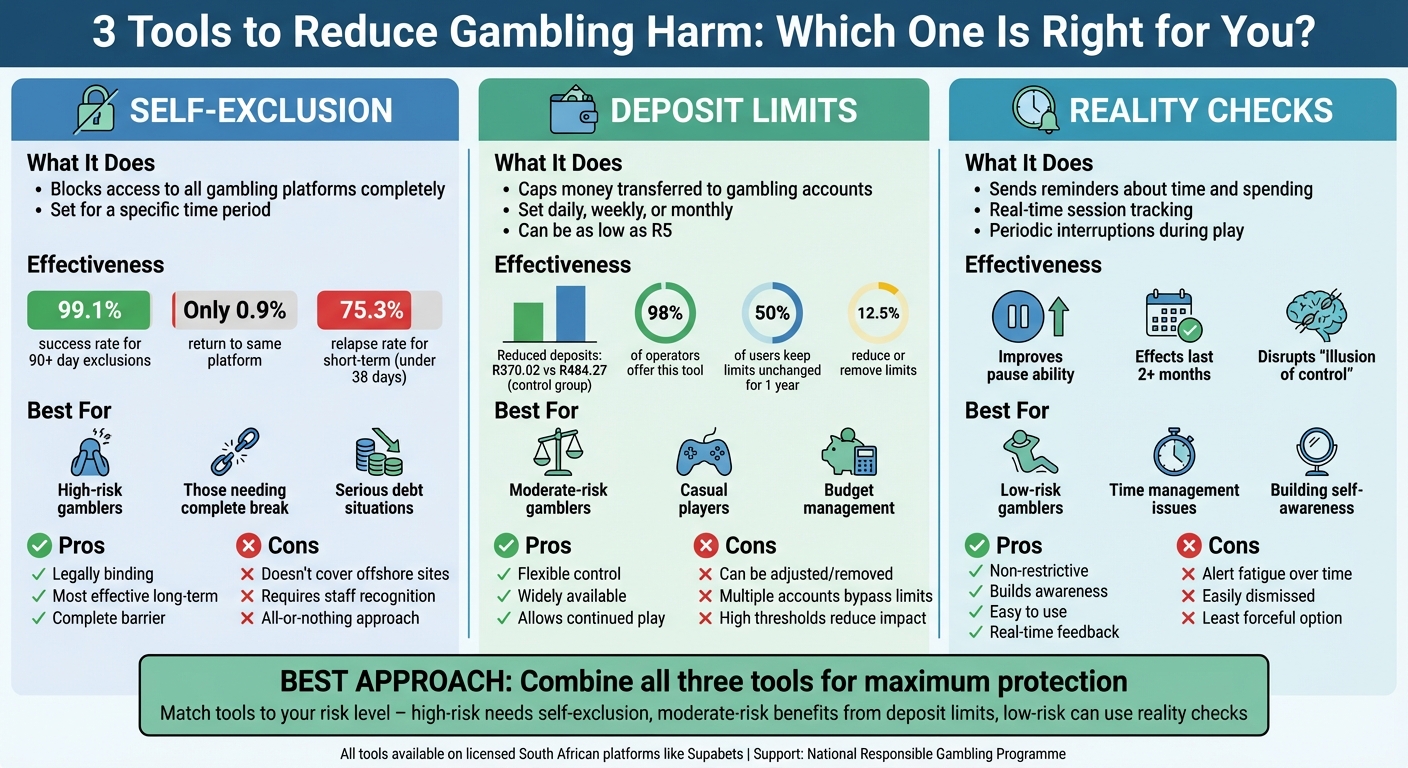
Comparison of Three Gambling Harm Reduction Tools: Effectiveness and Features
1. Self-Exclusion
Effectiveness in Reducing Gambling Harm
Self-exclusion is one of the most effective ways to immediately curb impulsive gambling, outperforming tools like deposit limits and reality checks. Unlike these measures, self-exclusion creates a complete barrier to gambling activity. Research shows that longer self-exclusion periods (90 days or more) are far more impactful than shorter ones. For instance, a study of British online casino players revealed that 75.3% of those who opted for short-term exclusion (up to 38 days) resumed gambling, compared to less than 1% of those who chose long-term exclusion (90 days or more).
The effectiveness of self-exclusion increases when combined with restrictions on promotional communications. A 2022 trial involving 2,548 French online gamblers on the PMU platform demonstrated this. Participants under a 9-month promotional ban deposited significantly less (€319,65 versus €455,68 at six months). However, self-exclusion isn’t foolproof. In Sweden, 49% of users in the nationwide Spelpaus system reported gambling during their exclusion, often on unregulated overseas platforms. This highlights both the strengths and limitations of self-exclusion, especially when local systems fail to block access to external sites.
Accessibility and Ease of Use
In South Africa, licensed platforms like Supabets have made self-exclusion easily accessible. The feature is built into their Responsible Gaming sections and is available alongside tools like deposit and time limits. Players can initiate self-exclusion from both desktop and mobile platforms, and assistance is available through multiple support channels, including 24/7 live chat, email, and phone.
Long-Term Impact
The duration of self-exclusion plays a critical role in its effectiveness over time. Gamblers who commit to at least 90 days of self-exclusion often experience meaningful behavioural changes. In contrast, shorter exclusion periods frequently fail to reduce the intensity of gambling when players return. Extended self-exclusion can also lead to lasting financial benefits. For example, the PMU study showed that reduced deposits persisted for up to 12 months. However, a common issue arises when operators resume promotional communications immediately after the exclusion ends, which can lead to a relapse.
sbb-itb-00c3b18
2. Deposit Limits
Effectiveness in Reducing Gambling Harm
Deposit limits act as a middle ground between casual gambling and more severe measures like self-exclusion. Unlike self-exclusion, which completely blocks access to gambling platforms, deposit limits allow users to control how much money they can add to their accounts over specific periods – daily, weekly, or monthly. This makes them a preferred choice for casual gamblers looking to prevent problems before they escalate.
Studies have shown that deposit limits can help reduce gambling intensity when set at reasonable levels. For instance, a 2022 trial on the PMU platform found that targeted interventions reduced deposits to R370,02 over a year compared to R484,27 in the control group. However, critics argue that overly high deposit thresholds diminish their impact. Industry expert Steve Ruddock commented:
"The daily deposit threshold is so high that it cannot possibly have an RG [responsible gambling] impact. It would have been better to say nothing… than to recommend such a ridiculously high threshold".
One limitation of deposit limits is their flexibility. Users can adjust or even remove their limits, which weakens their effectiveness compared to the stricter barrier provided by self-exclusion. While half of the users who set deposit limits keep them unchanged for a year, about one in eight either reduce or eliminate the limits altogether.
Next, we’ll explore how easily South African platforms make these tools available to users.
Accessibility and Ease of Use
Deposit limit tools are widely available, with 98% of leading gaming operators offering them. In South Africa, platforms like Supabets include deposit limits within their Responsible Gaming sections, alongside other tools like self-exclusion and time limits. These limits can be set directly through account settings, whether on desktop or mobile devices.
A noteworthy innovation in this space is the "opt-out" approach. For example, in Australia, introducing an opt-out policy for deposit limits led to a dramatic rise in usage – from just 4 users to 187 per month on one platform, representing a nearly 5,000% increase. Associate Professor Sally Gainsbury, Director of the GTRC, highlighted the potential of this approach:
"The marked success of the ‘opt-out’ limit setting policy has important implications; suggesting this strategy could be used to encourage other responsible gambling behaviours".
3. Reality Checks
Effectiveness in Reducing Gambling Harm
Reality checks, alongside tools like self-exclusion and deposit limits, focus on the psychological side of gambling behaviour. Instead of entirely blocking access, these tools provide real-time updates on how long a player has been gambling and how much they’ve spent. Essentially, they act as brief interruptions during gambling sessions.
These tools are particularly useful in addressing the mental traps of problem gambling. Many gamblers convince themselves they can influence outcomes or believe they’re on a winning streak. Reality checks disrupt this "illusion of control" by presenting clear, factual data about spending and time. Studies indicate that even short breaks or feedback during gambling sessions can significantly improve a player’s ability to pause, with these effects lasting for at least two months.
Unlike self-exclusion, which enforces a complete halt, reality checks provide periodic feedback. This makes them a great complement to other harm-reduction tools. They allow players to stay in control without necessarily ending their session, making them ideal for casual gamblers who want to monitor their habits before they potentially spiral.
Accessibility and Ease of Use
Reality checks are widely available on South African gambling platforms. Licensed operators like Supabets have integrated these tools into their Responsible Gaming sections, alongside other options like self-exclusion, deposit, and time limits. Players can easily access these features on both desktop and mobile versions of the platforms.
What makes reality checks so effective is their real-time tracking functionality. Mobile apps, for instance, enable players to view their betting totals and session durations instantly, giving them immediate insight into their gambling habits.
Long-Term Impact
Though reality checks might seem less forceful than self-exclusion, they offer meaningful benefits over time. They form part of a broader strategy that includes tools like limit-setting and self-assessments. Their primary strength lies in helping players gradually build greater self-awareness and control.
Many operators are now leveraging behavioural markers – such as frequent changes to deposit limits or unusually high deposits – to trigger personalised reality checks for players who may be at risk. This tailored approach allows platforms to address potential problems early. By presenting clear, objective data, reality checks challenge the belief that losses can be recovered by continuing to gamble. This makes them an excellent complement to tools like deposit limits and self-exclusion, encouraging ongoing self-monitoring and healthier gambling habits.
Advantages and Disadvantages
Let’s take a closer look at the strengths and challenges of the different tools mentioned earlier, highlighting how each can be effective in the right context.
Self-exclusion offers a strong, legally binding safeguard. If you gamble during your exclusion period, any winnings or losses are forfeited. The process involves identity verification, often through notarised forms or employee confirmation. However, its effectiveness depends on staff recognising excluded individuals at licensed venues. Plus, it doesn’t cover unlicensed offshore sites, leaving a gap in protection.
Deposit limits are a practical way to manage spending, allowing players to gamble within a predetermined budget. For instance, platforms like Supabets enable users to set limits as low as R5. The challenge here is emotional decision-making – players might set overly generous limits in the heat of the moment or open multiple accounts to sidestep restrictions.
Reality checks are the least restrictive tool in the mix. These reminders promote self-awareness by alerting players to their session duration or spending. Supabets describes them as a way to "set limits or take a break if things get hectic". While helpful, they can lose their impact over time, as players often dismiss alerts without giving them much thought – a phenomenon known as alert fatigue.
For the best results, experts suggest using a layered approach. Combining tools – like operator-level controls, bank transaction blocks, and device-level software – creates multiple layers of protection. In South Africa, the National Responsible Gambling Programme (NRGP) offers centralised support across provinces, helping to bridge gaps that regional-only solutions might leave.
The choice of tools should align with the gambler’s risk level. High-risk individuals struggling with debt may benefit most from full self-exclusion. Players at moderate risk might find deposit limits sufficient to keep their spending in check, while low-risk individuals who tend to lose track of time could rely on reality checks. Tailoring the approach to the specific needs of the individual ensures the best chance of success.
Conclusion
When it comes to assisting problem gamblers, long-term self-exclusion emerges as one of the most effective strategies, especially when extended beyond 90 days. Studies reveal that this approach leads to a minimal return rate of just 0.9% on the same platform. In contrast, short-term self-exclusion (lasting up to 38 days) results in a much higher relapse rate of 75.3%.
However, no single tool is a complete solution. As Sol Fayerman-Hansen, Editor-in-Chief of RG.org, explains:
"Responsible gambling isn’t about limiting fun – it’s about maximising enjoyment while minimising risk".
A multi-faceted approach works best, combining long-term self-exclusion, strict deposit limits, and regular reality checks. For high-risk gamblers, long-term self-exclusion is crucial, while moderate-risk players can benefit from tighter deposit controls and consistent reminders to stay on track. The key lies in honest self-reflection and selecting the tools that align with individual needs.
Supabets incorporates these solutions effectively, in partnership with South Africa’s National Responsible Gambling Programme. This programme offers centralised support across provinces, ensuring accessible help. Embracing these tools early can make a significant difference in reducing gambling-related harm.
FAQs
How do I choose the right self-exclusion period?
Choosing the right self-exclusion period is a personal decision that should align with your goals and concerns about gambling habits. Typical choices include one year, five years, or ten years. If you’re uncertain, opting for a shorter period, such as one year, can give you the chance to reassess your situation later. Keep in mind that self-exclusion is irrevocable during the selected timeframe, so it’s important to choose a duration that genuinely supports your commitment to responsible gambling.
What happens if I try to gamble while self-excluded?
If you try to gamble while on a self-exclusion list, you could be asked to leave the venue. On top of that, any winnings you might earn during this time could be taken away. The purpose of self-exclusion is to promote responsible gambling by ensuring you stay away from gambling activities during the set exclusion period.
How can I stop gambling on offshore sites during exclusion?
Self-exclusion can be a powerful way to regain control over gambling habits, especially when paired with regulated tools like Bet Stop South Africa. This tool allows you to block access to a wide range of betting platforms for a time period you choose. What’s more, it ensures that gambling operators adhere to South African laws, giving you an added layer of protection. By using self-exclusion, you can take a proactive step towards limiting access to gambling websites during your exclusion period.