Online betting in South Africa is legal and thriving, with over 30 licensed bookmakers and a market valued at around R800 million. You can bet on sports, esports, and virtual games from your phone, with deposits starting as low as R10. However, choosing licensed operators is crucial for legal protection and safety. Here’s what you need to know:
- Legal Framework: Sports betting is legal through licensed operators, but online casinos and poker remain prohibited.
- Regulations: Operators must comply with FICA, verifying your identity and address.
- Payment Options: Popular methods include Instant EFT, debit/credit cards, and prepaid vouchers.
- Responsible Gambling: Tools like deposit limits and self-exclusion help manage betting habits.
- Licensed vs. Unlicensed Sites: Licensed platforms offer legal protection, contribute taxes, and support responsible gambling programmes.
Always verify a platform’s licence, bet responsibly, and use tools to stay in control. For support, contact the National Responsible Gambling Helpline at 0800 006 008.
Over 90 online gambling sites operating illegally in SA
sbb-itb-00c3b18
Legal Framework for Online Betting in South Africa
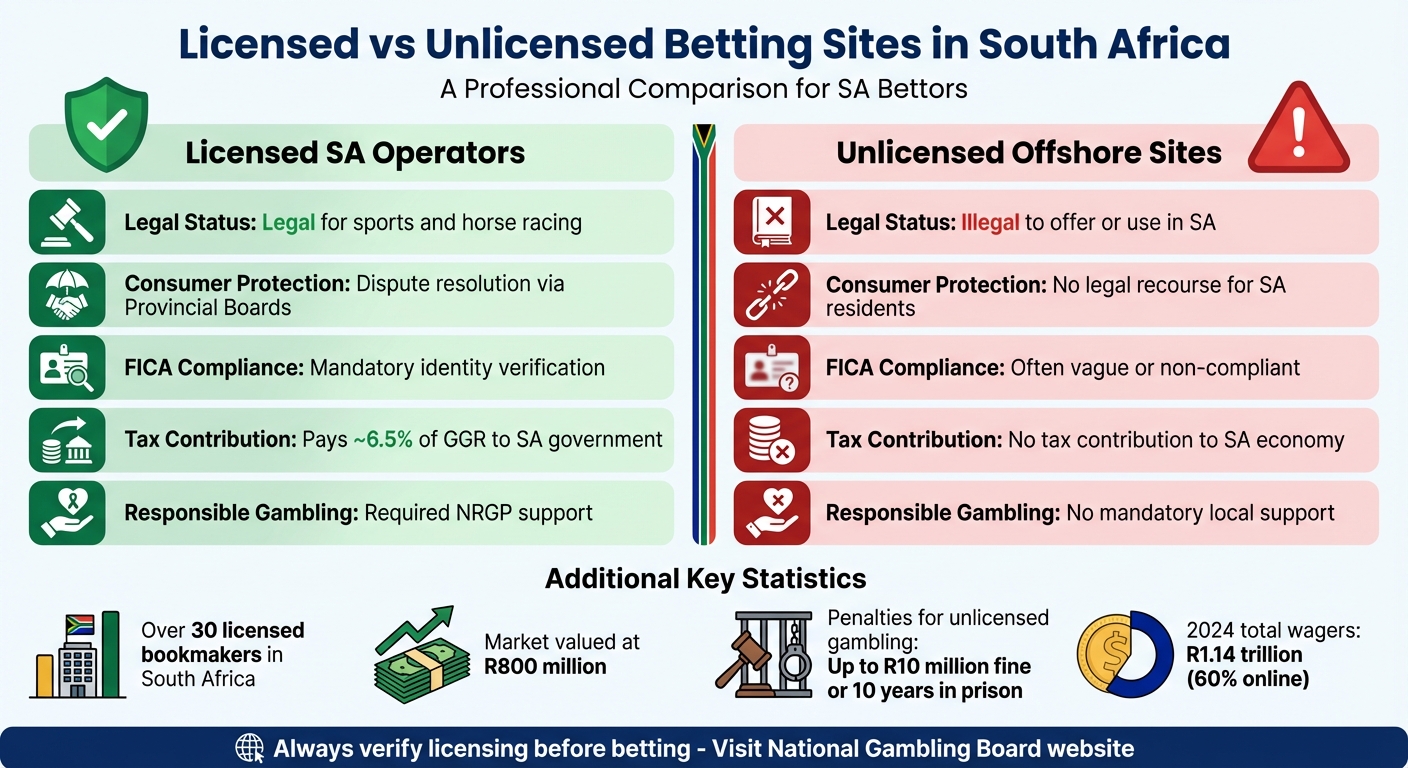
Licensed vs Unlicensed Betting Sites in South Africa Comparison
South Africa’s Gambling Regulations
The National Gambling Act of 2004 serves as the backbone of gambling laws in South Africa. Under this law, online sports betting and horse racing are allowed, but only through licensed bookmakers. However, interactive gambling – like online casinos, poker, and bingo – is strictly forbidden at a national level.
Gambling oversight operates on two levels: the National Gambling Board, which sets overarching standards, and the nine Provincial Boards, such as the Western Cape Gambling and Racing Board and the Gauteng Gambling Board, which handle licensing and enforcement.
Interestingly, some provinces, such as the Western Cape and Mpumalanga, have begun licensing fixed-odds casino-style games under bookmaker permits. However, this practice exists in a legal grey area nationally. The Remote Gambling Bill (B11-2024), which completed public consultations in early 2025, aims to address these inconsistencies by proposing a unified national framework for online casinos and poker.
All licensed operators must adhere to the Financial Intelligence Centre Act (FICA), which enforces strict identity and address verification for all bettors. Additionally, the legal gambling age is set at 18 years. Engaging with unlicensed offshore gambling sites can lead to severe penalties, including fines of up to R10 million or 10 years in prison.
This regulatory framework makes it clear why choosing a licensed operator is not just a legal requirement but also a prudent decision.
Why Choose Licensed Operators
Opting for a licensed operator goes beyond simply following the law – it’s about ensuring your safety and peace of mind. Licensed platforms offer formal dispute resolution mechanisms through Provincial and National Gambling Boards.
"The gambling operator should display their licensing information at their premises. In the case of legally licensed online gambling operators, the licensing information is found on the home page of their digital platform." – National Gambling Board.
Licensed operators also contribute significantly to the South African economy through tax payments. On average, bookmakers pay 6.5% of Gross Gaming Revenue (GGR) to provincial authorities, which helps fund public services like healthcare, education, and infrastructure. In contrast, offshore sites contribute nothing to the local economy and leave users without legal protection in cases of disputes. In 2024 alone, South African bettors wagered a staggering R1.14 trillion, with online platforms accounting for over 60% of this amount.
Moreover, licensed operators are required to support the National Responsible Gambling Programme (NRGP). This includes providing tools for self-exclusion, deposit limits, and access to a toll-free helpline (0800 006 008). These safeguards, along with the regulated casino industry’s role in creating over 100,000 jobs, show how licensed operators prioritise both compliance and player welfare.
| Feature | Licensed SA Operators | Unlicensed Offshore Sites |
|---|---|---|
| Legal Status | Legal for sports and horse racing | Illegal to offer or use in SA |
| Consumer Protection | Dispute resolution via Provincial Boards | No legal recourse for SA residents |
| FICA Compliance | Mandatory identity verification | Often vague or non-compliant |
| Tax Contribution | Pays ~6.5% of GGR to SA government | No tax contribution to SA economy |
| Responsible Gambling | Required NRGP support | No mandatory local support |
How to Register and Manage Your Betting Account
When diving into online betting, sticking with licensed operators is key. Here’s a step-by-step guide to help you register and manage your account securely and efficiently.
Registration and FICA Verification
Signing up on a licensed South African betting platform is a quick process, usually taking between 50 seconds and 3 minutes. To get started, you’ll need to provide:
- Your full name
- South African ID or passport number
- Mobile number and email address
- A unique username and a strong password (at least 8 characters combining uppercase, lowercase, numbers, and symbols)
After submitting your details, you’ll receive a One-Time Pin (OTP) via SMS to activate your account. Once registered, you’ll need to complete FICA verification before withdrawing any winnings. This involves submitting a government-issued ID (like a Smart ID Card, Green ID Book, passport, or driver’s licence) and proof of residence (such as a utility bill, bank statement, or municipal rates invoice dated within the last three months). The process typically takes 1 to 2 hours, though some platforms may take up to 48 hours.
"The Supabets ZA registration process is one of the easiest I experienced… the entire session took just over a minute." – Ernest Masuka, Betting Expert, Silentbet
Most betting sites let you upload these documents via WhatsApp, live chat, email, or a self-service portal. To avoid delays, ensure the details on your documents match your registration information exactly, as discrepancies can lead to rejection.
"My take is that the best way is to do your FICA on live chat so the representative can explain some of the requirements to you." – Ernest Masuka, Betting Expert, Silentbet
Payment Methods for South African Bettors
Once your account is verified, you’ll need to pick a secure payment method for deposits and withdrawals.
South African bettors have access to various payment options. Instant EFT services like Ozow and SiD are popular for their real-time transfers, zero fees, and strong security features like Two-Factor Authentication (2FA). Debit and credit cards (Visa and Mastercard) are also widely used, though withdrawals can take 24 to 72 hours. Prepaid vouchers like 1Voucher, OTT, and Blu Voucher allow for instant deposits at over 200,000 retail locations, including Shoprite, Checkers, and PEP, but note that vouchers can’t be used for withdrawals. For faster withdrawal times, e-wallets like Skrill and Neteller are excellent options, though some bonuses may not apply when using them.
| Payment Method | Deposit Fee | Withdrawal Fee | Deposit Time | Withdrawal Time |
|---|---|---|---|---|
| Instant EFT (Ozow/SiD) | Free | Free | Instant | Instant to 24 hours |
| Visa/Mastercard | 0%–5% | Free | Instant | 24–72 hours |
| E-Wallets (Skrill/Neteller) | Free | Free | Instant | Instant |
| Vouchers (OTT/1Voucher) | Free | N/A | Instant | N/A |
| Bank Transfer | ~R50 | Varies | 2–7 days | 2–7 days |
"Instant EFT providers like SiD and Ozow are the best payment methods for betting sites, as they allow you to deposit and withdraw directly from/to your bank account instantly and pay zero fees." – SportsBoom Editorial Team
Account Management Tips
To keep your betting experience secure and hassle-free, consider these tips:
- Use responsible gambling tools to set daily or monthly spending limits as soon as you join.
- Enable Two-Factor Authentication (2FA) on both your betting account and payment app to enhance security.
- Regularly review your betting history to spot any unusual activity.
- Make sure your FICA documents match the details provided during registration to avoid payout delays.
- If you need to update personal information, contact customer support immediately instead of waiting for an issue to arise.
Lastly, remember that the legal gambling age in South Africa is 18 years, and all licensed operators strictly enforce this rule. By following these steps, you can enjoy a safe and enjoyable betting experience in South Africa’s regulated market.
Betting Types, Odds, and Strategies
Common Betting Types in South Africa
South African bettors have a range of betting options to explore, each offering its own unique approach to wagering. These options form the backbone of the country’s regulated betting market.
Moneyline bets are straightforward – just pick the winner. For instance, you might back the Kaizer Chiefs to win their next PSL match.
Point Spread (Handicap) betting levels the playing field by giving the underdog a head start. For example, if you bet on the Springboks at -6.5 against Wales, they’d need to win by at least 7 points for your bet to win.
Totals (Over/Under) bets focus on whether the combined score of both teams exceeds or falls short of a number set by the bookmaker.
Parlays (Multi-Bets/Accumulators) combine multiple selections into a single ticket. While the potential payout is higher, every selection must win for you to cash out.
Prop Bets (Specials) are all about specific events within a match – like predicting the first goalscorer or the total number of corners.
Live (In-Play) Betting adds an extra layer of excitement by allowing you to place bets as the action unfolds, with odds updating in real time.
Futures are long-term bets, such as wagering on the Springboks to win the Rugby World Cup.
Sports betting dominates South Africa’s gambling market, accounting for around 60.5% of total revenue. In the 2023/24 fiscal year, sports betting contributed an estimated R700 billion out of R1.1 trillion in total bets. Mobile betting is also on the rise, with over 60% of wagers now placed through apps.
Next, let’s break down how odds work and how to calculate your potential winnings.
How to Read Odds and Calculate Winnings
In South Africa, decimal odds are the most common format. These odds are easy to use – just multiply your stake by the odds to calculate your return. For example, a R100 bet at 2.50 odds will return R250 (R150 profit plus your original R100 stake).
Fractional odds, often used in horse racing, are written as fractions. For instance, odds of 5/2 mean you’ll earn R5 for every R2 staked. A R100 bet at 5/2 would return R350 (R250 profit plus your R100 stake).
American odds are less common locally but may appear on international platforms. Positive numbers (e.g. +150) show the profit on a R100 stake, while negative numbers (e.g. -220) indicate how much you need to wager to win R100.
To assess value, you can calculate the implied probability of an outcome. Divide 1 by the decimal odds, then multiply by 100. Lower odds suggest a favourite with a higher chance of winning but smaller payouts, while higher odds indicate an underdog with a lower chance but bigger potential returns.
| Odds Format | Example | Calculation for R100 Stake | Total Return (ZAR) |
|---|---|---|---|
| Decimal | 2.50 | 100 × 2.50 | R250 |
| Fractional | 5/2 | 100 × (1 + 5/2) | R350 |
| American (+) | +150 | (100 × 1.5) + 100 | R250 |
Now that you understand the basics of odds, let’s look at strategies to improve your betting approach.
Betting Strategies for Beginners
For those just starting out, it’s best to stick to simpler bets like Moneyline or Totals before diving into more complex markets like handicaps or parlays. A good rule of thumb is to wager only a small percentage of your bankroll – typically 1–3% per bet. Keep track of your bets to identify trends and learn from your wins and losses.
Value betting is an essential strategy. This involves finding scenarios where the actual probability of an outcome is higher than what the bookmaker’s odds suggest. To do this effectively, research is key – look into team form, injury updates, head-to-head stats, and even external factors like weather, which can affect sports like rugby and cricket.
Avoid betting based on loyalty or emotion, and don’t chase losses with reckless wagers. Always place your bets on licensed platforms to ensure safety and compliance.
Stick to sports you’re familiar with, such as the PSL, United Rugby Championship, or Proteas cricket. This allows you to make more informed decisions. During major events like the Soweto Derby, look out for odds boosts or special promotions that can give you an extra edge.
Many South African sportsbooks make betting accessible, with minimum stakes starting as low as R5 to R10. As the online betting market continues to grow – projected at an 8% annual increase – new tools and features are making it easier for beginners to get involved.
Responsible Gambling and Online Safety
Taking care of your betting habits is just as important as managing your account. Responsible gambling practices ensure a safer and more enjoyable experience.
Setting Limits and Managing Risk
Betting should always be about fun, not stress. Stick to using only disposable income and aim to keep individual wagers within 3%–4% of your bankroll.
Licensed operators in South Africa provide tools to help you stay in control. These include deposit limits (daily, weekly, or monthly), loss caps, session timers that log you out automatically, and reality checks – pop-up alerts showing your playtime and spending. Before starting, configure these limits in your account settings. Another tip? Use a separate bank account for your betting funds to keep things organised. Setting a timer or phone alarm can also help you manage your sessions, while maintaining a log of your bets may reveal patterns that need attention.
"Responsible gambling means staying the boss of your play, not the other way around." – Henno Kruger, Founder, Running Wolf’s Rant
If gambling starts to feel overwhelming, you can opt for self-exclusion, which blocks you from all licensed platforms for at least six months. To lift this ban, proof of attending a treatment session is required. It’s also wise to avoid gambling under the influence of alcohol, during stressful times, or when tempted to chase losses in an attempt to recover funds.
Think of these measures as tools to help you stay in control and maintain a healthy relationship with gambling.
Warning Signs of Problem Gambling
Spotting the early signs of problem gambling can make a big difference. Warning signs include spending more money or time than planned, chasing losses, or neglecting responsibilities. Other red flags include lying about your gambling habits, borrowing money, selling possessions to fund bets, or using money meant for essentials like rent or groceries. Feeling anxious, irritable, or restless when trying to cut back – and using gambling to escape stress or depression – are also concerning.
If you notice these behaviours, take action immediately. Tighten your betting limits, seek financial advice, and try the free online self-assessment offered by the South African Responsible Gambling Foundation. If the problem persists, identify triggers and adjust your habits accordingly.
Support Resources in South Africa
In South Africa, the National Responsible Gambling Programme (NRGP), run by the South African Responsible Gambling Foundation (SARGF), is the main support system. It’s funded by about 0.1% of the gross gambling revenue from licensed operators [39,44] and offers free, confidential counselling and treatment for problem gamblers and their families.
If you need help, contact the National Responsible Gambling Helpline at 0800 006 008 (toll-free, available 24/7) or reach out via WhatsApp/SMS at 076 675 0710 [38,44]. You can also email helpline@responsiblegambling.org.za. The NRGP provides outpatient counselling with mental health professionals and, in severe cases, even covers inpatient treatment.
"Counselling is an opportunity to discuss issues and concerns with a mental health professional in a safe, confidential, non-threatening and accepting environment." – National Responsible Gambling Programme
Gamblers Anonymous (GA) South Africa is another option, offering peer support groups with region-specific contact details [38,44]. For extreme cases, South African law allows family members to request a loved one’s exclusion from gambling if their behaviour is causing harm. Additionally, all licensed operators are required to display the message "Winners know when to stop" alongside the 24/7 helpline number.
Conclusion
This guide has provided you with the essentials to navigate South Africa’s regulated online betting market. Online sports betting in South Africa is fully legal on licensed platforms, such as those regulated by the Western Cape and Gauteng Gambling Boards. The industry is booming, with an estimated value of around ZAR 75 billion annually and projected growth of 10–11% each year through 2030. Interestingly, about 80% of sports betting now takes place online, and nearly half of South Africans (49.4%) have placed a bet in the past year.
When betting, treat it purely as a form of entertainment – not as a way to make money. Always verify that a platform is licensed before depositing funds, and complete your FICA verification to avoid any delays when withdrawing winnings. A good rule of thumb is to limit individual bets to 2–5% of your total bankroll. Take advantage of tools like deposit limits and reality checks to manage your spending. For smoother transactions, opt for local payment methods like Instant EFT or vouchers.
"Betting is entertainment, not a way to make money. If you ever feel out of control, reach out to support services." – LiveScore
While sports betting is fully legal, remember that interactive gambling remains restricted in South Africa. If you find your betting habits becoming problematic, the South African Responsible Gambling Foundation offers free, confidential support 24/7 at 0800 006 008.
Stay informed, bet responsibly, and enjoy the process. The smartest bettors are those who check the details, set limits, and know when to step away.
FAQs
How do I check if a betting site is licensed in South Africa?
To verify if a betting site is operating legally in South Africa, look for a licence issued by a recognised regulatory authority. Legitimate betting platforms often use a domain ending in “.co.za” and prominently display their licensing details on their website. Be cautious of sites that fail to provide this information, as they could be unlicensed or potentially fraudulent.
Why can I bet on sports online but not play online casino games or poker?
Sports betting is completely legal in South Africa and operates under the regulation of licensed operators. On the other hand, online casino games and poker fall into a more complicated category. According to the National Gambling Act of 2004, these activities are technically illegal. However, some provinces have issued licences for specific casino-style games, which creates a bit of a legal grey area.
To stay on the safe side, always use platforms that are authorised by South African regulators. This ensures you’re operating within the law and avoiding any unnecessary risks.
What can I do if I can’t withdraw because my FICA verification is pending?
If your FICA verification is still pending, you’ll need to finalise it before you can make withdrawals. To complete the process, submit the necessary documents, including proof of identity (such as your ID, passport, or driver’s licence) and proof of residence (dated within the last three months and excluding a P.O. box address). Once your verification is approved, you’ll have no trouble withdrawing your winnings.