Gambling can be fun when managed wisely, but it’s easy to lose control. This guide provides practical tips to help you gamble responsibly on platforms like Supabets. Key strategies include:
- Set a budget: Only use disposable income, and never dip into essentials like rent or groceries. Divide your budget into smaller amounts for better control.
- Use time limits: Set session durations and enable reality check notifications to avoid overspending time or money.
- Spot warning signs: If gambling affects your finances, relationships, or mental health, it may be time to seek help.
- Set deposit and loss limits: Use Supabets tools to cap spending and prevent chasing losses.
- Take breaks: Self-exclusion options let you step away when needed.
- Seek support: Contact the National Responsible Gambling Programme (0800 006 008) or Gamblers Anonymous for free, confidential help.
Stay in control by treating gambling as entertainment, not a solution to financial problems. Use the tools and resources available to keep your experience safe and enjoyable.
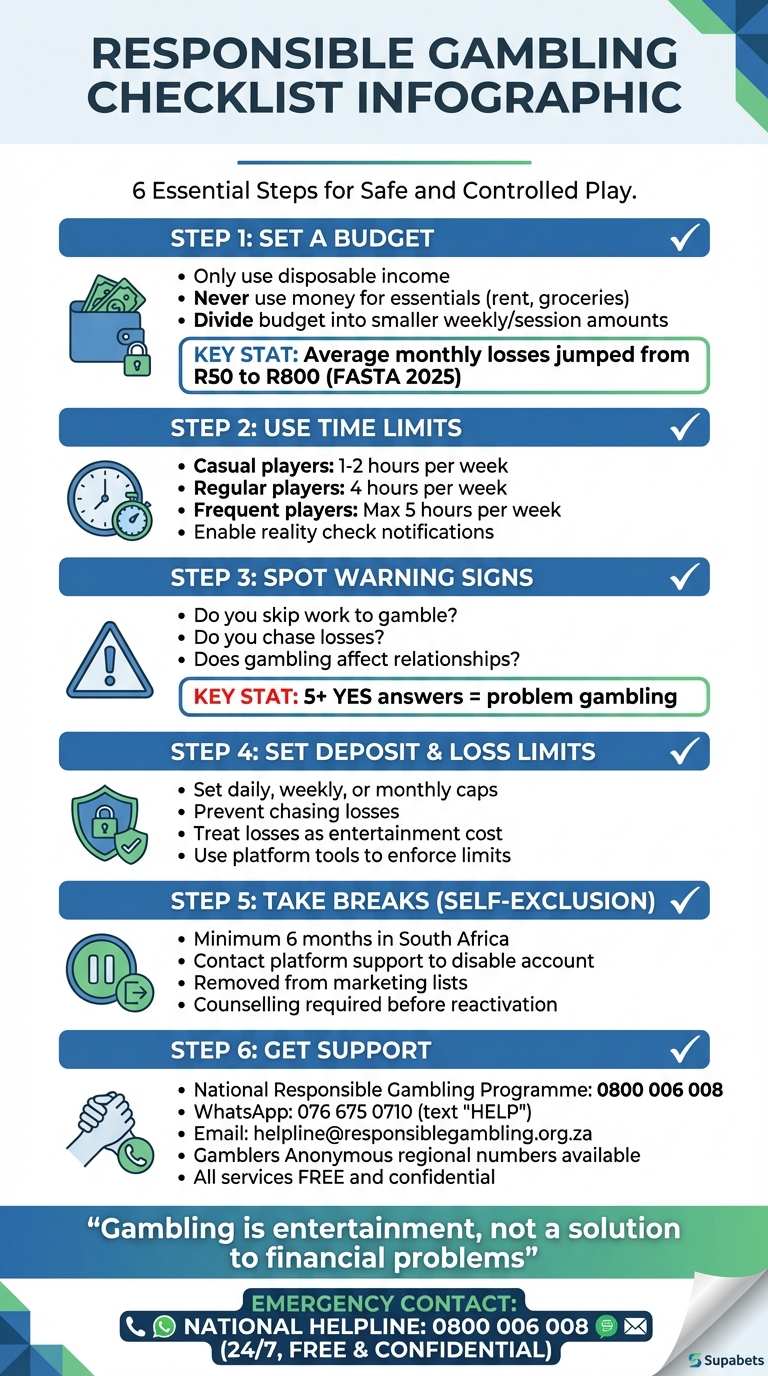
Responsible Gambling Checklist: 6 Essential Steps to Stay in Control
Practical Guide to Responsible Gambling
sbb-itb-00c3b18
Set a Gambling Budget and Follow It
Keeping a strict budget is a cornerstone of responsible gambling. By setting clear financial boundaries, you can ensure gambling funds remain separate from essentials like rent, groceries, and transport. Even small bets on platforms like Supabets can add up quickly. Think of gambling as an entertainment expense – like going to the movies or dining out – rather than a way to make money.
FASTA’s October 2025 report highlights a concerning trend: average monthly gambling losses have jumped from R50 (pre-October 2023) to R800. This kind of financial drain can reduce home loan qualifications by more than R100,000. For lower-income households earning between R8,000 and R15,000 per month, gambling can consume 40–41% of their income, compared to just 1–2% for higher earners.
"Gambling is no longer a harmless recreational activity; it has become a mainstream and highly saturated economic crisis." – Kevin Hurwitz, CEO, FASTA
These budgeting tips can help you stay disciplined and in control of your gambling habits.
Decide Your Monthly Gambling Amount
Start by calculating your disposable income – the money left over after covering all your essentials. Only use this surplus for gambling, and if the amount feels too high to lose comfortably, set a lower limit.
Break your monthly gambling budget into smaller chunks, such as weekly or per-session allowances. For instance, if your monthly budget is R400, you could divide it into four R100 weekly sessions. This approach helps prevent overspending in a single session[8,10]. To stick to your limits, consider using a dedicated e-wallet or prepaid vouchers like OTT, 1Voucher, or Blu Voucher through Supabets. Once the voucher runs out, your spending for that session is done.
Regularly tracking your spending is another key step in sticking to your budget.
Monitor Your Spending on Supabets
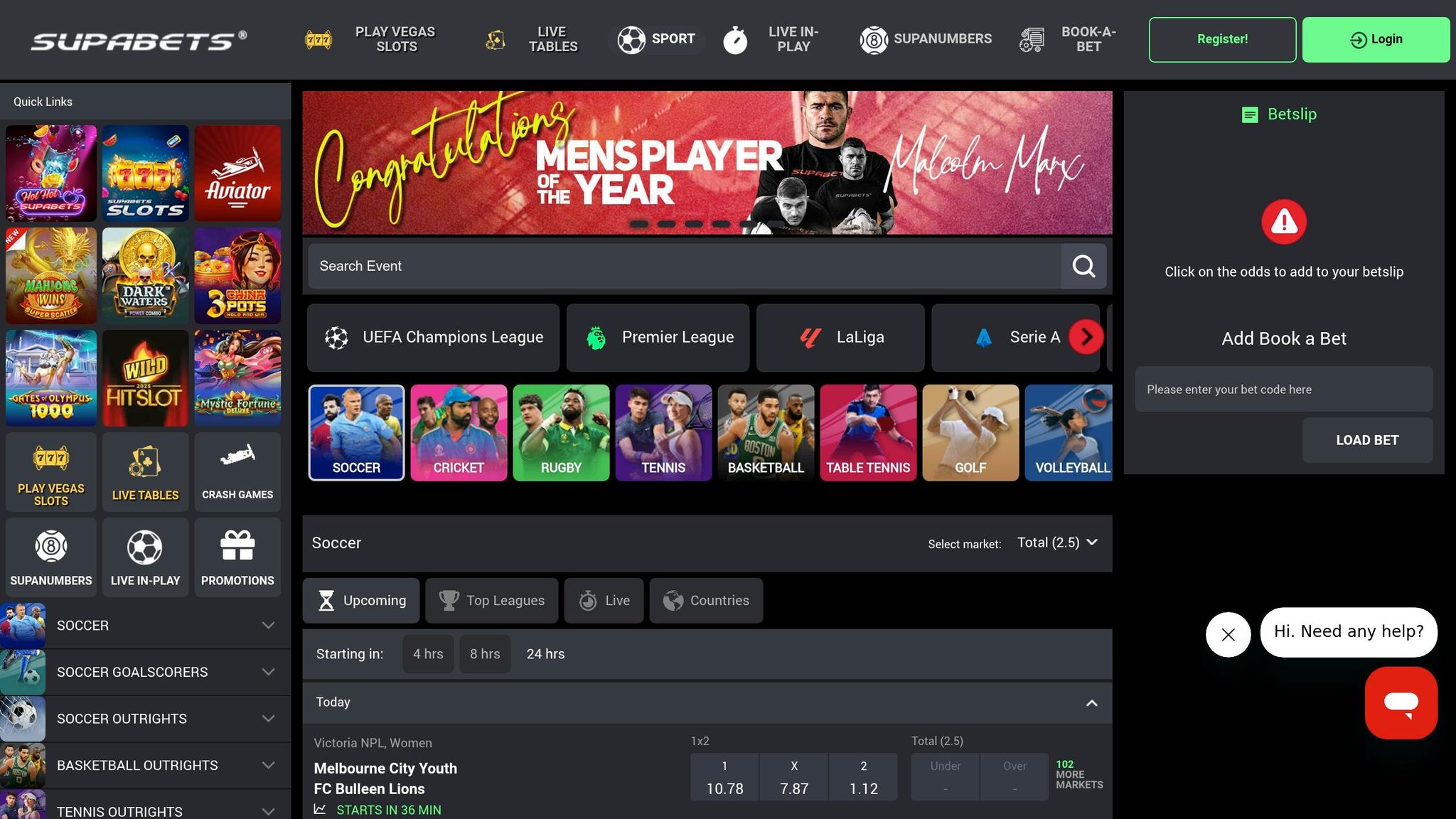
Supabets offers tools to help you manage your gambling habits. Their system flags risky spending patterns, and if you notice you’re overspending, you can reach out to their team at support@supabets.co.za for a temporary suspension.
"It’s important to keep track of the time you spend on gambling and monitor the amount of money you spend on gambling and betting." – Supabets
You can also set weekly staking limits directly through your Supabets account to cap how much you wager. Use features like Cash-Out to secure your winnings before risking them on further bets[1,13]. For a broader view of your finances, try a budgeting app like 22seven (powered by Old Mutual) to track gambling expenses alongside your other spending.
Use Time Limits and Reality Checks
It’s easy to lose track of time – and money – when gambling, especially with engaging games like online slots. This is where time limits and reality checks come into play. These tools are designed to help you stay in control and make more mindful decisions.
Time limits act as a firm boundary, automatically logging you out of your Supabets account once you’ve reached your chosen duration – whether that’s 30 minutes, an hour, or longer. Reality checks, on the other hand, are gentle reminders. These notifications pop up at intervals you set (like every 10, 30, or 60 minutes) to show how long you’ve been playing and how much you’ve spent. Both tools are invaluable for keeping gambling in the realm of entertainment rather than letting it disrupt your personal or professional life.
"There’s no better reality check than recognising how much time and money you spend while playing." – iGamingCare
Research backs this up: pop-up messages reminding players of their time spent significantly reduce gaming durations, with 65% of players using online safety tools to stay in control. The trick is to set reminders that are practical – too frequent, and they might just get ignored.
Set Time Limits for Your Sessions
Start by determining how much time you can comfortably allocate to gambling without it interfering with your daily responsibilities. If you’re a casual player, aim for 1–2 hours per week across all platforms. More frequent players should limit their playtime to 5 hours per week.
| Player Type | Recommended Daily Limit | Recommended Weekly Limit | Session Length Suggestion |
|---|---|---|---|
| Occasional | 30 minutes (Max 2 sessions) | 2 hours | 15 minutes |
| Regular | 1 hour (Max 3 sessions) | 4 hours | 20 minutes |
| Frequent | 2 hours (Max 4 sessions) | 5 hours | 30 minutes |
Need a break? Contact Supabets support at support@supabets.co.za to temporarily disable your account. You can also set limits on the number of sessions per day, such as capping yourself at three sessions with at least a 2-hour gap between them.
Combining these time limits with reality checks ensures you take regular breaks to reassess your activity.
Turn On Reality Check Notifications
Reality check notifications are an effective way to pause and reflect on your gambling activity. These alerts stop your gameplay briefly, showing you how long you’ve been playing and how much you’ve wagered. This gives you a moment to decide whether to continue or log out.
To enable these notifications on Supabets, log into your account and go to the "My Account" section. Here, you’ll find tools for self-management and tracking your activity. If you need help setting up alerts or restrictions, you can use the Live Chat feature on the Supabets website, email support@supabets.co.za, or call +27 011 215 7000 for assistance.
Choose notification intervals that suit your playing habits. For example, if you’re an occasional player, set alerts for every 15 or 30 minutes to keep tabs on your session duration. When the notification appears, take a moment to evaluate your "Net Position" (your wins versus losses) before deciding whether to continue. Studies show that self-reflective messages – like "Do you know how long you have been playing?" – are more effective than generic reminders and can significantly reduce gambling time.
Spot the Warning Signs of Problem Gambling
Being mindful of behavioural changes is just as important as managing your budget and time when it comes to responsible gambling. It’s essential to recognise when gambling moves from being an enjoyable pastime to something more concerning. These warning signs can sometimes be subtle but often show up in ways that affect your finances, relationships, or mental well-being. For instance, constantly thinking about gambling or trying to win back losses immediately after a defeat are common indicators. Spotting these signs early can help you maintain control.
Changes in your emotions or social life can also hint at a growing problem. For example, if you find yourself lying to others, avoiding social interactions, or neglecting important responsibilities to gamble, these are clear red flags. Feeling anxious, irritable, or down when you’re not gambling – or using gambling as a way to cope with stress or boredom – are also signs that gambling might be taking on a bigger role than it should.
"For some people gambling can change from being an entertaining and pleasurable activity and become a problem. When that happens, gambling becomes too important in a person’s life and hurt their social and financial well-being." – South African Responsible Gambling Foundation
Answer These Self-Check Questions
If you’re unsure about your gambling habits, take a moment to reflect by asking yourself these questions:
- Do you skip work or school to gamble?
- Have you experienced deep regret after gambling?
- Do you gamble in an attempt to solve financial problems or pay off debts?
- After winning, do you feel an urge to gamble again to win even more?
- Have you lied, stolen, or borrowed money to keep gambling?
- Does gambling interfere with your sleep?
- Do you gamble to escape stress, worry, or boredom?
- Have you lost interest in spending time with family, friends, or hobbies?
If you answer YES to five or more of these questions, it may be a sign that gambling is becoming problematic . Based on the National Responsible Gambling Programme (NRGP) screening tools, a score of 7 or more indicates a problem gambler, while a score of 14 or more points to a serious issue.
Take Immediate Action if Warning Signs Emerge
Just as setting limits is important, taking action at the first signs of trouble is crucial. If you notice any warning signs, reach out for help. You can contact the National Responsible Gambling Toll-Free Counselling line at 0800 006 008, send a WhatsApp message with "HELP" to 076 675 0710, or email Supabets at support@supabets.co.za to deactivate your account . All services are confidential and handled by professionals.
You can also set daily, weekly, or monthly deposit and loss limits to regain control . If gambling has caused financial difficulties, the NRGP offers free debt counselling and access to psychiatric consultations. For support from others who understand, contact Gamblers Anonymous SA: Gauteng (060 624 7140), KwaZulu-Natal (083 783 5715), or Western Cape (079 368 4477). Supabets also monitors gambling behaviour and trains staff to recognise problem gambling, so assistance is always available.
Set Deposit and Loss Limits
Establishing deposit and loss limits is a practical way to keep gambling within a budget. Supabets encourages users to set boundaries on how much they can wager in a week. The platform also uses technology to monitor betting patterns and detect potential problem gambling behaviours.
By setting these limits, you create a built-in system of self-control, reducing the need to rely on willpower during tough times. As betting expert Ernest Masuka wisely points out, "Betting is merely an entertaining activity, it’s not a means to make speedy money". When you cap your spending ahead of time, you treat gambling as a fun pastime with a fixed budget, rather than a solution to financial challenges. These limits work alongside your other budgeting and time management tools to protect your finances.
Set Daily, Weekly, or Monthly Deposit Limits
Deposit limits allow you to control how much you can add to your Supabets account over a specific timeframe. Whether it’s a daily, weekly, or monthly restriction, these limits help you stick to your budget. For example, if you decide R500 is your weekly entertainment budget, setting that as your limit ensures you won’t exceed it, even in moments of excitement.
To put these controls in place, reach out to Supabets support at support@supabets.co.za and request account restrictions that suit your needs. Regularly check your "Available to withdraw" balance in your profile to keep track of your spending and differentiate between deposited funds and winnings. Make sure your account is FICA-verified for smooth operations.
Apply Loss Limits to Prevent Chasing Losses
Loss limits add another layer of protection to your gambling habits. These limits stop you from trying to recover money after a losing streak, curbing the risky behaviour of chasing losses. Once you hit your pre-set loss limit, the system will prompt you to step away, helping you avoid the urge for "just one more spin".
This feature is especially important because chasing losses is one of the leading causes of problem gambling [4,33]. As rwrant.co.za explains, "Loss limits stop you from chasing your money. If you have hit your budget, take the time and walk away". Treat any losses as the cost of entertainment and ensure you prioritise essentials like rent and bills. Remember, the games will still be there when you’re ready to play responsibly within your limits. These settings are vital tools for maintaining control and supporting a balanced gambling experience.
Use Self-Exclusion to Take a Break
If deposit and loss limits aren’t enough to curb your gambling, self-exclusion offers a more decisive solution.
Sometimes, stepping away completely is the best way to regain control. Self-exclusion is a voluntary process where you commit to avoiding gambling for a specific period. It’s a proactive measure that gives you the space to reset. Supabets supports this by allowing you to disable your betting account for a time frame of your choice. Additionally, the National Responsible Gambling Programme (NRGP) provides counselling services to guide you through the process.
Once you’ve initiated self-exclusion, you’re legally barred from gambling for the duration of the agreement. In South Africa, this period is a minimum of six months. Gambling operators are required to remove you from their marketing lists to reduce temptation. If you attempt to gamble during this time, you could face trespassing charges, and any winnings will be forfeited.
"While the emphasis is still on the individual to bring their own gambling behaviour under control, the self‐exclusion period could help you to take a break from gambling while you get help".
This break provides a much-needed opportunity to focus on addressing deeper issues, with professional support available to help you along the way.
Enable Self-Exclusion on Supabets
To activate self-exclusion on Supabets, simply contact their support team at support@supabets.co.za and request to disable your account for a specific period. As Supabets explains:
"We can help by disabling your betting account for the amount of time you specify. Once that time’s up, you can log in again".
Make sure to clearly state the duration of your break.
For a broader, formal exclusion that applies to all licensed gambling venues and platforms in South Africa, you’ll need to contact the NRGP or your provincial gambling board to get the relevant forms. Keep in mind that after the mandatory six-month period, you won’t be able to resume gambling immediately. You’ll need to prove that you’ve attended counselling sessions with a professional before the exclusion can be lifted. This approach combines technical restrictions with professional support to help you regain control.
Contact NRGP for Extra Support
If you need more than just account deactivation, the NRGP provides professional guidance during your self-exclusion. Their free, confidential counselling services are designed to support you through this period. As they explain:
"The role that the NRGP plays in this programme is Counselling and Support for the excluded individuals and their immediate family members".
These services are funded by the gambling industry at 0.1% of Gross Gambling Revenue, so there’s no cost to you.
You can reach the NRGP’s 24/7 toll-free helpline at 0800 006 008, email Helpline@responsiblegambling.org.za, or send a WhatsApp or SMS to 076 675 0710. Their services include psychiatric consultations, debt counselling, and addiction treatment.
For additional support, you can also contact Gamblers Anonymous:
- Gauteng: 060 624 7140 / 081 874 1249
- KwaZulu-Natal: 083 783 5715
- Western Cape: 079 368 4477
These resources ensure you’re not alone in your journey to regain control over gambling.
Keep Track of Your Gambling Activity
It’s easy to lose track of time and money while caught up in the thrill of gambling. Whether you’re placing bets or playing fast-paced casino games, adrenaline can skew your sense of spending and time, especially during live betting sessions. That’s why regularly reviewing your gambling activity is a crucial step in staying in control. Along with setting budgets and session limits, tracking your activity gives you a clearer picture of your habits and helps you gamble responsibly.
Most platforms offer tools to help you stay on top of your activity. Use features like My Account, My Transactions, and My Bets to monitor your gambling history. The My Account section provides a detailed record of all your betting activity, including sports wagers and lottery tickets, while My Transactions allows you to track deposits, withdrawals, and unspent funds. If you’re using a mobile app, the My Bets tab simplifies this further by offering a quick overview of your active and settled sports bets.
Make it a habit to regularly review this data. For example, perform weekly checks on your transaction history. Compare how much you’ve deposited against your withdrawals to calculate your net spend. If you notice you’re consistently exceeding your budget or gambling more frequently than you’d planned, it could be a warning sign. Experts recommend limiting gambling to no more than four days a month to reduce the risk of developing unhealthy habits.
In addition to these tools, consider keeping a basic gambling journal. Jot down how much time you spend gambling, the amounts you wager, and even your emotional state during each session. Over time, this record can reveal patterns, like chasing losses or an increase in gambling sessions, that might signal it’s time to reassess your behaviour. While platforms like Supabets use behavioural monitoring to flag potential gambling problems, your own tracking remains essential for staying accountable. This self-awareness, combined with strategies like budgeting, time limits, and self-exclusion, helps ensure that gambling stays a fun and manageable activity.
Block Gambling Transactions Through Your Bank
One effective way to strengthen your commitment to quitting gambling is by requesting your bank to block gambling transactions. This service, usually free, stops your card from being used for any transactions categorised as gambling – whether online or at physical locations.
Most major South African banks provide this option. You can typically find it in your mobile banking app under settings like "card control," "merchant control," or "card freezes." If you don’t see the feature, reach out to your bank’s customer service or visit a branch. Keep in mind, these blocks are applied at the card level, so you’ll need to request a block for each card individually. Once activated, these settings ensure that your cards cannot process gambling-related transactions.
To further discourage impulsive decisions, banks impose a mandatory cooling-off period. If you decide to lift the block later, there’s usually a delay of 48 to 72 hours before gambling transactions are allowed again. This pause gives you time to reflect before making any changes. Discovery Bank has also voiced its stance on stricter gambling regulations, stating:
"As an organisation we would welcome increased regulation around the promotion and participation in gambling given the potential social and personal cost which gambling presents more broadly – we have raised these concerns with the prudential and conduct regulators".
While bank blocks are a helpful tool, they work best when combined with other responsible gambling measures, such as self-exclusion programmes or setting spending limits. If you notice a gambling transaction going through despite the block, report it immediately – this could mean the operator is using an incorrect Merchant Category Code. However, it’s important to note that these blocks don’t cover alternative payment methods like e-wallets or faster payments. Pairing bank blocks with additional self-management tools can help you maintain better control over your gambling habits.
Get Free Counselling and Support
If gambling has become a concern for you or someone you care about, professional support is just a call away. The South African Responsible Gambling Foundation (SARGF) offers free and confidential counselling 24/7. You can reach them toll-free at 0800 006 008, send a WhatsApp or SMS with the word "HELP" to 076 675 0710, or email them at helpline@responsiblegambling.org.za. Since its establishment in June 2000, this non-profit organisation has been at the forefront of assisting over 18,500 individuals struggling with gambling-related issues.
The foundation’s logo symbolises their unwavering commitment to providing a safe and confidential space for those seeking help.
"Counselling is an opportunity to discuss issues and concerns with a mental health professional in a safe, confidential, non-threatening and accepting environment." – South African Responsible Gambling Foundation
While setting limits and keeping track of gambling habits are important steps, professional counselling provides tailored guidance when self-management isn’t enough. Available treatments include immediate phone counselling, outpatient programmes, and even intensive inpatient care for severe cases. The SARGF also offers relapse prevention services and extends support to family members affected by gambling. It’s worth noting that approximately 1.5% of South Africans are compulsive gamblers, so if you’re facing challenges, you’re far from alone.
Thanks to voluntary contributions from licensed gambling operators, all these services are completely free for anyone in need. Whether you’re noticing early warning signs or require urgent assistance, reaching out to the SARGF is a vital step in regaining control and managing your gambling responsibly.
Know the Legal Age and Gambling Rules
Understanding and following the legal age and gambling rules is a cornerstone of responsible gambling. In South Africa, the minimum age for gambling is 18, and platforms like Supabets enforce this through their Challenge 21 programme. This initiative requires users who appear under the age of 21 to verify their age, ensuring compliance with legal requirements. These regulations are in place to protect players and prevent underage gambling.
Underage gambling is a serious concern. Minors often lack the emotional and financial maturity to manage the challenges of betting, and early exposure can increase the risk of developing gambling-related problems later in life.
To put things into perspective, the gambling industry in South Africa generated a staggering R74.9 billion in the last fiscal year. During the same period, the National Responsible Gambling Programme (NRGP) received over 1 million counselling calls, with nearly half coming from young adults aged 18–35. These statistics highlight the importance of safeguarding minors and promoting responsible gambling practices.
You can help protect minors by taking practical steps like securing devices with strong passwords, using filtering software such as Net Nanny or Gamban, and always logging out of your Supabets account on shared devices. Additionally, having open conversations with children about how gambling works and its risks can set a positive and responsible example.
Conclusion
Keep your gaming experience safe, fun, and under your control. As Henno Kruger, Founder of Running Wolf’s Rant, wisely says:
"Responsible gambling means staying the boss of your play, not the other way around".
By using practical tools and strategies, you can ensure your gaming remains a positive activity. Supabets offers responsible gambling tools designed to help you manage your play effectively and protect yourself.
This checklist is here to support you in gambling responsibly while prioritising your financial and personal wellbeing. If you notice any warning signs, take action immediately. You can contact the National Responsible Gambling Programme at 0800 006 008 for free and confidential counselling. Alternatively, reach out to regional Gamblers Anonymous groups – Gauteng (060 624 7140), KZN (083 783 5715), or the Western Cape (079 368 4477). Don’t hesitate to seek help when needed.