Progressive jackpots can pay life-changing money, but the odds are tiny and the rules matter. If I’m playing one of these slots, I need to know how the pool grows, which bets qualify, what the RTP looks like, and how much of my bankroll I’m prepared to lose before I spin.
Here’s the short version:
- A small part of each qualifying bet goes into a jackpot pool, often around 5%.
- When someone wins, the jackpot resets to a seed amount and starts building again.
- There are three main types: standalone, linked/in-house, and wide-area.
- Progressive slots often have lower base RTP and high volatility, with returns often in the 88% to 96% range.
- Some games only let me qualify for the top prize if I use the maximum bet or meet other paytable rules.
- Big wins do happen: a player in Cape Town won R89 million on Mega Moolah in 2019.
- The top jackpot can have odds around 50 million to 1, so bankroll limits are a must.
If I want the plain truth, it’s this: progressive jackpots are about huge upside, long dry spells, and strict rules. So before I play, I check the bet requirement, jackpot type, live meter, and session budget in Rand.
Quick comparison
| Type | Where the money comes from | Prize growth | Top prize size | Hit rate |
|---|---|---|---|---|
| Standalone | One machine or one game | Slow | Lowest | More common |
| Linked / In-house | One operator network | Medium to fast | Mid to high | Less common |
| Wide-area | Many casinos or a large provider network | Fast | Highest | Rare |
I also keep one thing in mind: every spin is random. A jackpot meter may be high, but that does not mean a win is due.
How to Play Online Slots to Win Progressive Jackpot
sbb-itb-00c3b18
How progressive jackpots work
Each qualifying spin adds money to the jackpot pool, and the meter goes up as eligible spins happen across the network. When more players are spinning at the same time, that total climbs faster. It’s pretty simple: more activity means more money flowing into the prize.
How wagers fund the jackpot pool
After a jackpot is won, it drops back to a seed amount set by the casino or game provider. For major linked jackpots, that starting point can be R1 000 000 or more, while standalone machines often reset to between R10 000 and R100 000.
How fast the prize grows depends on how many players are feeding the pool. A standalone jackpot usually builds at a slower pace. Linked jackpots move faster, and wide-area jackpots tend to grow the fastest because they pull in spins from a much larger network.
What triggers a jackpot win
The trigger rules change from one game to another, but the result is always random. In most cases, jackpots are paid in one of these ways:
- A certain symbol combination lands
- A bonus feature activates the jackpot
- A random award is given on any qualifying spin
Every spin is controlled by an RNG, which means each result stands on its own. One spin doesn’t make the next spin more likely to hit. So even if someone has been playing for ages, no amount of spinning can force a jackpot.
Must-drop jackpots work a bit differently in one sense: the prize has to land before it reaches a set point. Even then, the outcome is still random. That’s why it’s smart to check the paytable before you play, since the rules for qualifying and winning can change from game to game.
Types of progressive jackpots and how network size affects prize growth
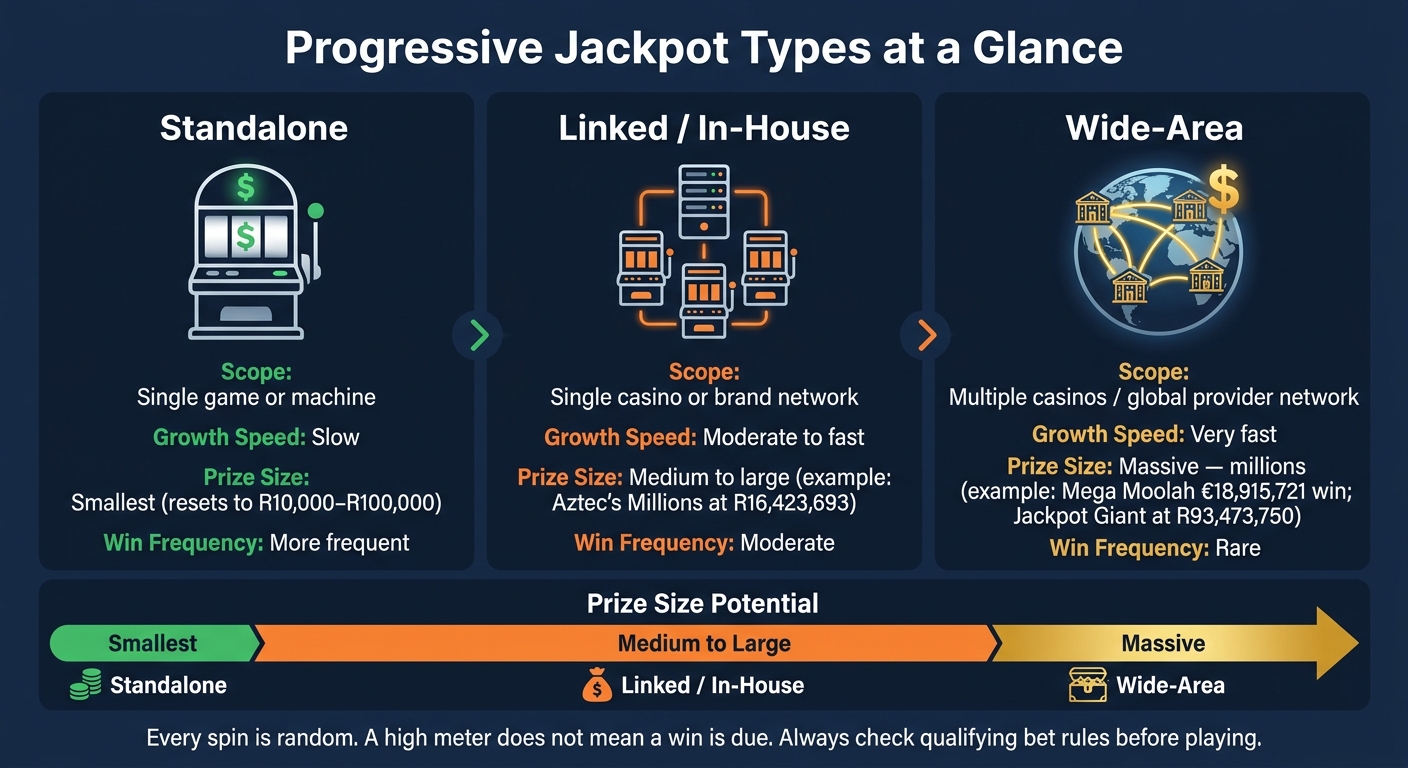
Progressive Jackpot Types Compared: Standalone vs Linked vs Wide-Area
Progressive jackpots mostly differ by network size: one machine, one casino network, or a much larger provider network. And that size matters. The bigger the pool of wagers, the faster the prize tends to grow.
That gives us three main models: standalone, linked, and wide-area.
Standalone progressive jackpots
A standalone progressive runs on a single machine or one game. Popular titles like Hot Hot Fruit often feature these localized prize pools. It grows at a slower pace and usually offers the smallest top prize.
They’re also easier to follow because the jackpot sits in one place. But there’s a trade-off: they tend to build more slowly and pay less at the top end.
Linked or in-house progressives
Linked progressives combine wagers from multiple machines or games within one operator network. Because more players feed the same prize pool, the jackpot grows faster than a standalone version.
In South Africa, these progressives are usually kept within one operator’s network.
A clear example is Aztec’s Millions by Realtime Gaming, which was recorded at R16 423 693,40.
Wide-area progressives
Wide-area progressives combine wagers across a large provider network, often stretching across multiple casinos and regions. More players, more pooled stakes, and a much faster-growing prize. That’s why these jackpots tend to reach the biggest figures.
For example, Mega Moolah set the record for the largest online progressive jackpot win in September 2018, when a player at Grand Mondial Casino won €18 915 721. Playtech’s Jackpot Giant has also featured jackpots as high as R93 473 750,00.
In South Africa, wide-area progressives are generally not allowed online when they pool funds across operators or borders.
| Feature | Standalone | Linked / In-House | Wide-Area |
|---|---|---|---|
| Scope | Single game | Single casino or brand group | Multiple casinos / global |
| Growth speed | Slow | Moderate to fast | Very fast |
| Prize size | Smallest | Medium to large | Massive (millions) |
| Win frequency | More frequent | Moderate | Rare |
Next, the rules behind each type matter just as much as the network feeding it.
Qualification rules, RTP, volatility, and jackpot tiers
Once you know how the pool grows, the next step is simple: find out whether your spin even counts.
Qualification rules that decide jackpot eligibility
Most progressive slots come with rules that decide if a spin can win the top prize. The big one is often a maximum bet requirement. In plain terms, some games only put you in the running for the main jackpot if you play at the highest stake on offer. Bet less, and you can still play the base game, but that spin won’t qualify for the biggest payout.
Other rules can matter too. Some games want all paylines switched on. Others set a minimum coin value or ask for a certain symbol combination to trigger the jackpot feature. The paytable is where you’ll find the exact rules on stake, symbols, and bonus features.
It also helps to check whether jackpot access is limited to real-money bets. Bonus funds and free spins often don’t count. A quick look at the paytable takes less than a minute, and it tells you exactly what does and doesn’t qualify.
RTP and volatility in progressive slots
Progressive slots often pay back less than standard slots because part of each wager goes into the jackpot pool.
Mega Moolah is a well-known case. Its base game RTP is 88.1%, and it only gets to about 93.4% once the jackpot contribution is included. That’s the trade-off: a lower base RTP for a chance at a huge prize.
And that trade-off matters. A massive jackpot can look tempting, but it doesn’t fix a poor session if the base return is low.
Volatility tells you how the wins and losses tend to show up. Progressive slots are usually high-volatility. That means you can go through long dry spells, then hit a very large payout out of nowhere. If you’re planning a session, that matters a lot because it has a direct effect on how long your bankroll is likely to last.
How multiple jackpot tiers affect win frequency
Many progressive slots split the prize into tiers, often Mini, Minor, Major, and Mega or Grand. The smaller tiers, like Mini and Minor, tend to land more often. The top tiers, such as Major and Grand, usually hit far less often.
Check the live jackpot meter before you spin.
With those rules in mind, your stake size and how long you plan to play become the next call.
Playing progressive jackpots with a disciplined bankroll
Once you know how progressive jackpots work, the next step is protecting your bankroll. These games use an RNG, which means every qualifying spin has the same independent chance of landing the prize. Betting more doesn’t improve those odds.
That matters because a top-tier progressive jackpot can sit at around 50 million to 1. That number isn’t there to put you off. It’s there to keep your expectations grounded, so you can enjoy the game without falling into the trap of trying to force a win.
Set a Rand budget and a session limit before you spin
Pick a Rand amount you’re fully prepared to lose before you open a game. Stick to disposable income only. If the money is meant for rent, groceries, fuel, or bills, it shouldn’t be in play.
It also helps to set a clear session limit. Choose a start time and an end time before you begin, then stop when the session ends – whether you’re ahead or behind. That one rule can save you from the “just one more spin” spiral.
Choose stake sizes that match the jackpot rules
Once you’ve checked the qualifying stake, line up your bet size with what your session budget can handle. Before you spin, read the game rules and make sure you know what stake qualifies for the top prize.
If the qualifying stake is more than your bankroll can carry through a full session, walk away from that game and pick one that fits your budget more comfortably. There’s no point forcing your way into a jackpot if the rules stretch your bankroll too thin. Read the game rules before you play.
Conclusion: Key points to remember about progressive jackpots
With those guardrails in place, here are the main points to keep in mind:
- How the pool grows: A portion of each qualifying bet feeds the pool, which resets to a seed amount after a win
- Local vs. wide-area networks: Local jackpots tied to one operator often hit more often than wide-area networks
- Qualification rules matter: Bet size, active paylines, and real-money wager rules decide whether your spin even qualifies
- RTP, volatility, and bankroll control: Progressive slots usually have lower base RTP, often between 88% and 96%, higher volatility, and call for strict bankroll control – set a Rand limit, set a time limit, match your stake to the rules, and never chase losses
FAQs
Can I win the jackpot without betting max?
It depends on the game’s rules. Some progressive slots let you land the jackpot with smaller bets, but many only pay the top prize if you place the maximum bet.
Bet less than the required amount, and you might still add money to the jackpot pool without qualifying to win it. Check the paytable or game rules before you play.
Are progressive jackpots really random?
Yes. Progressive jackpots are generally random. In most modern slots, the top prize is triggered at random during play, which means every qualifying spin has a chance to win.
That also means no strategy can guarantee a jackpot. You can’t force the outcome.
That said, some games work a bit differently. In certain slots, higher stakes can improve your chances or open access to other prize tiers. So while the result is still random, the game rules may affect what you’re eligible to win.
At Supabets, the weekly Jackpot Race also triggers randomly during its scheduled time window for eligible players.
How much should I budget for a session?
Set a strict budget before you start, and only play with money you can afford to lose. Progressive jackpot wins are rare, so don’t chase losses or spend more because you’re hoping for a big payout.
Smaller progressives can give you more play-time if you’re working with a modest bankroll. It also helps to check the minimum bet. If you bet too little, you might not qualify for the jackpot. On some Supabets promotions, for example, you need to bet at least R2 per spin.