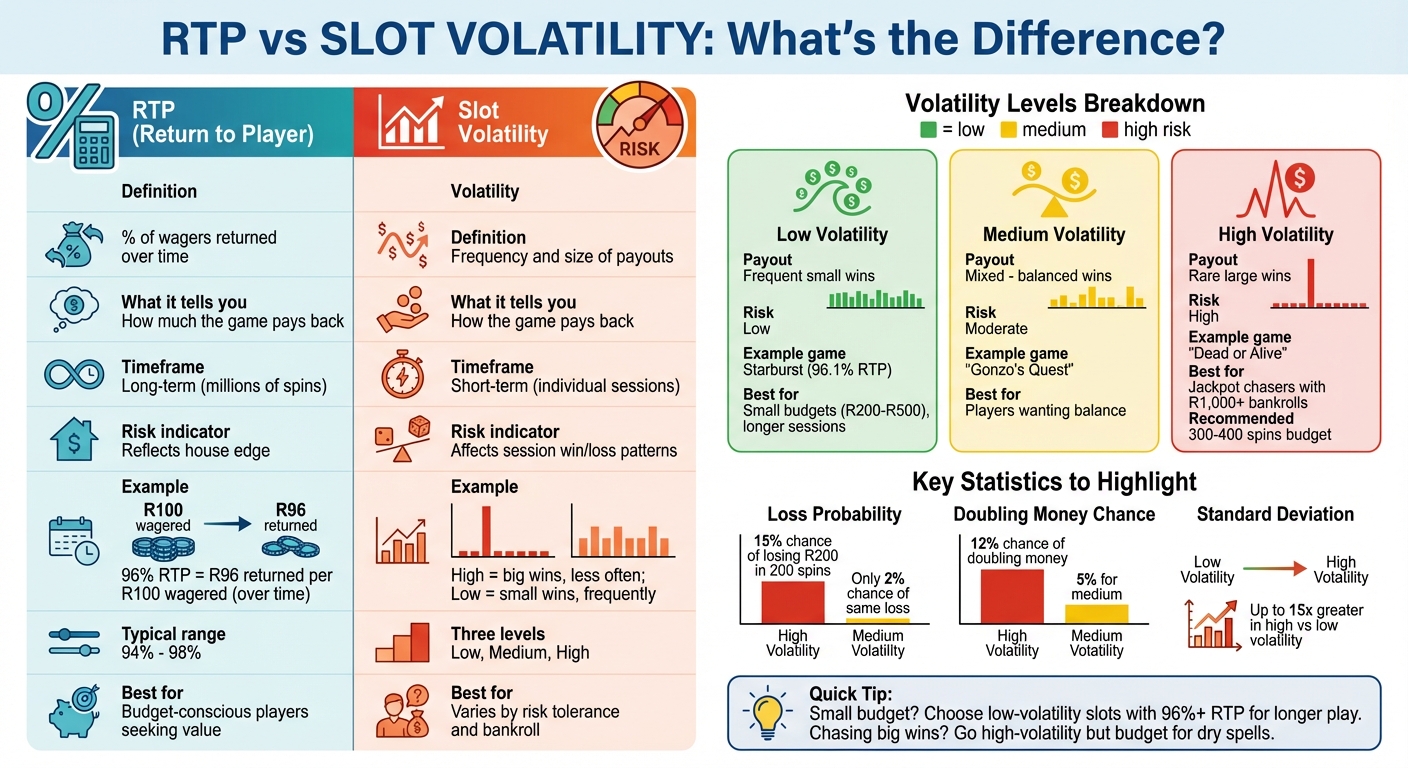
When you play online slots, two metrics shape your experience: RTP (Return to Player) and slot volatility. RTP tells you how much a game pays back over time, while volatility shows how often and how much you can win in a session. Here’s what you need to know:
- RTP: A percentage indicating long-term returns. For example, a 96% RTP means R96 is returned for every R100 wagered, on average, over millions of spins.
- Volatility: Measures risk. High-volatility slots offer big wins but less often, while low-volatility games provide smaller, frequent payouts.
Key takeaway: If you have a small budget, choose low-volatility slots with high RTP for longer play. For bigger wins (and bigger risks), go for high-volatility slots but ensure you have enough funds for dry spells.
Quick Comparison:
| Attribute | RTP (Return to Player) | Slot Volatility |
|---|---|---|
| Definition | % of wagers returned over time | Frequency and size of payouts |
| Risk | Reflects house edge | Affects session win/loss patterns |
| Timeframe | Long-term (millions of spins) | Short-term (individual sessions) |
| Player Type | Budget-conscious players | Jackpot chasers with higher budgets |
Understanding these metrics helps you pick the right slots for your goals and budget.
RTP vs Slot Volatility: Quick Comparison Guide for Online Slots
What are RTP and Volatility in online slots?
sbb-itb-00c3b18
What is RTP?
Return to Player (RTP) refers to the percentage of total bets that a slot machine is designed to return to players over its lifetime. This percentage is based on a mathematical model that accounts for all possible symbol combinations and feature activations, showing what players can expect to get back in the long run.
The difference between 100% and the RTP is known as the house edge. For example, a slot with a 96% RTP has a 4% house edge. Most modern online slots have RTPs ranging from 94% to 98%, with anything above 98% being considered top-tier.
How RTP Works
RTP is calculated over an enormous number of spins – millions or even billions – so it reflects a long-term average rather than short-term outcomes. In South Africa, a slot with a 96% RTP means that, over time, R96 is returned for every R100 wagered. However, this doesn’t mean that every R100 bet will instantly yield R96. Instead, the return gradually aligns with the RTP over a large number of spins.
"RTP is a certainty at scale but noise at the individual level. Over 10 million spins, a 96% RTP slot will return very close to 96%. Over 200 spins… the actual return could be anywhere from 0% to 500% or more."
– James Whitfield, Lead Editor & Casino Analyst
Before any slot game is launched, independent testing labs like eCOGRA, iTech Labs, or GLI run rigorous simulations to ensure the actual returns match the stated RTP. This verification guarantees fairness and transparency, giving players confidence in the game’s reliability.
Why RTP Matters for Players
Choosing slots with a higher RTP – ideally 96% or above – can help you get more value from your wagers. Higher RTP slots slow down the rate at which your bankroll depletes, allowing for longer play sessions. Even a small difference in RTP, like 1% or 2%, can significantly impact how much playtime you get. For example, if you’re working with a budget of R500, playing a high RTP slot can help your funds last longer, as a greater portion of your bets is returned over time.
It’s also worth noting that high RTP slots are particularly useful when meeting wagering requirements for casino bonuses. By retaining more of your wagers, they help you maximise the value of the bonus.
Always take a moment to check the RTP in the game’s information or help section before playing. Some operators might offer the same slot with different RTP settings, so it’s important to know what you’re getting. With RTP in mind, we can now explore how slot volatility influences gameplay and risk.
What is Slot Volatility?
Slot volatility, also known as variance, refers to the risk level and payout pattern of a slot game. While RTP (Return to Player) gives you the overall payout percentage, volatility explains how those payouts are distributed. In essence, it’s the difference between steady, smaller wins and the occasional big jackpot.
Volatility plays a significant role in shaping your gaming experience. High-volatility slots are known for long dry spells, but when they pay out, the rewards can be massive. On the other hand, low-volatility slots offer more frequent but smaller payouts, helping you stretch your bankroll and enjoy longer play sessions. Research shows that high-volatility games can have standard deviations up to 15 times greater than low-volatility games, even when both have the same RTP.
For example, if you play 200 spins with a R200 bankroll (R1 per spin) on a high-volatility slot like Great Rhino Megaways, there’s a 15% chance you’ll run out of money. By contrast, a medium-volatility slot like Safari King gives you just a 2% chance of losing your entire bankroll in the same scenario. However, that high-volatility game also offers a 12% chance of doubling your money, compared to only 5% on the medium-volatility option.
Types of Slot Volatility
Slot games generally fall into three volatility levels, each catering to different player preferences and risk tolerances.
| Volatility Level | Payout Frequency | Payout Size | Risk Level | Ideal Player Profile |
|---|---|---|---|---|
| Low | Frequent | Small | Low | Players who prefer longer sessions with steady wins |
| Medium | Moderate | Mixed | Moderate | Those seeking a balance between frequent payouts and occasional big wins |
| High | Infrequent | Large | High | Jackpot chasers with larger bankrolls who enjoy high-risk, high-reward gameplay |
Low-volatility slots, such as Starburst (NetEnt, 96.1% RTP), are perfect for players looking for predictable gameplay. These games deliver frequent small wins, making them ideal for casual players or those with a limited budget.
Medium-volatility slots, like Gonzo’s Quest (NetEnt), Thunderstruck II (Microgaming), and Safari King (Pragmatic Play), offer a mix of smaller frequent wins and occasional larger payouts. They’re great for players who want a balance of excitement and bankroll stability.
High-volatility slots, including Dead or Alive (NetEnt), Raging Rhino (WMS), and Buffalo Blitz (Playtech), are tailored for thrill-seekers chasing big jackpots. These games can drain your bankroll during dry spells, so experts recommend having enough funds for 300–400 spins to handle the variance.
Volatility and Player Preferences
Choosing the right volatility level depends on your goals and budget. If you’re playing for fun and want your R500 to last all evening, low-volatility slots are a good match. The frequent small wins keep the game engaging without major swings in your bankroll.
For players dreaming of massive jackpots, high-volatility slots are the way to go. However, these games often come with extended losing streaks, so it’s essential to manage your bankroll wisely. A quick tip: check the paytable – high-volatility games usually have large top prizes and noticeable gaps between low-tier and high-tier symbol payouts. Trying a game’s demo mode can also help you gauge its hit frequency and payout patterns before betting real money.
Medium-volatility slots are a middle ground, offering a mix of steady wins and occasional big payouts. They’re perfect for players who want excitement without taking on too much risk.
Understanding slot volatility helps you choose games that align with your goals and budget. Combined with RTP, it provides a clearer picture of what to expect from your gameplay. Next, we’ll explore how these two metrics work together to influence your overall experience.
Key Differences Between RTP and Slot Volatility
Now that we’ve broken down RTP and volatility individually, let’s dive into how these two factors differ and influence your slot gaming experience. While both are crucial, they affect gameplay in entirely different ways. RTP, or Return to Player, gives you a theoretical percentage of payouts over the long haul, whereas volatility determines how often and how much you win during a session.
Think of RTP as the "big picture" statistic – it reflects performance over millions of spins. Volatility, on the other hand, directly impacts your short-term experience, shaping the rhythm of wins and losses in a single session.
James Whitfield, Lead Editor & Casino Analyst at African Wildlife Trust, captures this distinction perfectly:
"RTP is a certainty at scale but noise at the individual level".
That means while RTP unfolds its accuracy over countless spins, volatility defines what happens in your typical 200-spin gaming session.
Comparison Table
| Attribute | RTP (Return to Player) | Slot Volatility (Variance) |
|---|---|---|
| Definition | Theoretical percentage of wagers returned to players | Frequency and size of payouts |
| Focus | "How much" the game pays back | "How" the game pays back |
| Timeframe | Long-term (millions or billions of spins) | Short-term (individual sessions) |
| Risk Level | Reflects the house edge | Drives session risk and bankroll fluctuations |
| Bankroll Impact | Determines long-term loss rate | Affects how quickly your bankroll might deplete |
| Payout Pattern | Consistent theoretical value | Frequent small wins or rare large payouts |
How RTP and Volatility Work Together
RTP and volatility combine to shape your overall experience on the reels. For instance, a slot with high RTP and low volatility, like Starburst (96.1% RTP), delivers frequent small wins. This makes it great for stretching a R500 bankroll over a relaxed evening of play.
In contrast, a game with high RTP but high volatility, like Great Rhino Megaways (96.58% RTP), offers better long-term returns but comes with substantial short-term risk. For example, in a 200-spin session, there’s about a 15% chance of losing your entire bankroll compared to just a 2% chance with medium volatility.
Then there are slots with low RTP and high volatility, such as Mega Moolah (88.12% RTP). These progressive jackpot games demand a larger bankroll – 300 to 400 spins – and a higher tolerance for risk. Here, around 5.5% to 6% of each wager contributes to the jackpot pool, which lowers the base RTP but keeps the allure of rare, life-changing wins.
Understanding how these metrics interact is key to choosing the right slot for your budget and goals. A game might boast an appealing RTP, but if its volatility doesn’t match your bankroll, you could run out of funds before seeing those theoretical returns. By balancing these factors, you can find slots that suit your style and maximise your enjoyment.
Tips for Choosing Slots on Supabets

Understanding RTP and volatility is just the starting point. To get the most out of your experience, you need to align your slot choices with your budget and playing preferences. Supabets makes it simple to access the information you need to make informed decisions.
Matching Slots to Your Bankroll
Your bankroll plays a big role in determining the type of slots you should play. For a smaller budget, say between R200 and R500, it’s better to stick to low-volatility slots with a high RTP (96% or more). These games typically offer about 30 wins per 100 spins, keeping your play session steady and enjoyable. If you’re working with a larger bankroll, like R1,000 or more, high-volatility slots become an option. However, you’ll need to plan for at least 100 to 200 bets in reserve to handle potential losing streaks.
A good rule of thumb is to split your budget: allocate 70% to low-risk, stable slots and the remaining 30% to higher-risk, high-volatility games. If you’re playing high-variance slots, consider lowering your stakes (e.g. from R1.00 to R0.20 per spin) to stretch your budget and increase your chances of hitting a big win.
Once you’ve set your budget and identified the right volatility level, the next step is finding the game’s technical details on Supabets.
Finding RTP and Volatility Information on Supabets
Supabets makes it easy to access game metrics. Look for the information icon within each slot game – it might appear as an ‘i’, a question mark, three dots, or horizontal lines. Clicking on this will open the game’s menu, where you can find the paytable and the RTP percentage.
If the game’s volatility isn’t explicitly listed, you can figure it out by examining the paytable. Slots that offer frequent small wins across many symbol combinations are usually low-volatility. On the other hand, games with fewer, larger jackpots and noticeable gaps between prize tiers are likely high-volatility.
To get a feel for a game before committing real money, try the demo mode. Play 50–100 spins to observe the win frequency. For extra accuracy, verify the RTP on the developer’s official site, such as NetEnt or Pragmatic Play. Keep in mind that most quality slots have RTPs between 94% and 98%. Be cautious if you come across a game with an RTP below this range.
Conclusion
RTP measures long-term returns, while volatility influences short-term win patterns. For example, a slot with a 96% RTP suggests that, over millions of spins, you could theoretically get back R96 for every R100 wagered. However, it’s the volatility that dictates whether your session is filled with frequent smaller wins or the occasional massive payout.
Understanding these concepts gives you more control over your gaming choices on Supabets. If you’re working with a limited budget, consider slots with a high RTP (96% or more) and low volatility for steadier returns. On the other hand, if you have a larger bankroll and are aiming for a big win, high-volatility slots might suit you better – though you should be prepared for longer losing streaks.
"RTP and volatility are decision-making tools, not entertainment features. They exist to help you choose games that match your bankroll and objectives." – James Whitfield, Lead Editor & Casino Analyst, African Wildlife Trust
FAQs
Can two slots have the same RTP but feel totally different?
Yes, two slots with the same RTP can feel entirely different. RTP, or Return to Player, represents the percentage of total bets a game is expected to pay back over time. However, it doesn’t reveal how often or how much you might win.
For instance, low-volatility slots tend to deliver smaller, more frequent payouts, making the gameplay steady and predictable. On the other hand, high-volatility slots are all about larger payouts that occur less often, creating a more unpredictable and thrilling experience. Despite having identical RTP percentages, these differences in volatility can make each game feel unique.
How do I estimate my bankroll for a high-volatility slot?
When planning your bankroll for high-volatility slots, it’s important to understand how these games work. They’re designed to deliver bigger wins, but those wins come less often. This means you’ll need enough funds to weather the possibility of long losing streaks.
Make sure your bankroll aligns with how much you usually bet and how much risk you’re comfortable taking. It should be large enough to cover dry spells, as these are more common with high-volatility games. The key is to have a cushion that keeps you in the game until those significant wins come your way.
How can I check a slot’s RTP and volatility on Supabets?
To find a slot’s RTP and volatility on Supabets, start by opening the game and checking its information or description section. Game developers usually include these details there.
If you don’t see them, head over to the game provider’s website or their help section for more information. RTP shows the theoretical return percentage, while volatility gives insight into how often and how much a game might pay out. These details can help you pick a game that matches your preferences.