Most crash-game losses come from three things: betting too much, waiting too long to cash out, and playing past your limit.
If I want to keep my risk in check, I need a simple plan before the first round starts:
- Use a fixed bankroll
- Keep each bet small
- Set auto cash-out in advance
- Use a stop-loss and profit target
- Stop after a set time or round count
- Never chase losses
The numbers make the point clear. A game with about a 3% house edge means R100 wagered returns about R97 over time. A 2x target hits only about 48% to 49% of rounds, while 10x lands in less than 10%. And if I stake R50 from a R500 session budget, just 10 losses can wipe me out.
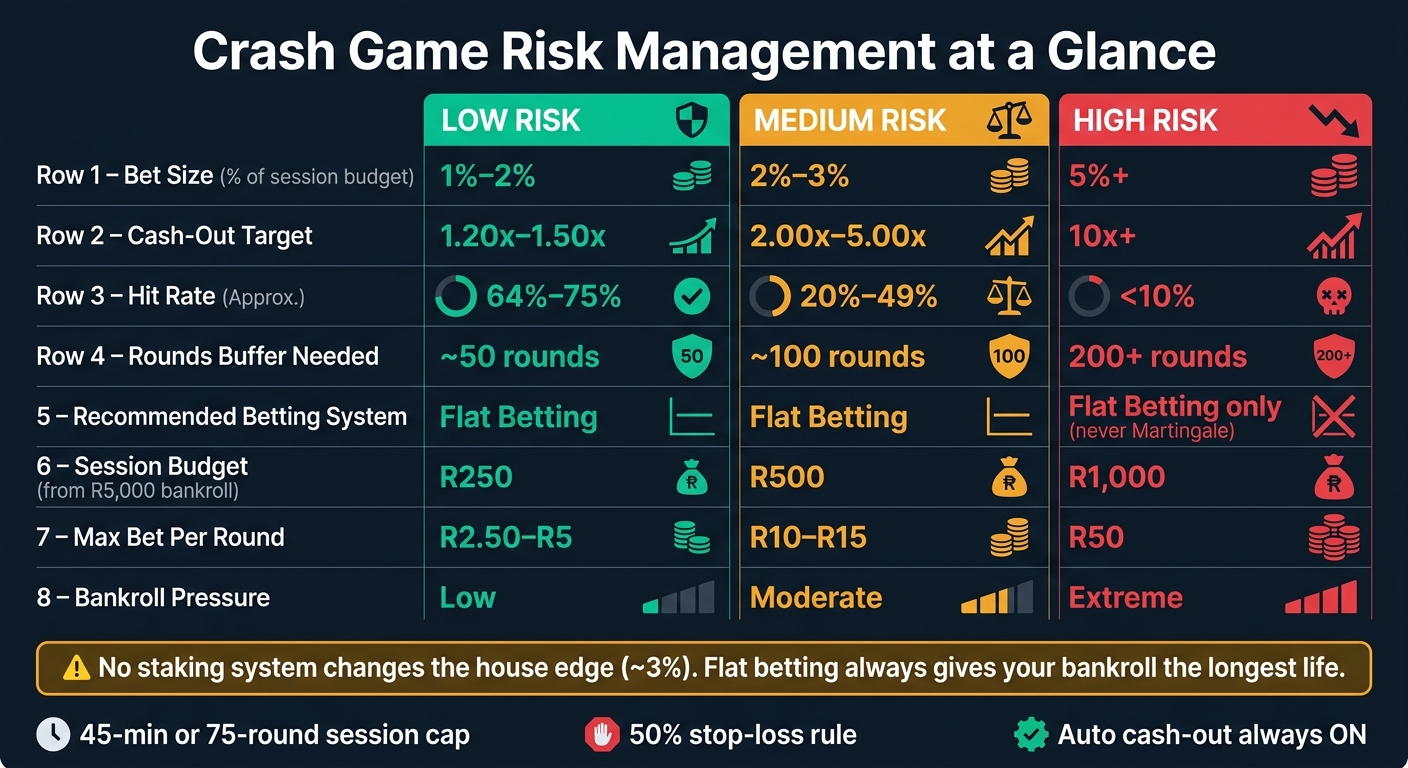
Crash Game Risk Levels: Bankroll, Cash-Out & Betting System Comparison
How to Play Crash Games? Most Lose Because of this Mistake..
sbb-itb-00c3b18
Quick comparison
| Area | Lower-risk approach | Higher-risk approach |
|---|---|---|
| Bet size | 1% to 2% of session budget | 5%+ of session budget |
| Cash-out target | 1.20x to 1.50x | 10x+ |
| Bet system | Flat betting | Progression systems like Martingale |
| Session control | 45 minutes or 75 rounds | Open-ended play |
| Main result | Slower losses, more room for error | Shorter bankroll life |
For South African players, there’s one more risk: load shedding and connection drops. That’s why I’d treat auto cash-out as a basic safety step, not an extra.
This guide is about one thing: keeping losses capped in rand, so one bad run does not turn into a bigger problem.
Bankroll rules that limit losses in rand
Set a bankroll, session budget, and maximum stake per round
Risk of ruin drops when each round uses only a small part of your bankroll. Put simply, smaller bets give variance less room to do damage.
Keep a separate crash-game bankroll. Use only entertainment money. Then set your session budget at 5% to 10% of that bankroll, and cap each stake at 1% to 2% of the session budget. For example, a R5 000 bankroll gives you a R250 to R500 session budget. That keeps your rand exposure fixed instead of letting one bad run spiral.
Stake size is usually what wrecks a bankroll. If you want lower-risk play, keep each bet between 1% and 2% of your session budget. On a R500 session budget, that works out to R5 to R10 per round. At R5 per round, you can survive 100 consecutive losses before the session budget is gone. Move that stake up to R50 – or 10% of the budget – and the same losing streak wipes you out in just 10 rounds.
Set stop-loss and profit target limits before the session starts
Set your stop-loss and profit target before the first bet. A simple rule is a 50% stop-loss and a 100% profit target before you start. Don’t shift those limits in the middle of a session. That’s where people often come unstuck.
The R1 minimum stake also helps if you’re playing on a smaller budget, because it lets you keep stake sizes low without stretching beyond your limits.
Comparison table: example bankroll plans by risk level
The table below shows how the same R5 000 monthly bankroll can be split into different session plans based on risk appetite. These figures are illustrative and do not guarantee results.
| Risk Level | Total Bankroll | Session Budget | Max Bet Per Round | Session Stop-Loss | Profit Target |
|---|---|---|---|---|---|
| Low | R5 000 | R250 | R2,50 to R5 (1% to 2%) | R125 (50% loss) | R250 (100% gain) |
| Medium | R5 000 | R500 | R10 to R15 (2% to 3%) | R250 (50% loss) | R500 (100% gain) |
| High | R5 000 | R1 000 | R50 (5%) | R500 (50% loss) | – |
The low-risk setup gives you the most rounds to work with, which matters in a game shaped by variance.
Once your bankroll limits are fixed, the next control is your cash-out target.
Cash-out discipline and multiplier targets
Once your stake size is set, cash-out discipline shapes how often you bank a win before the crash. This gets much easier with auto cash-out.
Pick one target before the round starts, then stick to it. The moment you wait for “just a bit more”, greed and hesitation start doing the driving. That’s where players get hurt. Pre-set rules cut out that temptation.
Low-, medium-, and high-risk cash-out ranges
Your target multiplier changes two things at once: how often you win, and how much pressure a losing streak puts on your bankroll. Lower targets hit more often, but the profit per round is smaller. Higher targets can pay far more, but they also bring longer dry spells that can chew through your session budget before a win shows up.
At the lower-risk end, a 1.5x target lands in about 64% to 75% of rounds. Those steady, smaller wins can keep swings lower, but progress is slower. And there’s still a catch: a short run of early crashes can wipe out several rounds of gains in a hurry.
Medium-risk targets (2x–5x) sit in the middle. A 2x cash-out hits at about 48% to 49% – almost like a coin toss. You’ll deal with longer losing runs than at 1.5x, but each win pays more. For players who can handle a few dry patches without chasing losses, this range often feels like the middle ground.
High-risk targets (10x+) are a different game. A 10x target lands in fewer than 10% of rounds – about 9.7%. Put plainly, wins are rare. That’s why stakes need to be much smaller, and your buffer needs to be much bigger: about 200 rounds at 10x+ versus about 50 rounds at 1.5x.
Why auto cash-out helps control emotion
Auto cash-out cuts out hesitation and helps you avoid missed clicks during lag or load shedding. It also keeps you from changing your plan mid-round. And the lower your target, the less pressure each losing streak puts on your bankroll.
Comparison table: multiplier targets vs risk profile
| Risk Profile | Target Range | Hit Rate (Approx.) | Bankroll Pressure | Psychological Stress |
|---|---|---|---|---|
| Low Risk | 1.20x – 1.50x | 64% – 75% | Low; needs ~50-round buffer | Low; frequent wins |
| Medium Risk | 2.00x – 5.00x | 20% – 49% | Moderate; needs ~100-round buffer | Moderate; requires patience |
| High Risk | 10.00x+ | <10% | Extreme; needs ~200+ round buffer | High; long losing streaks |
Your target only works if your stake size fits it. The next step is to match those targets with a staking system that doesn’t blow up your risk.
Bet sizing systems and their real risk
No staking system changes the maths of the game. It only changes how fast your losses pile up. So this is a bankroll-speed problem, not an edge problem. The aim is simple: slow the drawdown, not try to win losses back.
Flat betting, Martingale, and D’Alembert explained
Flat betting means using the same rand amount on every round. It’s the simplest option, and it gives your bankroll the best shot at lasting through a full session.
Martingale does the opposite. After each loss, you double the next bet and hope one win covers what came before. A R10 starting bet turns into R20, then R40, then R80. And because early crashes can bunch together in any session, that climb can happen fast. After eight losses, the next recovery bet is R1 280.
D’Alembert moves more slowly. You add one unit after a loss and subtract one unit after a win. That sounds calmer on paper, but during a losing run it still pushes your bet size up. Over time, that puts real strain on your bankroll.
Why progression systems can raise the risk of ruin
Here’s the catch: progression systems don’t control variance. They magnify it. At a 1.8x cash-out target, the chance of hitting an eight-round losing streak is about 35% per session. That’s not some freak event. It’s common enough to matter.
There’s another problem too. Most tables have a betting cap. So even if your system says, "double again", the next recovery bet may be too big to place. When that happens, the loss is locked in.
Progression systems don’t remove the house edge. They just pack losses into fewer, bigger rounds. That’s the opposite of good risk control.
Comparison table: betting systems by volatility and bankroll pressure
| System | Complexity | Bankroll Requirement | Risk Spike Potential | Suitability |
|---|---|---|---|---|
| Flat Betting | Low | Low | Low | Conservative players; long sessions |
| Martingale | Low | Very High | Extreme | Aggressive players; high risk of total ruin |
| D’Alembert | Medium | Moderate | Medium | Players seeking a "controlled" progression |
Flat betting won’t make you rich in a hurry, but it does keep your exposure steady. When your stake stays fixed, the next thing that matters is how long you stay in the session.
Session control and responsible play in South Africa
Once you’ve fixed your stake size and your exit point, there’s one last thing to lock down: session length. Stake size matters, of course. But time is what often drains a bankroll faster than people expect. Session control is what ties the whole plan together.
Set time limits, round limits, and cooling-off breaks
Crash games move at a serious pace, so 50 to 100 bets can fly by in a single session. That’s exactly why firm session limits matter.
Set a 45-minute session cap before you begin. Put a phone alarm on and stop when it goes off, or stop after 75 rounds, whichever comes first. When you hit either limit, step away and take a cooling-off break before you decide if you want to play again.
In South Africa, there’s another risk to think about: execution risk. It matters just as much as bankroll risk. Load shedding or a dropped connection can stop a manual cash-out in the middle of a round. That’s why it makes sense to use server-side auto cash-out. Your exit can still go through during load shedding or if your connection drops.
Never chase losses and always play within your budget
Putting up your stake after a loss is the clearest warning sign. If you catch yourself doing it, or even see your bets slowly edging up, stop at once and take a cooling-off break.
Only use spare entertainment money. Set a hard rand limit before you log in, and don’t reload once you hit it. If you need support at any point, the National Responsible Gambling Programme helpline is 0800 006 008.
Conclusion: core rules that protect a crash-game bankroll
Every part of this guide points back to the same truth: consistency beats prediction. You can’t know when the next crash will hit. What you can control is how much you risk each round, when you cash out, and when you stop for the day.
The rules are simple:
- Fix your stake
- Fix your exit
- Fix your session limit
- Stop when any limit is reached
Discipline, applied the same way across many sessions, is what protects a crash-game bankroll. The maths only gets a chance to work in your favour if you’re still in the game long enough to let it play out.
FAQs
How do I choose the right cash-out target?
Choose a cash-out target that fits your risk tolerance and bankroll. No multiplier gets rid of the house edge.
Lower targets like 1.50x to 2.00x tend to give you smaller wins more often. Higher targets such as 5.00x or 10.00x can pay much more, but those hits come less often and the swings are harsher.
For tighter risk control, use auto-cashout and keep each stake to 1% to 2% of your session bankroll per round. A disciplined dual-bet setup usually means placing one larger bet with a low target, plus a second smaller bet with a higher target.
What should I do if my connection drops mid-round?
If your connection drops in the middle of a round, the outcome comes down to one thing: whether you set auto-cashout before the round began.
Because auto-cashout runs on the server side, it stays active even if your internet cuts out or your device switches off.
If you set an auto-cashout value, your winnings are collected if the plane reaches that multiplier. If you depend only on a manual click, you lose your stake if the game crashes before the server gets your command.
How do I know if I’m starting to chase losses?
You may be chasing losses when emotion starts driving your decisions after a setback. It often shows up in simple ways: putting up bigger stakes to win money back fast, making snap calls out of frustration or panic, or getting stuck on one loss and trying to "fix" it.
Your body can warn you too. A racing heartbeat, sweating, or a clenched jaw can all be signs that you’re no longer thinking clearly.
If you start ignoring the limits you set for yourself at Supabets, step away.