Betting can be fun, but it’s easy to make costly mistakes. Here are the top 7 errors bettors often make, along with ways to avoid them:
- Chasing Losses: Doubling bets to recover losses leads to impulsive decisions and bigger losses.
Solution: Set loss limits and stick to a 1–2% bankroll rule per bet. - Poor Bankroll Management: Mixing gambling money with essential expenses creates financial stress.
Solution: Only bet with disposable income and keep bets small (1–2% of your bankroll). - Betting With Emotion: Placing bets based on loyalty or frustration clouds judgment.
Solution: Do research, stay objective, and pause after losses to regain focus. - Misunderstanding Odds and Value: Backing favourites without assessing value often drains funds.
Solution: Learn to calculate implied probabilities and compare them to bookmaker odds. - Betting on Too Many Events: Spreading bets across multiple games reduces focus and increases risk.
Solution: Limit bets to 3–5 well-researched events per day. - Ignoring Research: Overlooking stats, form, or external factors leads to uninformed decisions.
Solution: Study team form, injuries, and conditions before placing bets. - Inconsistent Strategies: Constantly changing your approach prevents long-term success.
Solution: Stick to a clear, consistent strategy and track your bets over time.
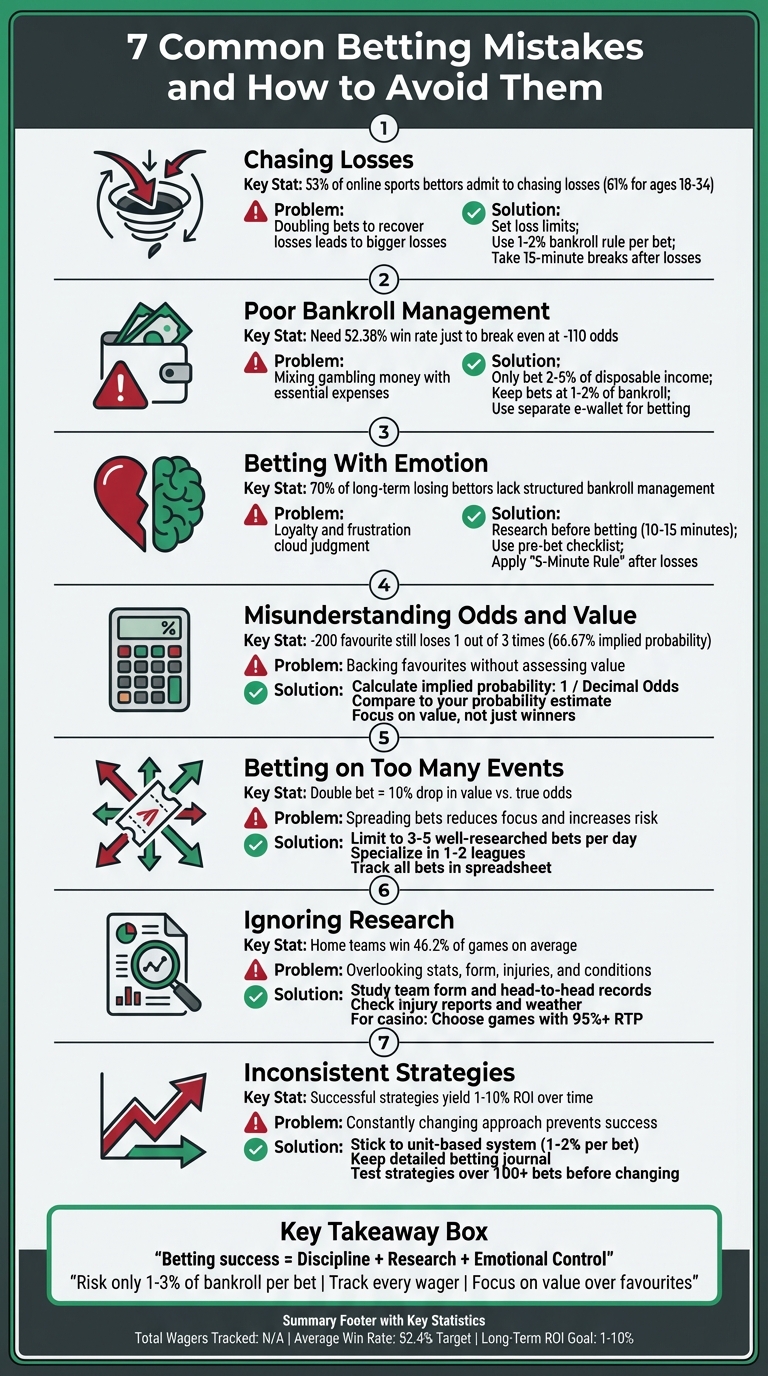
7 Common Betting Mistakes and How to Avoid Them Infographic
Sports Betting 101: Avoid These Common Mistakes
Chasing Losses
Imagine this: you lose a R200 bet on a Kaizer Chiefs match. Frustrated, you decide to double your next wager to R400, hoping to recover your losses. This behaviour, called chasing losses, is one of the most damaging habits in betting. In fact, over 53% of online sports bettors admit to chasing losses, and the number climbs to 61% for younger bettors aged 18–34.
Why Chasing Losses Backfires
Chasing losses is rooted in two common psychological traps: the sunk cost fallacy and the gambler’s fallacy. The sunk cost fallacy convinces you to recover money you’ve already spent, while the gambler’s fallacy makes you believe that a win is "due" after a losing streak. The reality? Each bet is a separate event, unaffected by past outcomes.
Adding to the problem, losing can cloud your judgment. When frustration kicks in, your prefrontal cortex – the brain’s rational decision-maker – might not function properly. This emotional state often leads to impulsive choices, such as raising your stakes or choosing riskier bets. Research even shows that the pain of losing feels about twice as intense as the joy of winning. This emotional imbalance creates a cycle of desperation that’s tough to break.
"Chasing is an addiction hallmark related to difficulty cutting back and withdrawal symptoms".
Recognising these traps is the first step toward breaking free.
How to Stop Chasing Losses
The key to avoiding this cycle is creating a clear boundary between your emotions and actions. One way to do this is by using tools like Supabets’ account settings to set daily or weekly loss limits. For example, decide upfront that you won’t lose more than R500 in a week. Once you hit that limit, stop betting entirely – even if the next wager seems like a sure thing.
Another approach is the 1–2% rule: never risk more than 1–2% of your total bankroll on a single bet. If your bankroll is R5,000, this means betting between R50 and R100 per event. This method, known as "unit betting", helps protect you from short-term swings and eliminates the urge to place larger, riskier bets.
After a loss, take a 15-minute break to cool off. This pause allows your emotions to settle and gives your rational mind a chance to regain control. Finally, shift your mindset: treat your betting bankroll as an entertainment budget, not an investment that needs to be recovered. By doing so, you can enjoy the experience without the pressure of chasing every lost rand.
Poor Bankroll Management
Mismanaging your betting budget can quickly turn a fun pastime into a source of financial stress.
Imagine setting aside R1,000 for betting this month. After a few losses, you dip into money meant for groceries or rent to place "just one more bet." Suddenly, you’re facing bills you can’t pay. That’s poor bankroll management in action, and it’s a slippery slope from entertainment to financial trouble. Recognising these risks is the first step towards smarter betting habits.
What Poor Bankroll Management Can Lead To
When you mix gambling money with funds for essentials, the fallout can be severe. Using money meant for rent, bills, or groceries to gamble creates unnecessary financial strain. As one expert bluntly states:
"If gambling money is coming from rent, bills, or groceries, it is time to stop".
Another common mistake is selective accounting – tracking your wins while ignoring your losses (often referred to as the Ostrich Effect). Without an honest record of both, it’s impossible to spot losing trends or adjust your strategy. Experts recommend allocating only 2–5% of your monthly disposable income to gambling.
Overbetting is another pitfall of poor bankroll management. This happens when you place too many bets at once or risk a large percentage of your funds on a single event. For sports betting, breaking even requires winning 52.38% of your bets with standard -110 odds. Achieving a win rate above 55% is considered excellent but is challenging to sustain over time.
"What gets measured gets managed, and better management leads to smarter, more sustainable betting."
Like chasing losses, poor bankroll management clouds judgement and undermines smart decision-making.
Tips for Managing Your Bankroll
The solution starts with setting a clear budget. Pick an amount – say, R1,000 – that won’t affect your daily needs, and ensure it comes exclusively from your disposable income. Never gamble with money meant for savings or essentials.
Adopt a unit-based betting system. This involves risking 1–2% of your bankroll per bet. For a R1,000 budget, that translates to R10–R20 per wager. Even professional bettors rarely exceed 1–2% of their total bankroll on a single bet. This method helps you endure losing streaks without running out of funds.
Take advantage of tools offered by platforms like Supabets, such as deposit and loss limits. These features allow you to control how much you deposit weekly or monthly and set automatic stop points when losses hit a specific threshold. Experts often suggest walking away after losing 40–50% of your session budget. Reviewing your transaction history regularly can also help you identify patterns and spot potential problems early.
Keep your betting money separate from the rest of your finances. Using a dedicated e-wallet or prepaid card for gambling can make it easier to stick to your budget and avoid dipping into essential funds. This simple step creates a clear boundary between entertainment spending and everyday expenses.
"Treat lowering your stakes as a strategic reset, not a failure. If you can’t drop down when the maths says so, you don’t have a bankroll strategy – you have a gambling habit."
Betting With Emotion Instead of Logic
Picture this: it’s Saturday afternoon, and you’re so fired up for the Springboks game that you throw down R500 without even glancing at the stats. That’s emotional betting in action, and it’s a quick way to see your bankroll vanish.
When emotions take the wheel, rational thinking gets sidelined. Fans often inflate their team’s strengths, brushing off weaknesses as flukes or temporary setbacks. This mix of loyalty and excitement clouds judgement, turning what should be a calculated risk into a decision driven by hope rather than hard facts.
How Emotion Derails Betting Decisions
Emotional betting sets off a cycle of impulsive choices. Wins and even close losses can trigger dopamine, tricking your brain into thinking a big win is just around the corner. This chemical rush often leads to reckless bets.
Then there’s loss aversion. Research shows that losing feels about twice as painful as winning feels good. This explains why bettors often chase losses, doubling down not because it’s smart, but because they’re desperate to avoid the sting of defeat.
"Betting with your heart can also lead to one of the mortal sins of betting: chasing your losses."
A 2024 study revealed that over 70% of long-term losing bettors lacked any structured bankroll management, showing that emotion, not strategy, was steering their decisions. Ever found yourself obsessively refreshing a score app or panicking right after placing a bet? These are classic signs that emotions are in control.
This emotional bias undermines the discipline and data-driven strategies needed for successful betting.
How to Bet With Logic
To break free from emotional impulses, switch to a logical, research-based approach. This shift helps bring clarity and control to your decisions.
Start by asking yourself: “Would I still bet on this team if they weren’t my favourite?” If the answer is no, that’s your clue to walk away.
Before placing a bet on platforms like Supabets, take advantage of the stats, form guides, and match previews they offer. Look into recent performances, head-to-head records, injuries, and tactical matchups. Spending just 10–15 minutes on research can transform your betting from guesswork to informed decisions.
Use a pre-bet checklist to verify your research, assess value, and confirm your edge. After a loss, apply the “5-Minute Rule” – pause and cool off before making another move. Keep a record of your bets, noting your reasoning and emotional state, to hold yourself accountable. If you’re feeling frustrated or angry, step away for at least 15 minutes to regain focus.
"Smart betting reflects realism rather than disloyalty, proving that awareness of bias leads to stronger decision-making."
Stick to staking 1–5% of your bankroll for each bet. This prevents the temptation to go overboard based on a hunch or team loyalty. Tracking your emotions alongside your bets – whether you were feeling confident, bored, or tilted – can also help you identify patterns and avoid emotional traps in the future.
Misunderstanding Odds and Value
Once you’ve got a handle on managing your emotions and bankroll, the next step is understanding odds and value. This is essential if you want to make smarter, more consistent bets.
A common mistake many bettors make is focusing solely on picking winners. Sure, backing favourites might feel like a safe bet, but if the odds don’t reflect the true probability, you could still end up losing money in the long run.
So, what’s a value bet? It’s when your estimated probability of an outcome is higher than what the bookmaker’s odds suggest. For instance, if you think a team has a 60% chance of winning, but the odds imply only a 50% chance, there’s value in that bet. Spotting these opportunities consistently is what separates long-term winners from casual punters.
"Understanding value is the key to long term betting success."
Here’s a key stat to keep in mind: at standard -110 odds (common for spreads), you need to win 52.38% of your bets just to break even. That’s because bookmakers build in a margin – known as the "edge" – to ensure they profit. In a typical two-way market with -110 odds on both sides, the total implied probability adds up to 104.76%. That extra 4.76% is their cut. Even heavy favourites aren’t as safe as they seem. For example, a -200 favourite has a 66.67% implied probability, meaning it still loses roughly one out of three times. Without factoring in value, chasing low odds can slowly drain your bankroll.
Why Value Matters More Than Favourites
Betting isn’t just about predicting who wins; it’s about determining whether the odds justify the risk. Favourites might win more often, but their odds are frequently skewed by public sentiment, leaving little value. In contrast, underdogs or less popular picks often hold better value because the market underestimates their chances.
Take this example: a 10/1 underdog has an implied probability of 9.1%, meaning it will lose the vast majority of the time. But if you believe the underdog has a 15% chance of winning, the odds represent excellent value. Even if it loses most bets, the occasional win at 10/1 could make it profitable over time.
"The value comes in being able to bet on an event that is more likely to happen than the betting odds suggest." – Steve Madgwick, OLBG
Seasoned bettors don’t just ask, "Who will win?" Instead, they ask, "What’s the probability, and do the odds reflect that?".. This shift in thinking transforms betting into a calculated, data-driven approach rather than a guessing game.
How to Find Value Bets on Supabets

So, how do you put this into action on platforms like Supabets? Start by calculating the implied probability of the bookmaker’s odds. For decimal odds – the format used on Supabets – the formula is simple:
1 / Decimal Odds
For example, if the odds are 2.50, the implied probability is 40% (1 / 2.50 = 0.40). Next, compare this to your own probability estimate. If you think a team has a 50% chance of winning, but Supabets’ odds imply only a 40% chance, you’ve found potential value. To confirm, use this formula:
Value = (Your Estimated Probability × Bookmaker Odds) − 1
In this case, if you estimate a 50% chance at odds of 2.50, the calculation is (0.50 × 2.50) − 1 = 0.25. A positive result confirms value in the bet.
To maximise your chances, focus on specific leagues or niche markets where you can develop deeper insights. Supabets covers popular sports like the PSL, English Premier League, and rugby, offering live odds. During live betting, you might spot value as odds shift due to factors like momentum swings, player fatigue, or tactical changes – areas where the bookmaker’s algorithms might lag behind an observant bettor.
Keep an eye out for "drifters" – teams whose odds increase unexpectedly. For instance, if a team’s odds rise from 2.00 to 2.50, it could indicate value if the new odds exceed their true chances of winning. Spend a few minutes comparing your probability estimates with live odds to uncover these opportunities.
Finally, track your bets and note your reasoning. Over time, this will help you identify patterns – where you consistently find value and where you might overestimate probabilities. This habit turns value betting from a theoretical concept into a repeatable, profitable strategy.
sbb-itb-00c3b18
Betting on Too Many Events
Once you’ve got the hang of value bets, it’s crucial to avoid falling into the trap of betting on everything. It might be tempting to wager on every PSL clash, English Premier League showdown, or rugby international over a packed weekend, but spreading yourself too thin can quickly empty your bankroll and blur your focus.
Why Betting on Too Many Events Can Hurt You
Placing 10–15 bets in a single night might seem like you’re maximising your chances, but it’s a risky move. As Action Network Staff puts it:
"Betting 10 or 15 games per night is dangerous. You are taking on massive risk and one bad night can decimate your bankroll."
When you bet on too many events, it’s harder to do the proper research and keep track of everything, which means you’re more likely to rely on guesses. Adding multiple selections to an accumulator also works against you. For instance, while a single bet carries a small margin of about 1.7%, turning it into a double can lead to a 10% drop in value compared to the true odds. On top of that, tracking so many bets makes it tough to identify which markets are actually profitable.
Bettingbase highlights the importance of narrowing your focus:
"Rather than spreading attention across multiple sports, successful bettors often specialise in particular areas where they have strong knowledge and understanding."
Let’s break down how to avoid overloading your bets and improve your strategy.
How to Narrow Your Betting Focus
The key to avoiding these pitfalls is to limit your bets to a manageable number. Instead of placing wagers on every event, aim for 3–5 well-researched bets per day. This approach gives you the time to dive into important details like team form, injuries, and tactics, while also protecting your bankroll. Professional bettors typically stake only 1–3% of their total bankroll per bet to weather losing streaks, a strategy that works especially well when you’re selective about your bets.
It’s also worth specialising in one or two leagues or sports that you follow closely. For example, if you’re a PSL fan, you might notice patterns that others miss – like how certain teams perform after midweek games or which clubs struggle on the road. This level of knowledge can give you an edge. Platforms like Supabets often offer promotions on specific leagues, which can help you get more out of your focused strategy.
Finally, keep track of your bets in a simple spreadsheet. Record details like the league, stake, odds, and result. This will help you identify which markets are working for you and where adjustments might be needed.
Ignoring Research and External Factors
Even with disciplined bankroll management and a logical betting approach, neglecting research can undermine your strategy. Whether you’re betting on Bafana Bafana in a high-stakes match or trying your luck on a slot machine, overlooking critical details can turn a promising wager into an avoidable loss.
How External Factors Affect Betting Outcomes
External factors can dramatically shift betting outcomes. For instance, if Mamelodi Sundowns are missing their star striker for a PSL game, their chances of winning might drop – even if the bookmaker’s odds don’t immediately reflect this. Similarly, a team’s recent winning streak might look impressive, but if those victories came against weaker opponents, they may falter against stronger competition.
Environmental conditions and scheduling also play a big role. Heavy rain at Ellis Park can turn a rugby match into a slow, defensive grind, while strong winds at Kingsmead in Durban might skew cricket totals. Even in football, home advantage matters – Premier League teams win about 46.2% of home games on average, though this varies by club and situation. Additionally, factors like fixture congestion, travel fatigue, or a team’s position in the league (e.g., fighting relegation or chasing a title) can heavily influence performance.
For casino games, research is equally vital. Knowing the Return to Player (RTP) percentage and game rules helps you understand the house edge. For example, European Roulette has an RTP of 97.30%, while American Roulette drops to 94.74% due to the extra double-zero. Blackjack, when played with perfect basic strategy, offers an RTP as high as 99.5%. These details give you a clearer picture of your potential returns before placing a bet.
Understanding these external factors ensures your betting decisions are based on solid information, not guesswork, and strengthens your overall strategy.
How to Research Before Betting
A structured research approach can help you navigate these external influences. Focus on objective data rather than intuition or hype. For sports betting, study key stats like shots on target, possession rates, and expected goals (xG). Avoid relying on social media chatter or personal biases. Stay updated with in-play news from platforms like Supabets, which can alert you to last-minute injuries, lineup changes, or weather updates that may impact the game.
For casino games, understanding RTP and game rules is crucial. Aim for games with an RTP of 95% or higher to maximise your potential returns. High RTP, low-variance games provide steady, smaller wins, ideal for preserving your bankroll. On the other hand, low RTP, high-variance games are better suited for players chasing large, rare payouts. Testing games in demo mode can also help you gauge volatility and payout patterns before wagering real money.
Finally, avoid falling into the trap of over-analysing irrelevant trends. For example, a stat like a player failing to score during a specific month may not have any real impact on the game’s outcome. Stick to factors that logically influence performance and results. By doing so, you’ll make better-informed decisions and improve your chances of success.
Inconsistent Betting Strategies
When it comes to betting, sticking to a clear and logical approach is just as important as managing your bankroll. Consistency in your strategy is what sets apart those who succeed from those who rely on sheer luck.
Constantly changing your approach can derail your progress. If you switch strategies after a few losses, you’re likely reacting to short-term fluctuations – those inevitable ups and downs that come with any betting system.
Why Consistency Matters in Betting
Jumping from one strategy to another makes it nearly impossible to spot profitable patterns. Each time you switch, you essentially reset your progress, erasing any advantage you might have gained. A true betting edge only becomes evident over hundreds, even thousands, of bets – not just a handful. Even seasoned bettors can face long losing streaks due to the unpredictable nature of sports outcomes.
Without a consistent approach, keeping an effective betting journal becomes nearly impossible. If you’re constantly shifting gears, you can’t accurately track which markets or bet types are working for you. This lack of focus is often driven by emotional decisions, leading to poorly researched bets and compounding mistakes from earlier missteps.
"Your true edge comes from longevity, patience, and consistency, not chasing profits after one big night or a short-term hot streak." – LJ Blut, Sportsbook Expert
Now that we’ve established why consistency is so crucial, let’s look at how to build a stable betting strategy.
How to Build a Consistent Strategy
Just as solid bankroll management and thorough research are key to successful betting, a consistent strategy is essential for maintaining a long-term edge.
Start with a unit-based system. Allocate 1–2% of your total bankroll to each wager. This keeps your bet sizes steady, no matter your recent wins or losses, and helps you avoid making emotional decisions. Professional bettors stick to this range to weather losing streaks without risking their entire bankroll.
Keep a detailed betting journal. Track every bet you place on platforms like Supabets. Record the stake, odds, reasoning, and outcome. Then, set aside time each week – say, every Sunday – to review your performance. This prevents emotional decisions that might come from focusing on daily ups and downs. If you want to test a new strategy, commit to at least 100 bets before making adjustments. Remember, most successful strategies yield a Return on Investment (ROI) of 1% to 10%, so patience is key.
Set a tilt limit. To avoid emotional betting, establish a rule that you’ll never increase your bet size by more than 25%, even after a big win or a tough loss. This keeps your strategy on track, allowing it to work over the long haul.
Conclusion
Avoiding the seven most common betting mistakes boils down to maintaining discipline, doing your homework, and keeping your emotions in check. Whether it’s chasing losses, overbetting, making impulsive decisions, or spreading yourself thin across too many events, each of these pitfalls can be avoided with a structured approach.
One of the cornerstones of success is proper bankroll management. This involves sticking to unit-based staking – risking just 1% to 3% of your bankroll per bet – and keeping a detailed betting log. It’s also crucial to focus on finding value rather than blindly backing favourites. For example, betting on a favourite at odds of 1.20 means you’d need five consecutive wins just to recover from one loss.
Supabets provides tools to support these disciplined practices. From match statistics and head-to-head data to injury updates and features like deposit limits and session time-outs, these resources are designed to help you make informed decisions based on data rather than emotion.
Think of betting as a marathon, not a sprint. Focus on a few leagues or markets that you know well, track every bet carefully, and give yourself a break after consecutive losses. By sticking to consistent strategies and making decisions based on research, betting can remain an enjoyable and well-managed form of entertainment that rewards patience and planning.
FAQs
How do I set my betting unit size?
To determine your betting unit size, set aside a small percentage of your total bankroll – usually between 1% and 5%. For instance, if your bankroll is R10,000, a 1% unit size would amount to R100. As your bankroll fluctuates, adjust the unit size accordingly. This strategy helps you control risk, stay disciplined, and steer clear of placing too much on one bet.
How do I spot a value bet quickly?
To identify a value bet efficiently, you need to compare the bookmaker’s odds with the actual probability of an event occurring. A value bet arises when the odds offered are better than what the true likelihood suggests.
Here’s how to approach it:
- Evaluate the odds: Look for differences between the bookmaker’s odds and your own probability estimates.
- Work out the implied probability: Convert the odds into a percentage and compare this to your calculated probability.
- Stay focused and disciplined, placing bets only when there’s a clear advantage.
What should I track in a betting journal?
When maintaining a betting journal, make sure to record these important details to sharpen your strategy:
- Sport and event: Note which sport and specific event you placed your bet on.
- Bet type: Specify whether it was a moneyline, spread, props, or another type of bet.
- Odds: Write down the odds available at the time you placed the wager.
- Amount wagered: Keep track of how much money you put on the line.
- Date and time: Record when the bet was made.
- Outcome: Document whether the bet resulted in a win, loss, or a push.
By keeping track of this information, you can better evaluate your results, spot trends in your betting habits, and stay on top of your bankroll management.