Betting odds explain two things: how likely an event is to happen and how much you can win. They come in three main formats: fractional odds (common in the UK), decimal odds (popular in South Africa), and moneyline odds (used in the US). While they may look different, they all represent the same basic information.
- Fractional odds (e.g. 5/1) show profit relative to your stake. For instance, a R100 bet at 5/1 returns R600 (R500 profit + R100 stake).
- Decimal odds (e.g. 2.50) include both your stake and profit in one number. A R100 bet at 2.50 returns R250.
- Moneyline odds use positive (+) and negative (-) signs. Positive odds (e.g. +200) show profit on a R100 bet, while negative odds (e.g. -200) indicate how much you need to bet to win R100.
Understanding these formats helps you calculate payouts, spot favourites, and identify underdogs. For example, smaller decimal odds (e.g. 1.40) or negative moneyline odds (-200) indicate favourites, while larger odds (e.g. 5/1 or +500) suggest underdogs with higher potential payouts.
Here’s a quick comparison of the formats:
| Odds Format | Example | Profit on R100 Stake | Total Payout |
|---|---|---|---|
| Fractional | 5/1 | R500 | R600 |
| Decimal | 2.50 | R150 | R250 |
| Moneyline | +200 | R200 | R300 |
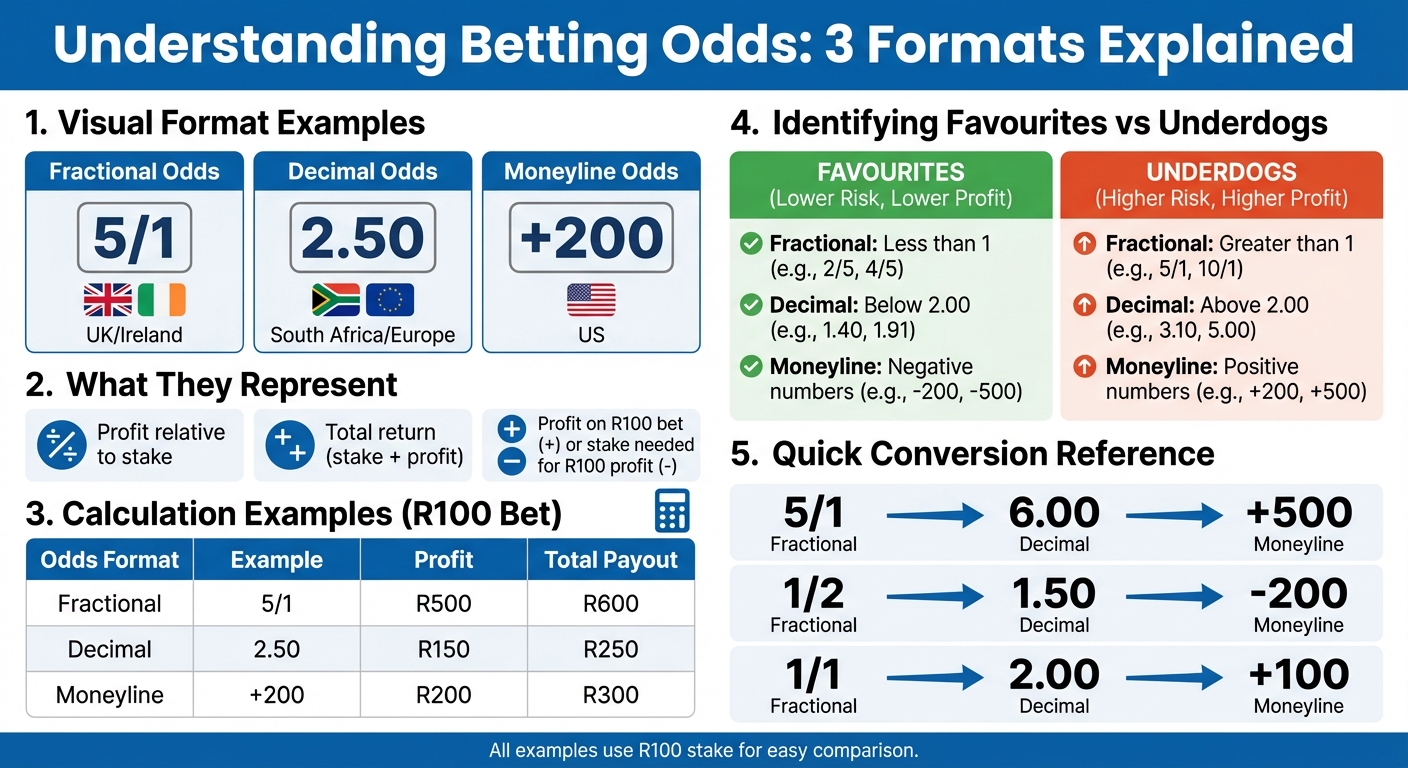
Betting Odds Formats Comparison: Fractional, Decimal, and Moneyline
How to Read Fractional Odds
How Fractional Odds Work
Fractional odds, like 5/1 or 7/2, show the profit-to-stake ratio. For example, odds of 7/2 mean that for every R2 you bet, you earn R7 in profit, resulting in a total payout of R9 (R7 profit + R2 stake). The first number represents the profit, while the second represents the stake. This format is widely used in South Africa, the United Kingdom, and Ireland.
Calculating Fractional Odds: Examples
To calculate your potential profit and payout, divide your stake by the second number (denominator) and multiply by the first number (numerator). Here are a few examples:
- A R10 bet at 5/1 odds: Divide R10 by 1, then multiply by 5. This gives you a profit of R50. Add your original R10 stake for a total payout of R60.
- Even money odds (1/1): Your profit equals your stake. For instance, a R100 bet will return R100 in profit, plus the original R100 stake, totalling R200.
- Odds of 8/5: If you bet R100, divide R100 by 5 and multiply by 8. This gives a profit of R160, resulting in a total payout of R260.
Here’s a quick reference table for clarity:
| Fractional Odds | Stake | Potential Profit | Total Payout |
|---|---|---|---|
| 5/1 | R10 | R50 | R60 |
| 7/2 | R20 | R70 | R90 |
| 1/1 (Evens) | R100 | R100 | R200 |
| 8/5 | R100 | R160 | R260 |
Identifying Favourites and Underdogs
Fractional odds also help you spot favourites and underdogs. Odds smaller than 1 (e.g. 2/5 or 4/5) indicate favourites, meaning the outcome is more likely to happen. On the other hand, longer odds like 5/1 or 10/1 suggest underdogs, where the outcome is less likely, but a successful bet pays out more. Essentially:
- Smaller ratios (e.g. 2/5) = Favourites, lower risk, lower profit.
- Larger ratios (e.g. 10/1) = Underdogs, higher risk, higher profit.
Understanding this distinction is crucial when weighing your betting options across different odds formats.
sbb-itb-00c3b18
How to Read Decimal Odds
How Decimal Odds Work
Decimal odds show your total return for every R1 you bet. Unlike fractional odds, which focus only on profit, decimal odds include both your profit and your original stake in a single figure. For example, odds of 2.50 mean that for every R1 you wager, you’ll get R2.50 back if you win – this breaks down into R1.50 profit plus your R1 stake. This format is commonly used in South Africa, as well as in countries like Canada, Australia, New Zealand, and across Europe.
The smaller the number, the more likely the outcome is expected to happen. For instance, odds of 1.40 indicate a favourite, while odds of 3.10 suggest an underdog with a higher payout potential. Once you understand this, calculating your potential return becomes a breeze.
Calculating Decimal Odds: Examples
To figure out your total return, simply multiply your bet by the decimal odds. The formula is:
Stake × Decimal Odds = Total Return
Here are a couple of examples:
- A R100 bet at odds of 1.91 gives you R191 back (R100 × 1.91). That’s R91 profit plus your R100 stake.
- A R100 bet at odds of 2.60 returns R260 (R100 × 2.60), which includes R160 profit.
If you’re only interested in calculating profit, use this formula:
(Odds – 1) × Stake = Profit
| Stake | Decimal Odds | Total Payout | Net Profit |
|---|---|---|---|
| R100 | 1.40 | R140 | R40 |
| R100 | 1.91 | R191 | R91 |
| R100 | 2.60 | R260 | R160 |
| R100 | 3.10 | R310 | R210 |
Why Decimal Odds Are Easier to Use
As the examples show, decimal odds are incredibly simple to work with. They’re often considered the easiest format for beginners because you only need one multiplication to figure out your total return. There’s no need to manually add your stake back, as with fractional odds, or deal with the complexities of positive and negative figures like moneyline odds.
A quick tip: the number 2.00 acts as a useful reference point. Odds below 2.00 indicate a favourite, where your profit is smaller than your stake. Odds above 2.00, on the other hand, offer profits larger than your stake. This makes it easy to compare odds between matches – just look for the higher number to spot better potential returns.
How Betting Odds Work in 8 Minutes – Beginners Explanation 2026
How to Read Moneyline Odds
After covering fractional and decimal odds, let’s dive into moneyline odds. Moneyline odds, also known as American odds, are widely used and rely on positive (+) and negative (-) signs to differentiate between underdogs and favourites. Using a R100 benchmark, negative odds show how much you need to stake to make a R100 profit, while positive odds indicate the profit you’d make from a R100 bet. Grasping these basics can help you quickly evaluate value and calculate potential winnings.
Positive vs Negative Moneyline Odds
A minus sign (-) identifies the favourite. For instance, odds of -200 mean you need to bet R200 to earn R100 in profit.
On the other hand, positive odds signal the underdog. For example, odds of +150 mean a R100 bet would result in R150 profit. Generally, the higher the positive number, the bigger the underdog (and the larger the potential payout). Meanwhile, larger negative numbers suggest a stronger favourite, which typically offers lower returns.
Calculating Moneyline Odds: Examples
Here’s how you can calculate potential returns for both positive and negative odds:
- Positive odds: Divide the odds by 100, then multiply by your stake.
- A R100 bet at +500 gives R500 in profit (R100 × 5.0), for a total return of R600.
- A R50 bet at +150 yields R75 in profit (R50 × 1.5), resulting in a total return of R125.
- Negative odds: Divide 100 by the absolute value of the odds, then multiply by your stake.
- A R200 bet at -200 results in R100 profit (R200 × 0.5), with a total payout of R300.
- A R150 bet at -150 gives about R100 profit (R150 × 0.67), for a total return of R250.
Here’s a summary of potential returns for a R100 bet:
| Moneyline Odds | R100 Bet Profit | Total Payout |
|---|---|---|
| -500 | R20 | R120 |
| -200 | R50 | R150 |
| +100 | R100 | R200 |
| +150 | R150 | R250 |
| +500 | R500 | R600 |
Like fractional and decimal odds, moneyline odds reflect both the likelihood of an outcome and the potential return, offering another perspective to assess value.
Understanding Probability from Moneyline Odds
Moneyline odds also reveal the implied probability of an event, which reflects the bookmaker’s estimate of its likelihood. Negative odds indicate a higher probability of success. For example, odds of -500 suggest about an 83.33% chance of winning, while odds of +500 imply roughly a 16.67% chance.
In evenly matched contests, both sides might be set at -110, translating to an implied probability of approximately 52.4% for each team. Combined, these probabilities exceed 100% due to the sportsbook’s margin, often called the vig or juice.
Understanding these aspects equips you to spot value and make smarter betting choices.
Converting Between Odds Formats
Understanding how fractional, decimal, and moneyline odds work makes converting between them much easier. This skill is essential if you want to compare odds across different platforms. The formulas are straightforward and quick to apply. Let’s break down how to convert fractional odds into other formats.
Converting Fractional to Decimal Odds
To switch from fractional to decimal odds, just follow these steps:
- Divide the numerator (top number) by the denominator (bottom number).
- Add 1.00 to the result.
For example, if you have fractional odds of 3/2, calculate 3 ÷ 2 = 1.5, then add 1 to get 2.50. Another example: fractional odds of 1/4 convert to 1.25 because 1 ÷ 4 = 0.25, and 0.25 + 1 = 1.25. This formula works for any fractional odds you might encounter.
Converting Fractional to Moneyline Odds
The method for converting fractional odds to moneyline format depends on whether the odds represent an underdog or a favourite:
- For underdogs (fractional odds above 1/1), multiply the fractional value by 100. For instance:
- 2/1 becomes +200 (2 × 100 = +200).
- 3/2 converts to +150 (1.5 × 100 = +150).
- For favourites (fractional odds below 1/1), divide -100 by the fractional value. For example:
- 1/3 becomes -300 (-100 ÷ 0.333 = -300).
- 1/2 converts to -200 (-100 ÷ 0.5 = -200).
Using Odds Conversion Tools
If you don’t want to do the maths manually, online odds conversion calculators can handle the work for you. These tools not only convert between formats but also show the implied probability and potential payouts. Many sportsbook apps in South Africa also let you switch between odds formats directly in the settings, making it even more convenient.
Calculating Your Potential Winnings
Now that you understand the basics of odds, let’s dive into how to calculate your potential winnings for each format. These simple formulas will help you determine both your profit and total payout.
Calculating Payouts with Fractional Odds
Fractional odds represent only the profit, so you’ll need to add your stake afterwards to get the total payout. The formula is:
(Numerator ÷ Denominator) × Stake = Profit
Then, add your stake to this profit for the total payout.
Here’s an example:
- A R40 bet at 5/4 odds:
(5 ÷ 4) × R40 = R50 profit. Adding your R40 stake gives a total payout of R90. - Similarly, a R100 bet at 8/5 odds:
(8 ÷ 5) × R100 = R160 profit. The total payout here is R260 (R160 profit + R100 stake).
Calculating Payouts with Decimal Odds
Decimal odds are straightforward: multiply your stake by the decimal odds to find the total payout. To calculate your net profit, simply subtract your original stake.
For example:
- A R100 bet at 2.6 odds:
R100 × 2.6 = R260 total payout. Subtracting your R100 stake leaves you with a R160 profit.
"Decimal odds… are a bit easier to work with and understand. The favourites and underdogs can be spotted instantaneously by looking at the numbers." – Investopedia
This simplicity makes decimal odds a popular choice among South African bettors.
Calculating Payouts with Moneyline Odds
Moneyline odds require a slightly different approach depending on whether the odds are positive or negative.
- Positive Moneyline Odds:
At +150 odds, a R100 bet yields a R150 profit, giving a total payout of R250. - Negative Moneyline Odds:
At -200 odds, the calculation changes. A R100 bet would result in:
R100 ÷ (200/100) = R50 profit. Adding your stake, the total payout is R150.
Quick Reference Table
Here’s a handy table to summarise the calculations across different formats:
| Odds Format | Example | Calculation for Profit | Total Payout (on R100 Stake) |
|---|---|---|---|
| Moneyline (Positive) | +150 | R100 × (150/100) = R150 | R250 |
| Moneyline (Negative) | -200 | R100 ÷ (200/100) = R50 | R150 |
| Decimal | 2.50 | (R100 × 2.50) – R100 = R150 | R250 |
| Fractional | 8/5 | (R100 × 8) ÷ 5 = R160 | R260 |
This table serves as a quick guide for comparing odds formats, helping you calculate profits and evaluate bets with confidence. Armed with this knowledge, you’re better equipped to make informed decisions while betting.
Conclusion
By understanding how to interpret different odds formats and calculate returns, you’re equipped to make more informed betting decisions. Fractional, decimal, and moneyline odds may look different, but they all convey the same core information: potential payouts and the likelihood of outcomes.
- Fractional odds express profit relative to your stake.
- Decimal odds show the total return, including your stake.
- Moneyline odds highlight favourites and underdogs using a baseline.
Knowing how to calculate implied probabilities is another essential skill. For example, decimal odds of 4.0 correspond to a 25% implied probability (100 ÷ 4.0). Comparing this to your own assessment of an event helps you spot value bets.
On Supabets, decimal odds are particularly user-friendly for quick comparisons and calculations. Multiply your stake by the decimal odds, and you’ll instantly know your total return. This simplifies evaluating markets and managing your bankroll effectively.
FAQs
How do I turn odds into an implied probability?
To figure out implied probability from betting odds, here’s how you can break it down:
- Fractional odds (e.g., 5/1): Add the numerator (5) and denominator (1), then divide the denominator by the total. For 5/1: 1 ÷ (5 + 1) = 16.67%.
- Decimal odds (e.g., 2.50): Simply divide 1 by the decimal odds. For 2.50: 1 ÷ 2.50 = 40%.
- Moneyline odds (e.g., +200 or -150): The calculation depends on whether the odds are positive or negative:
- For positive odds (+200): 100 ÷ (200 + 100) = 33.33%.
- For negative odds (-150): 150 ÷ (150 + 100) = 60%.
These formulas help translate betting odds into probabilities, making it easier to understand the chances implied by the numbers.
How do I convert odds between fractional, decimal and moneyline?
Understanding how to convert betting odds between different formats can make analysing bets much simpler. Here’s how you can do it:
- Fractional to Decimal: Divide the numerator by the denominator, then add 1. For example, 5/1 becomes 6.0 (5 ÷ 1 + 1 = 6.0).
- Decimal to Fractional: Subtract 1 from the decimal, then express the result as a fraction. For instance, 6.0 becomes 5/1 (6.0 – 1 = 5, written as 5/1).
- Moneyline to Decimal:
- For positive odds: Divide the odds by 100, then add 1. Example: +200 becomes 3.0 ((200 ÷ 100) + 1 = 3.0).
- For negative odds: Divide 100 by the absolute value of the odds, then add 1. Example: -200 becomes 1.5 ((100 ÷ 200) + 1 = 1.5).
- Decimal to Moneyline:
- If the decimal is greater than 2.0: Subtract 1, then multiply by 100. Example: 3.0 becomes +200 ((3.0 – 1) × 100 = +200).
- If the decimal is less than 2.0: Subtract 1, divide 100 by the result, and make it negative. Example: 1.5 becomes -200 (100 ÷ (1.5 – 1) = -200).
These conversions allow you to switch between formats seamlessly, no matter where you’re betting.
What’s the difference between profit and total payout?
Profit is the amount you gain from your bet, determined by the odds and the amount you wager. For example, if you place a R100 bet at fractional odds of 5/1, your profit would be R500.
Total payout, on the other hand, includes both your original stake and the profit. Using the same example, your total payout would amount to R600 (R100 stake + R500 profit). In short, profit is your net earnings, while the total payout is the complete sum you receive.