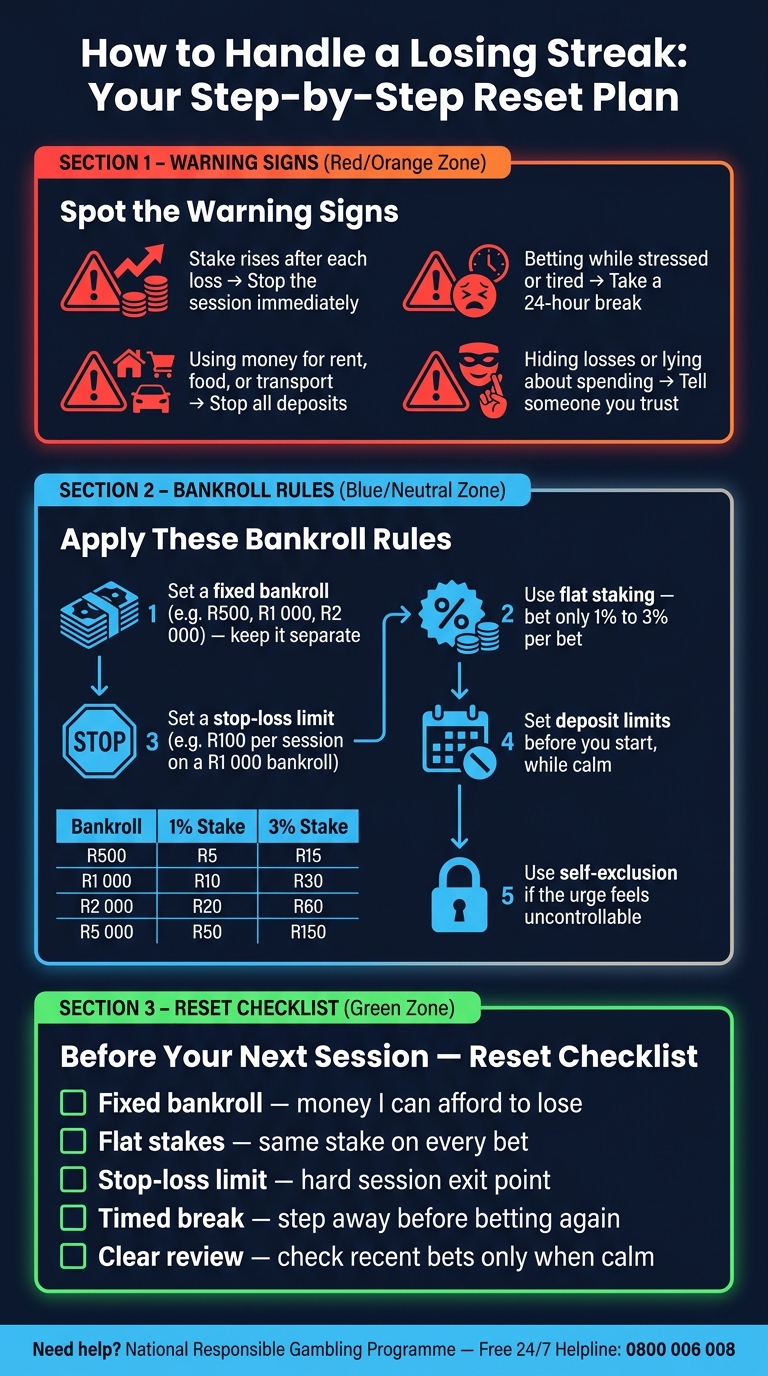
A losing streak is the point where I need to slow down, not stake more. If I keep bets small at 1% to 3% of my bankroll, set a hard stop-loss, and walk away when I hit it, I cut the chance of one bad session turning into a money problem.
Here’s the short version:
- I treat betting as entertainment only
- I never use money meant for rent, food, transport, or savings
- I keep one fixed bankroll, such as R500, R1 000, or R2 000
- I use flat stakes instead of increasing my bet after a loss
- I stop at a set loss limit, like R100 per session
- I take a break if I feel angry, tired, or under pressure
- I review my last bets before I place another one
- I get help if I start hiding losses or using money meant for day-to-day costs
A few losses in a row can happen by chance. But when I start chasing, betting late, or topping up after I said I’d stop, that’s usually the warning sign. The fix is simple: pause, check my behaviour, and protect what’s left of my bankroll.
| Risk sign | What I do |
|---|---|
| I increase stakes after losing | Stop the session at once |
| I bet while stressed or tired | Take at least a 24-hour break |
| I use money meant for daily costs | Stop betting and cut off deposits |
| I hide spending or lie about losses | Tell someone I trust and get support |
If I can’t stick to my own limits, I should step away for the day. And if the urge still feels strong, I can contact the National Responsible Gambling Programme on 0800 006 008 for free, 24/7 help in South Africa.
How to Handle a Losing Streak: A Step-by-Step Bankroll Reset Guide
Top 3 Strategies and Tips to Break and Handle Your Sports Betting Losing Streak
sbb-itb-00c3b18
The problem: signs that a losing streak is turning into bad betting behaviour
Losing control often starts small. A few losses come first. Then the stakes get bigger. Then the budget slips. That’s usually how a losing streak turns into risky betting behaviour.
Chasing losses with bigger stakes and more bets
One of the clearest signs is simple: your stake goes up after every loss. Another is jumping into live markets with no plan.
Live betting can feel like a quick way to win money back. But when urgency is driving the bet, not strategy, things can go south fast. When urgency shapes market choice, losses tend to pile up faster.
As stakes climb, emotions usually climb with them.
Betting while frustrated, tired, or under pressure
Frustration, tiredness, and pressure can wreck good judgement. People start ignoring limits and making poor bets.
That can look like:
- betting late at night after a rough day
- placing bets while irritated
- carrying on after you’ve already hit your limit
A more serious warning sign is using money meant for basics. If you’re using taxi fare, airtime, or grocery money, the session has moved past entertainment.
The same goes for deleting bank alerts to hide spending or lying to family about losses. Those signs can build quietly, which is what makes them risky.
Once these signs show up, bankroll rules need to take over.
Comparison table: warning signs, what they look like, and the likely damage
| Problem Behaviour | Visible Signs | Immediate Action |
|---|---|---|
| Chasing losses | Stake size rises after each loss | Stop the session immediately. |
| Emotional betting | Late-night sessions; betting on unfamiliar leagues; keeping betting after your limit | Take a 24-hour break. |
| Using essential funds | Depositing taxi fare, airtime, or grocery money | Stop using essential funds. |
| Hiding spend | Deleting alerts, lying about losses | Tell someone you trust. |
The fix is to slow the session down with firm bankroll limits.
The solution: bankroll rules that limit damage during a losing streak
Once a losing streak starts affecting your decisions, the goal changes. You stop trying to win it all back and start limiting the damage. That’s where bankroll control comes in first.
Set a fixed bankroll and bet in small units
Set a bankroll you can afford to lose without touching rent, groceries, savings, or emergency money. Keep that money in a separate account so you can’t top it up on impulse.
If you’re in a losing streak, use flat staking. That means keeping each bet at 1% to 3% of your bankroll.
| Total Bankroll | 1% Unit (Conservative) | 3% Unit (Upper limit) |
|---|---|---|
| R500 | R5 | R15 |
| R1 000 | R10 | R30 |
| R2 000 | R20 | R60 |
| R5 000 | R50 | R150 |
Small, steady stakes make it much harder for a bad run to burn through your bankroll in no time.
Use stop-loss limits and cut back after a bad run
Set a stop-loss before you begin, then stop the moment you hit it. For example, if your bankroll is R1 000 and your session limit is R100, you stop as soon as you’re down R100.
If the urge to win it back is still there, don’t place the next bet straight away. Pause first.
After a bad run, either lower your stake size or take a break. Both options give you space to reset instead of betting while annoyed.
Set deposit limits on Supabets before you start betting, while you’re calm.
If frustration is already driving your next bet, step away and reset first.
Comparison table: bankroll tools and how to use them on Supabets
| Bankroll Method | How to Apply on Supabets | Example Amount | Benefit During a Losing Streak |
|---|---|---|---|
| Deposit Limits | Set daily, weekly, or monthly caps in account settings | R200 per week | Prevents topping up in the heat of the moment |
| Fixed Unit Staking | Manually enter the same stake on every bet slip | R10 per bet on a R1 000 bankroll | Keeps the bankroll alive through a long run of losses |
| Stop-Loss Limit | Self-imposed session budget; stop when reached | R100 per session | Limits the damage of a single bad day |
| Fixed Bankroll | Use a separate e-wallet for all Supabets deposits | R500 monthly budget | Protects rent and grocery money from being used for bets |
| Self-Exclusion | Email support@supabets.co.za to disable your account | 1-week cool-off | Forces a cooling-off period when emotions are running high |
Regaining control: how to reset and return to safer play
Bankroll rules protect your money. Behaviour control helps stop one bad run from turning into another poor choice. The two work side by side to protect the limits you set in the previous section.
Pause the session and take a set break
When a losing streak starts nudging you towards impulse bets, the best move is simple: stop before you place another one. A pause is a reset, not giving up. Decide on the break before you come back – 30 minutes after a bad run, 24 hours after a rough session, or longer if the urge still feels strong.
One simple way to enforce this on mobile is to set a phone alarm before the session starts. When it goes off, you stop. No exceptions.
That timed break gives you room to do the next thing that matters: check whether your last bets stuck to your plan.
Check your last bets before placing another one
Before your next bet, open your bet history and look over your last few picks. Ask yourself:
- Did each stake match my planned unit size?
- Did I bet on markets I actually know?
- Was each bet planned, or was I reacting in the moment?
If your stakes were climbing or you were betting on unfamiliar markets, emotion was in the driver’s seat – not logic.
Comparison table: emotional triggers and the best response
Use these triggers and responses to reset faster.
| Trigger | Typical Reaction | Safer Replacement Action | Best Result |
|---|---|---|---|
| Losing several bets in a row | Chasing losses with bigger stakes | Close the app and take a 24-hour emotional reset | Prevents spiralling and protects your remaining bankroll |
| Feeling stressed or angry | Betting to escape | Engage in a non-gambling hobby or physical activity | Ensures betting only happens with a clear, rational mind |
| A "near-miss" result | Immediate re-betting on the same market | Step away for 30 minutes to reset | Breaks the psychological illusion of control |
| Hitting your session time limit | "Just one more" mentality | Log out immediately and review your session stats | Maintains discipline and prevents fatigue-based errors |
| Hitting your loss limit | Urge to deposit again right away | Log out and use a temporary block | Enforces your budget and prevents financial regret |
If the urge is still there after the break, extend it. Come back only when the next bet fits your plan.
Conclusion: use a losing streak as a reason to slow down, not to chase
Losing streaks happen. What matters is how you react. The safer move is to slow the session down, not try to win everything back in a rush.
Chasing losses with bigger stakes or extra bets usually makes a bad run worse. It can turn one rough session into a bigger money problem fast.
Betting on Supabets should stay entertainment-only. That means betting only with money left after rent, groceries, and savings. A fixed bankroll, a stop-loss limit, and a timed break are simple ways to stop a rough patch from spilling into money you need for daily life.
Use this quick reset before your next session:
- Fixed bankroll – money you can afford to lose
- Flat stakes – the same stake on each bet
- Stop-loss limit – a hard session exit point
- Timed break – step away before betting again
- Clear review – check recent bets only when calm
If the urge still feels strong, step away and stop for the day.
If you need support, the National Responsible Gambling Programme offers a free, 24/7 toll-free helpline at 0800 006 008.
FAQs
How do I choose the right bankroll?
Choose a bankroll that you can afford to lose. Keep it separate from your living costs and savings, so betting stays what it should be: entertainment.
One simple way to do that is to use a dedicated account or e-wallet for your betting budget. Put in only the amount you’ve set aside for the week, and set your deposit limits as soon as you register.
When should I stop betting for the day?
Stop at once if you hit your pre-set loss or time limit, or if you catch yourself chasing losses.
Step away too if you feel upset, stressed, or are under the influence of alcohol. If betting starts affecting work or family, feels like a source of income, or involves money you can’t afford to lose, take a break and contact support to disable your account.
How do I know if I’m chasing losses?
You may be chasing losses if you feel a strong urge to deposit more money or bump up your wagers to win back what you’ve lost. It can also look like not being able to walk away once you’ve hit your pre-set budget or loss limits.
Other warning signs include lying to loved ones, gambling to escape stress or negative feelings, or feeling restless and irritable when trying to stop.