Most bad bets start with a feeling, not a good reason. If I want to keep betting under control, I need to do four things every time: check my mood, stick to fixed bankroll rules, stop when I feel tilted, and run a short pre-bet test.
Here’s the article in one view:
- Spot triggers early, like frustration, boredom, fatigue, stress, or overconfidence.
- Use fixed stakes such as 2% to 5% of a set bankroll. On R1 000, that means R20 to R50 per bet.
- Set hard limits for losses, deposits, time, or number of bets.
- Take a 15 to 20-minute break if I feel the urge to chase losses or increase my stake.
- Ask four fast questions before every wager: Am I calm? Is this planned? Does it fit my budget? Would I still take it tomorrow?
- Track bets and emotions so I can see patterns instead of guessing.
What this comes down to is simple: don’t let the last result control the next bet. If I can’t explain a wager without talking about my last win or loss, I should skip it.
This article shows how I can build that routine in plain steps and keep betting as entertainment, not income.
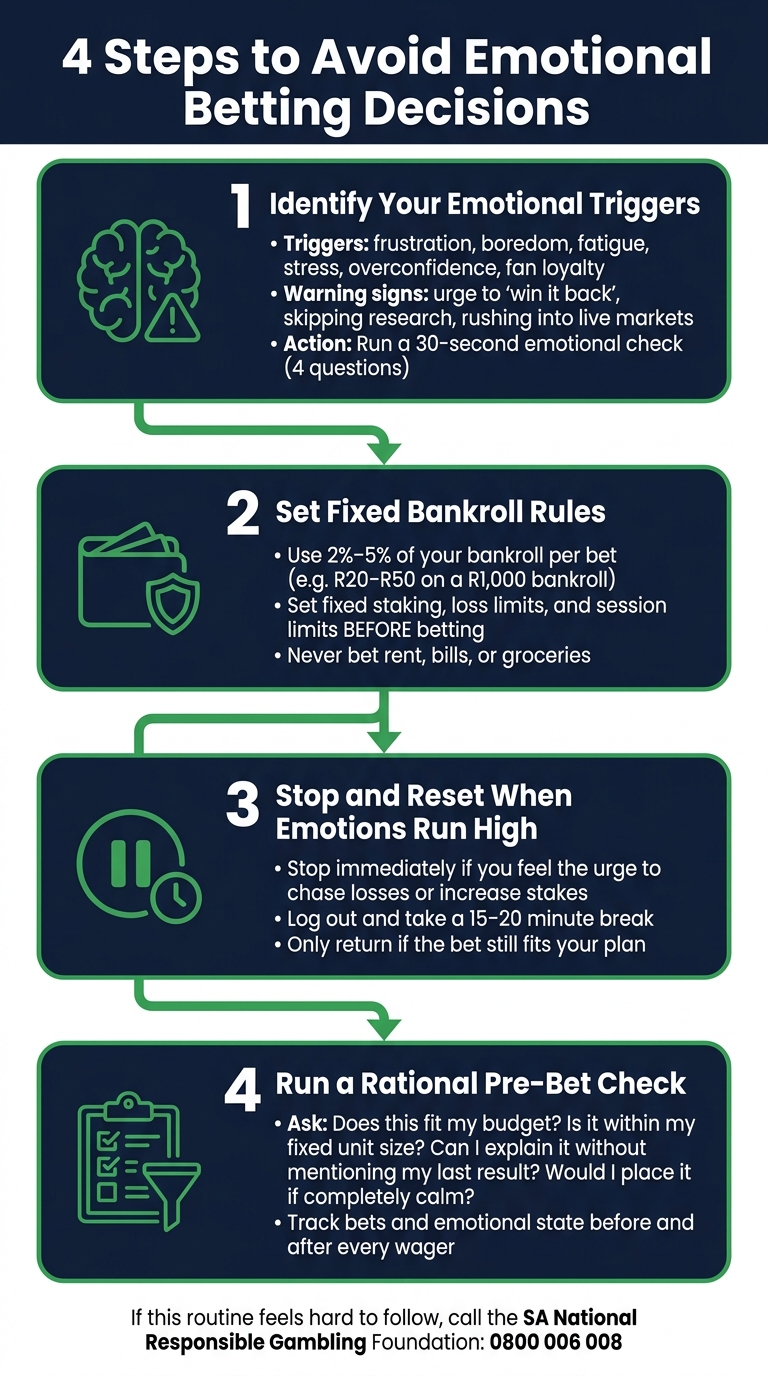
4-Step Routine to Avoid Emotional Betting Decisions
How to Control Your Emotions in Sports Betting: The Ultimate Guide to Controlling Emotions
sbb-itb-00c3b18
Step 1: Identify your emotional triggers before you bet
Spotting the trigger is what keeps emotion from running the next bet. Most impulsive bets start with a feeling, not a plan. Frustration, stress, fatigue, boredom, urgency, and overconfidence can all nudge you into bets you’d normally pass on.
Fan loyalty and boredom are two of the biggest traps. One clouds your judgement. The other pulls you into bets with no edge. And the first warning signs often show up before you place anything.
Warning signs that appear before chasing losses
The warning signs are usually plain to see: "I need to win this back", bigger stakes after a loss, or skipping your usual research. Upping your stake after losing, jumping into a live market without doing the homework, or feeling rushed instead of focused are all signs to take seriously. Betting when you’re tired, stressed, or distracted can also make clear thinking harder.
Once you notice those signs, stop for a moment and test the bet before doing anything else.
A 30-second emotional check before every bet
Use a quick check to break the urge before it turns into a bet. Run through these four questions before every wager, especially on mobile betting apps where live markets are just one tap away:
- Am I calm? If you feel irritated, anxious, or drained, stop.
- Is this a plan or a reaction? Does this bet fit your usual criteria, or are you reacting?
- Would I still place this bet tomorrow morning? If the answer is no, don’t bet.
- Am I chasing? If the goal is to win back a set rand amount from an earlier loss, the decision is impulsive.
If you can’t honestly say yes to being calm and sticking to a plan, step away for 15 to 20 minutes. If this check fails, the next safeguard is simple: fixed bankroll rules that don’t shift with your mood.
Step 2: Set bankroll rules that do not change with your mood
Set your bankroll rules before you start betting. Fixed limits cut out in-the-moment choices when emotions run high. That’s why the next layer is a fixed betting budget, set before the session begins.
Only bet with money you’ve set aside for discretionary spending. Not rent. Not bills. Not groceries or transport. As Shannon Manuel, writing for GQ South Africa, puts it:
"Treat betting funds like any other discretionary expense, completely separate from rent, bills, and groceries."
Use fixed staking, loss limits, and session limits
Three rules sit at the centre of a sound betting budget. Each one blocks a different kind of emotional decision.
| Rule | Purpose | Benefit | What to do when reached |
|---|---|---|---|
| Fixed Staking | Keeps the same unit size per bet | Protects your bankroll and helps you ride out variance | Maintain the same stake; do not increase your stake to recover losses |
| Loss Limits | Caps the total amount lost in a day or session | Prevents emotional chasing and bankroll damage | Stop betting immediately and log out |
| Session Limits | Caps the total time spent or number of bets placed | Prevents fatigue-based errors and overtrading | Step away from screens and do something else |
The simplest way to use these rules is to set one fixed rand unit and leave it there.
Pick a unit size in rand and stick to it
Choose a stake unit in rand that fits a small, fixed percentage of your dedicated bankroll. For example, with a R1 000 bankroll, a 2% to 5% stake comes to R20 to R50 per bet.
Keep that stake fixed after a win and after a loss. Set your deposit and loss limits before you begin betting. That way, the rules are already in place before emotion gets a say.
If you hit a limit, stop at once and reset before you bet again.
Step 3: Stop and reset when emotions are running high
Even fixed bankroll rules can fall apart when emotion jumps into the driver’s seat. In the heat of the moment, it can push you into bets you’d never place with a clear head. That’s why the best move is often the simplest one: stop before the next bet.
When to stop betting immediately
Stop at once if you notice the urge to:
- win back a loss
- increase your stake
- place a bet without following your usual process
That’s usually the point where emotion starts calling the shots.
A simple cooling-off routine
Log out and step away for 15 to 20 minutes. Give yourself a proper break. A change of scene helps too, even if it’s just a short walk around the block. The goal is to cut the impulse before it turns into action.
Only come back if the bet still fits your plan. If the feeling is still strong after the break, leave it until the next day.
When you return, place a bet ONLY if it still meets your preset criterial .
After the reset, run the bet through a quick rational filter before you place anything. That leads straight into the next step.
Step 4: Run a rational check before confirming each bet
After you reset, stop for a moment before you confirm the bet. Put one last filter in place.
Use a short decision filter before placing a bet
Before placing any bet, run through four simple questions:
- Does this fit my budget?
- Is this within my fixed unit size?
- Can I explain this bet without mentioning my last win or loss?
- Would I still place it if I were completely calm?
If any answer makes you hesitate, skip the bet.
If the bet passes, record it straight away.
Track bets and emotions to spot patterns over time
One bet doesn’t tell you much. A log does. Over time, it shows when emotion starts creeping into your choices.
Record these details before and after each bet:
| Before Bet | After Bet | Why It Matters |
|---|---|---|
| Reasoning: Data, form, or value identified | Result: Win, loss, or push | Shows whether your strategy is working or whether you are leaning too much on gut feel |
| Stake & Odds: The amount in rand and the price | Closing Odds: Were the odds better or worse at kick-off? | Helps you see whether you are finding value in the market |
| Emotional State: Calm, rushed, or frustrated | Reflection: Was the reasoning solid despite the outcome? | Shows when emotions such as chasing losses may be affecting your decisions |
| Budget Check: Does this fit your daily or monthly limit? | Bankroll Update: New total after the result | Keeps you within your money limits and helps you avoid overtrading |
Conclusion: Build a routine that keeps impulse bets in check
Emotional betting often doesn’t feel wrong at the time. That’s the trap.
The four steps in this guide work best when you use them together, not one by one. First, spot your triggers early. Then set fixed bankroll rules before you begin. If you feel tilted, step away. And before every bet, do a short rational check.
Put simply, this routine comes down to four controls:
- trigger awareness
- fixed stakes
- cooling-off breaks
- a pre-bet filter
Review your log every week or month. Judge the decision, not the result.
Treat betting as paid entertainment, not income.
If this routine still feels hard to follow, call the South African National Responsible Gambling Foundation helpline on 0800 006 008.
FAQs
How do I know if I am betting emotionally?
Emotional betting often shows up in your body, your thoughts, and your behaviour. You might notice a racing heartbeat, sweaty palms, shallow breathing, or a tight, tense feeling. In your head, it can look like obsessing over a recent loss or using betting to tune out stress, boredom, or other hard feelings.
There are other warning signs too. Chasing losses is a big one. So is bumping up your stakes on impulse, placing bets without checking the stats, or feeling snappy when you’re not gambling. A betting journal can make these patterns easier to spot.
What should I do if I keep chasing losses?
If you keep chasing losses, stop at once. Chasing is an emotional reaction, not a plan, and trying to win money back fast can lead to even bigger impulsive losses.
Step away from your device for 15 to 20 minutes to settle down. Use Supabets account tools like daily or weekly loss limits and deposit caps. If you’re still struggling, contact support@supabets.co.za for a cooling-off period or temporary self-exclusion.
How do I choose a safe stake size?
Start with a dedicated betting bankroll. A good rule of thumb is 2% to 5% of your monthly disposable income, kept separate from your day-to-day expenses.
Then, for each bet, stake only 1% to 3% of your total bankroll.
That simple setup does two jobs at once. It helps protect your money when you hit a losing streak, and it makes it less likely that you’ll bet on emotion after a bad run.
As your bankroll goes up or down, adjust your unit size to keep your risk level the same.