If I had to boil bankroll allocation down to one rule, it’s this: split your gambling money before you play, not while you’re losing.
I keep my bankroll separate from day-to-day money, cap it at 10% of disposable income, then break it into monthly, weekly, and session limits. From there, I use small fixed stakes for sports, session caps for casino play, and hard stop-loss and stop-win rules so one bad run doesn’t wipe out the lot.
Here’s the whole idea in plain terms:
- Set one fixed bankroll from money I can afford to lose
- Keep it separate from rent, food, transport, and savings
- Split it by time: month, week, and session
- Split it by activity: sports betting and casino play should not share one pool
- Stake small: about 1% to 2% per sports bet
- Use session budgets for casino games, not one open-ended balance
- Lower stakes on high-variance games like slots, crash games, and virtual sports
- Stop at preset limits:
- daily sports stop-loss: 5 units
- weekly stop-loss: 15 to 20 units
- casino session stop-loss: 50% of session bankroll
- stop-win target: 50% to 100% profit
- time cap: 60 to 90 minutes
- Track results in rand and cut stake size after drawdowns like 10%, 20%, and 30%
A simple example: if my monthly bankroll is R1 000,00, I can split it into about R250,00 per week, then R50,00 to R100,00 per session. If my sports bankroll is R5 000,00, a 1% unit is R50,00. And if I take a R500,00 casino session, blackjack stakes might sit around R5,00 per hand, while high-volatility slots should stay closer to R1,50 to R2,50 per spin.
| Area | Simple rule |
|---|---|
| Total bankroll | Max 10% of disposable income |
| Sports bets | 1% to 2% per bet |
| Hard sports cap | No more than 5% on one bet |
| Casino sessions | Split monthly budget into fixed sessions |
| High-risk games | Use smaller stake fractions |
| Stop-loss | End the session or day when the limit hits |
| Record-keeping | Track in rand and review often |
Put simply, I treat bankroll allocation as a spending plan, not a guess. That keeps betting money in its lane and makes it easier to stay in control.
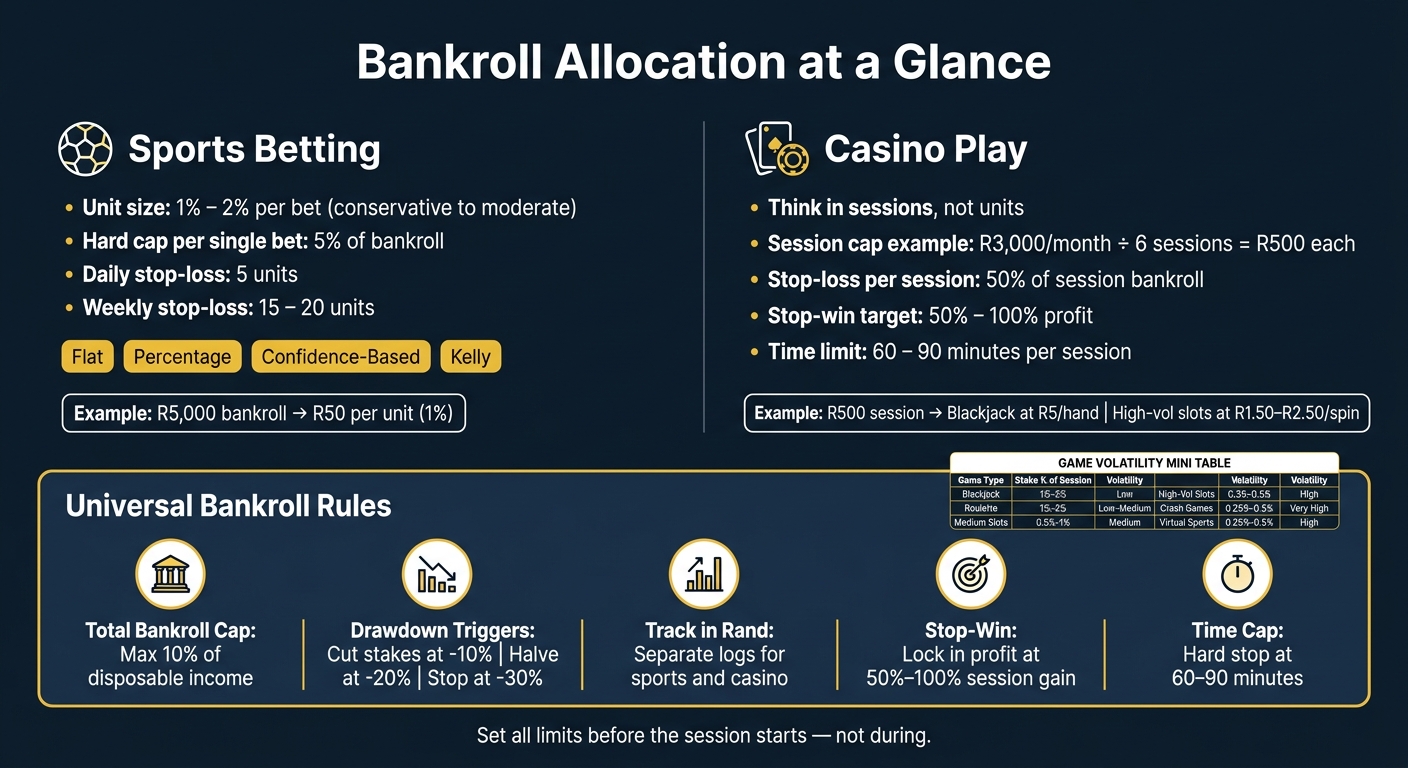
Bankroll Allocation Rules: Sports Betting vs Casino Play
5 Tips To Become A Profitable Sports Bettor | Bankroll Management 101
sbb-itb-00c3b18
Sports betting bankroll allocation on Supabets
Think of your sports bankroll as fixed betting capital. Once you’ve ring-fenced that money, the next step is simple: decide your unit size. A clear staking plan keeps your bet sizes steady across different markets and stops you from making it up as you go.
Set a unit size before placing any bets
A unit is a fixed percentage of your total bankroll that you use as your base stake. A good starting point is 1% per bet. So, if your sports bankroll is R5 000,00, your unit is R50,00. At 2%, that becomes R100,00. For most single bets, keep stakes between 1% and 2% of bankroll, and set a hard cap at 5%.
Why does this matter? Because fixed unit sizing builds discipline. It helps cut out the urge to chase losses after a rough patch or bump up stakes just because you’re feeling sure of yourself. It also makes it much easier to judge your results over 50 to 100 bets.
| Total Bankroll | 1% Unit (Conservative) | 2,5% Unit (Moderate) | 5% Unit (Aggressive) |
|---|---|---|---|
| R1 000,00 | R10,00 | R25,00 | R50,00 |
| R5 000,00 | R50,00 | R125,00 | R250,00 |
| R10 000,00 | R100,00 | R250,00 | R500,00 |
From there, the goal is to pick a staking method that fits your risk tolerance.
Compare flat, percentage, confidence-based, and Kelly-style staking
Not every staking method fits every bettor. Some are simple and steady. Others ask for more skill and a lot more self-control.
| Method | Stake Variability | Complexity | Volatility | Advantages | Disadvantages | Best For |
|---|---|---|---|---|---|---|
| Flat staking | Fixed | Low | Low | Simple; easy to track; prevents rapid losses | Doesn’t capitalise on high-value opportunities | Beginners |
| Percentage staking | Adjusts with bankroll | Moderate | Moderate | Protects bankroll during downswings; grows with wins | Requires constant recalculation | Intermediate |
| Confidence-based | 1–3 units based on edge | Moderate | Moderate | Rewards stronger research and perceived value | Subjective; prone to emotional bias | Experienced |
| Kelly staking | Mathematical, value-based | High | High | Mathematically optimises long-term growth | High risk if edge is miscalculated | Professionals |
Flat staking is the easiest method to follow. You stake the same amount each time, which keeps things neat and helps you avoid big swings.
Percentage staking shifts with your bankroll. If your bankroll drops, your stake drops too. If it grows, your stake grows with it. That gives you a built-in buffer during a losing run.
Confidence-based staking lets you go a bit bigger when your edge looks stronger. The catch? You need to be brutally honest with yourself. If emotion creeps in, this method can get messy.
Kelly staking is more mathematical and works best when you can estimate probability with care. It can be strong over the long haul, but only if your edge is accurate. That’s why fractional Kelly is often the safer option; it cuts down the swings.
Match your staking style to bet type and risk level
Your staking style should fit both your experience and the kind of bet you’re placing. For simple pre-match bets, flat staking at 1% keeps things tidy and repeatable.
If you’ve got more experience and you’ve found a real edge in a market, confidence-based sizing gives you a controlled way to stake a bit more. For example, you might move from 1 unit to 2 units or 3 units without throwing discipline out the window.
If you’re a value bettor and can estimate probabilities well, fractional Kelly is better suited to long-term bankroll growth while lowering risk.
Sports bets are sized per wager; casino play needs a session-based approach.
Casino and gaming bankroll allocation by session
Sports betting often works best with units. Casino play is different. Here, it makes more sense to think in sessions.
Use a separate casino session bankroll for slots, live tables, crash games and virtual sports. On Supabets, each of these game types burns through money in its own way, so they need different staking plans. Keeping those funds apart cuts confusion and helps stop a rough patch in one game from eating into the rest of your play.
Break a monthly casino bankroll into smaller sessions
The easiest way to control casino spending is to split your monthly budget into fixed session caps. If you’ve set aside R3 000,00 for casino play this month, divide it into six sessions of R500,00 each.
Once that session bankroll is gone, stop. That’s the line. This hard cap helps prevent loss-chasing and stops you from dipping into your sports bankroll or the funds meant for your next session.
At R2,00 per spin, a R500,00 session gives you 250 spins. That’s enough room for normal variance without burning through your budget too fast.
Adjust stake size based on game volatility
Not every casino game moves through a session bankroll at the same speed. Low-volatility games like blackjack and even-money roulette bets tend to pay more often, but in smaller amounts. That means they can handle a slightly bigger stake fraction per round.
High-volatility games, like crash games or progressive slots, are a different story. They usually pay less often, but when they do, the wins can come in bigger bursts. The catch? You need more breathing room in your session bankroll to get through the losing stretches between those hits.
Higher volatility means smaller stakes. And if you switch game types, reset your stake size. Don’t carry over the same amount and hope it works out.
Stake fraction guide by game type
Use these ranges as your default stake fractions.
| Game Type | Recommended Stake (% of Session Bankroll) | Typical Volatility | Risk of Rapid Depletion |
|---|---|---|---|
| Blackjack | 1% – 2% | Low | Low |
| Roulette | 1% – 2% | Low to Medium | Moderate |
| Medium-Volatility Slots | 0,5% – 1% | Medium | Moderate |
| High-Volatility Slots | 0,3% – 0,5% | High | High |
| Crash Games (e.g., Aviator) | 0,25% – 0,5% | High | Very High |
| Virtual Sports | 0,25% – 0,5% | High | High |
On a R500,00 session, a 1% stake on blackjack puts you at R5,00 per hand. That’s a steady level for a lower-volatility game. That same R500,00 session on a high-volatility slot should mean staking no more than R1,50 to R2,50 per spin.
Crash games and virtual sports sit at the highest-risk end of the table, so keep those stakes near the lower end of the range.
Next, apply stop-loss and stop-win rules to each session.
Practical rules to protect your bankroll
Once your stake sizes are set, add hard limits that tell you when to stop. That’s the next layer of control. It stops one rough patch from wrecking the system you’ve already put in place.
Set maximum stake limits and stop-loss thresholds
For sports betting, cap single bets at 1% to 3% of your bankroll. For high-variance casino games, keep stakes small compared with your session budget.
A stop-loss rule sets the point where the session ends. If you’ve lost 50% of your session bankroll, stop. Don’t chase losses.
For sports betting, use a daily stop-loss of 5 units. If you hit it, close the app and walk away. A weekly stop-loss of 15 to 20 units gives you a second guardrail. If the week goes south early, taking a break gives you space to reassess without chewing through the whole month’s budget.
Use stop-win targets and session time limits
The same discipline should apply when things are going well. Set a profit target before you begin, such as 50% to 100% of your session bankroll. If your R500,00 casino session grows to R750,00 or R1 000,00, cash out and end the session. Simple. You’ve locked in profit instead of giving it back.
Time limits matter too. Set a hard cap of 60 to 90 minutes per session. When the timer goes off, stop. Fatigue has a sneaky way of leading to poor calls.
Quick-reference rules table
Use this as your default setup. Adjust the rand figures to suit your bankroll, but keep the percentages the same.
| Rule | Typical Range | Purpose | How It Protects You |
|---|---|---|---|
| Max Stake – Sports | 1% – 3% of total bankroll | Consistency | Prevents one loss from significantly damaging your bankroll |
| Max Stake – Casino | 2% – 5% of session budget | Longevity | Gives you enough hands or spins to ride out normal variance |
| High-risk stake cap | 0,25 – 0,5 units for high-risk bets | Risk control | Reduces the impact of high-variance markets |
| Daily Stop-Loss | 5 units | Emotional control | Forces a break during losing streaks to prevent tilt betting |
| Stop-Win Target | 50% – 100% profit on session budget | Profit protection | Locks in gains before variance turns |
| Session Time Limit | 60 – 90 minutes | Focus | Reduces impulsive decisions caused by fatigue |
| Weekly Stop-Loss | 15 – 20 units | Pause | Pauses activity if a week starts with heavy losses |
These rules work best when you set them before the session starts, not in the middle of one. During a losing run, it’s easy to shift the goalposts and tell yourself one more bet will fix it. Preset limits cut that urge off at the knees.
Track these limits against your results so you can adjust them using actual data.
Track results and refine your allocation plan
Track results in rand so you can see if your rules are doing the job. That feedback loop matters. It tells you whether your unit sizes and session caps are holding up across both sports and casino play.
Review your betting and gaming records regularly
Keep separate logs for sports bets and casino sessions. For sports betting, record the date, sport and league, market, odds, stake in units, and the result in rand. For casino sessions, log the game type, volatility level, session budget, stakes in rand, and session length.
Those records can show patterns fast. You may spot that your stakes are too big, or that you keep leaning on the wrong bet types. Once the numbers speak, use them to change your unit size and session caps.
Review your sports records after every 100 to 200 bets. For casino play, review sessions often enough to catch stake creep and sessions that start stretching longer than planned.
Use drawdown triggers:
- Cut unit size after a 10% bankroll drop
- Halve stakes after 20%
- Stop completely after 30%
Those limits mean nothing if you decide on them in the heat of the moment. Set them before a session starts, then stick to them.
Keep bankroll allocation simple, separate, and consistent
Use discretionary money and split it by activity. Stake sports bets in units. Size casino play by session and volatility. Then review your records on a regular basis.
The hard part isn’t writing the plan down. It’s sticking to it when a session is going badly, or when things are going so well that you feel untouchable. That’s where your records help. Adjust from the numbers, not impulse. Head to Supabets Sports to put it into practice.
FAQs
How do I calculate disposable income for my bankroll?
Start with your take-home pay. Then subtract your fixed monthly costs, like rent or bond repayments, utilities, transport, groceries, medical aid, insurance, and debt repayments.
What’s left is your surplus. From that amount, put aside only a small share for betting, usually 5% to 10% of your total monthly surplus. Treat it as an entertainment budget, not money for bills or day-to-day living.
Keep that fund separate from your main spending money. That small step makes it much easier to avoid dipping into cash meant for the basics.
When should I reduce my unit size after a losing run?
Reduce your unit size when your bankroll drops by a big margin, usually 20% to 30%.
A percentage-based staking plan of 1% to 2% of your remaining bankroll does this on its own. As your bankroll shrinks, your unit size shrinks too.
If your bankroll hits a set drawdown limit, such as 25% or more below its peak, recalculate your unit size straight away.
Should I use one bankroll for both sports and casino play?
It’s usually best to keep your sports betting funds and casino gaming funds separate.
That simple split helps prevent cashflow blur. And when your money isn’t all mixed together, it’s much easier to track performance and manage risk for each activity on its own.
Separate balances also make discipline easier. You can apply the right unit-sizing approach, like the 1–3% rule, avoid emotional calls, and protect your entertainment budget without the two activities bleeding into each other.