Set your cap before you play: if your monthly disposable income is R5 000, keep gambling to about R250 to R500 a month, then split that into weekly, session, deposit, loss, and stake limits.
I’d keep it simple: only use money left after rent, food, transport, debt, and school costs. Then I’d set a monthly deposit cap, a hard loss limit, a session time limit, and a small stake cap before logging in. That matters even more when 31% of surveyed participants were flagged for problem gambling in 2024/25, and 83,7% of problem gamblers took on extra debt.
Here’s the short version:
- Use disposable income only
- Keep gambling spend to 5% to 10% of that amount
- Break one monthly cap into weekly and session caps
- Set deposit and loss limits on Supabets
- Keep stakes low enough to stretch your bankroll
- Track every rand
- Stop at once if you chase losses or dip into bill money
A simple example:
- Disposable income: R5 000
- Monthly gambling cap: R500
- Weekly cap: about R125
- If I play 3 times a week: about R41 per session
One small table makes the setup easier:
| Cap type | What I’d use it for |
|---|---|
| Deposit limit | Stops me from adding more than my set amount |
| Loss limit | Stops the session when my net loss hits my line |
| Session/time limit | Cuts down long play sessions |
| Stake cap | Keeps each spin or round small |
The point is simple: I’d decide the amount in rand first, lock it in on the account, and follow my own stop rules every time I play.
Work out a safe casino budget in South African rand
Separate essential expenses from entertainment money
Start with your monthly take-home pay. Then subtract your fixed costs: housing, bills, transport, groceries, debt, savings, and family support. What’s left is your disposable income. That’s the only money that should go toward casino play.
Here’s the plain test: if losing your full gambling budget would put you under pressure, the budget is too high.
A solid rule of thumb is to keep casino play to no more than 5–10% of your disposable income. Use that figure to set your monthly cap, and treat it as a hard ceiling, not something you’re supposed to hit every month.
Once you’ve got your monthly cap, break it into weekly and per-session limits.
Break one monthly amount into weekly and session caps
A monthly number can feel harmless at first, then disappear before you know it. Splitting it into smaller caps makes it much easier to stay in control. At 10%, the maths looks like this:
| Monthly Casino Budget | Weekly Limit (÷4) | Session Limit (3 sessions a week) |
|---|---|---|
| R300 | R75 | R25 |
| R500 | R125 | R41 |
| R1 000 | R250 | R83 |
| R1 500 | R375 | R125 |
Take the R500 example. Your weekly cap is R125. If you play three times in a week, each session works out to about R41. That gives you a clear number to work with, and it helps you pick stake sizes that fit your budget instead of stretching it.
Two extra rules can help keep spending in check:
- Stop the session the moment you lose 50% of your session bankroll
- Don’t pull next week’s cap into the current session to chase losses.
Next, turn those numbers into deposit, loss, and stake limits.
sbb-itb-00c3b18
Live Slot Play on $300 Budget 🎰 Learn How to Control Your Spending!
Turn your budget into deposit, loss, and stake limits
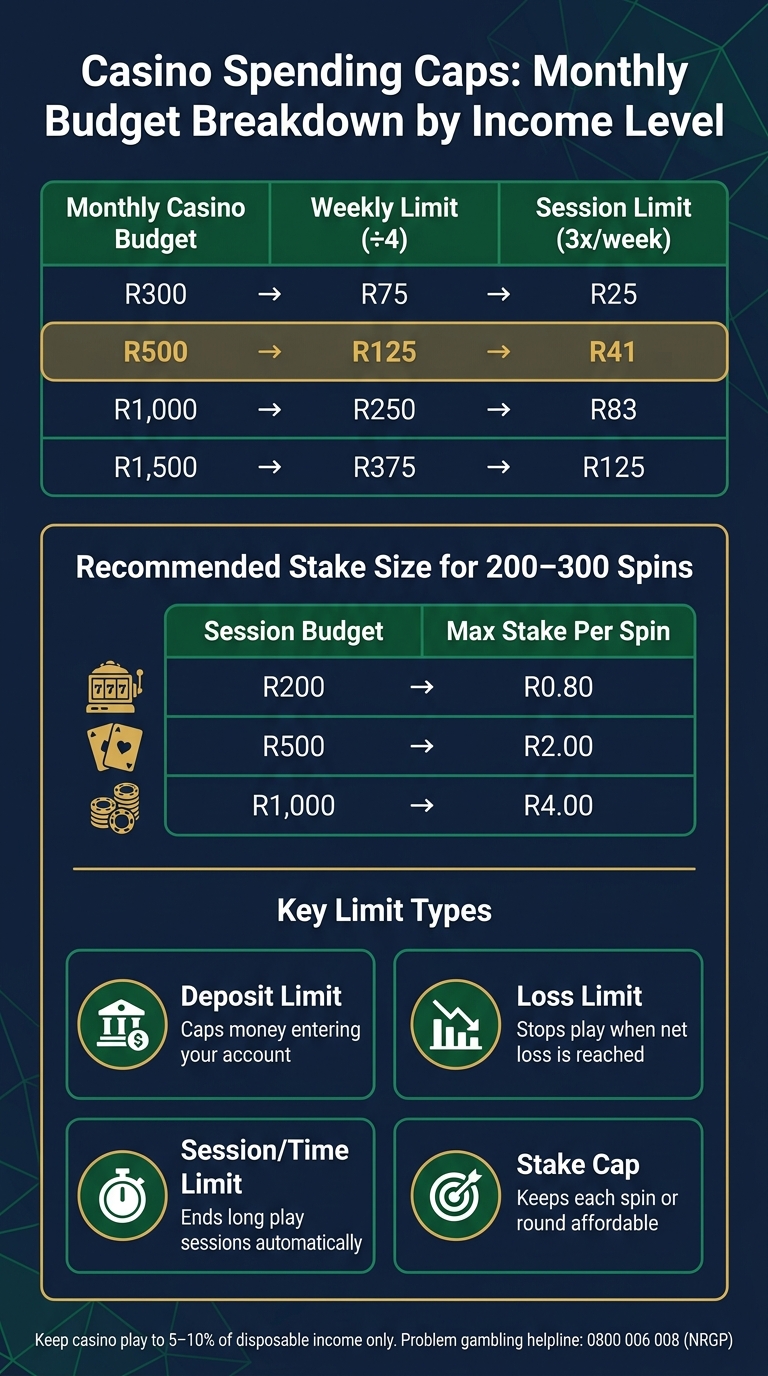
Casino Spending Caps: Monthly Budget Breakdown by Income Level
Set a deposit cap that matches your monthly budget
Set a monthly deposit limit in your casino’s responsible gaming settings that lines up with your budget. Use the monthly rand amount you’ve already decided on. If your budget is R500 a month, set your deposit limit to R500.
Deposit limits control the money going into your account. Loss limits track your net losses. Use both at the same time for the best cover. The smart move is to set this before your first deposit, while your head is still clear.
Once that cap is in place, set a loss limit below it. Then keep your stake size low enough to make your session budget last.
Set a hard loss limit and a small stake size
A hard loss limit is the top rand amount you’re willing to lose in one session. When you hit that number, stop at once – no exceptions.
Stake size decides how fast your session budget runs out. Pick a stake small enough for your session budget to last 200 to 300 spins or hands. Your stake cap should stay well below your session loss limit.
| Session Budget | Stake for 200–300 spins |
|---|---|
| R200 | R0,80 |
| R500 | R2,00 |
| R1 000 | R4,00 |
Use smaller stakes on high-variance slots, especially progressive slots. Wins come less often, so you need a bigger buffer of spins to ride out the dry spells.
Apply your caps on Supabets and support them with personal rules
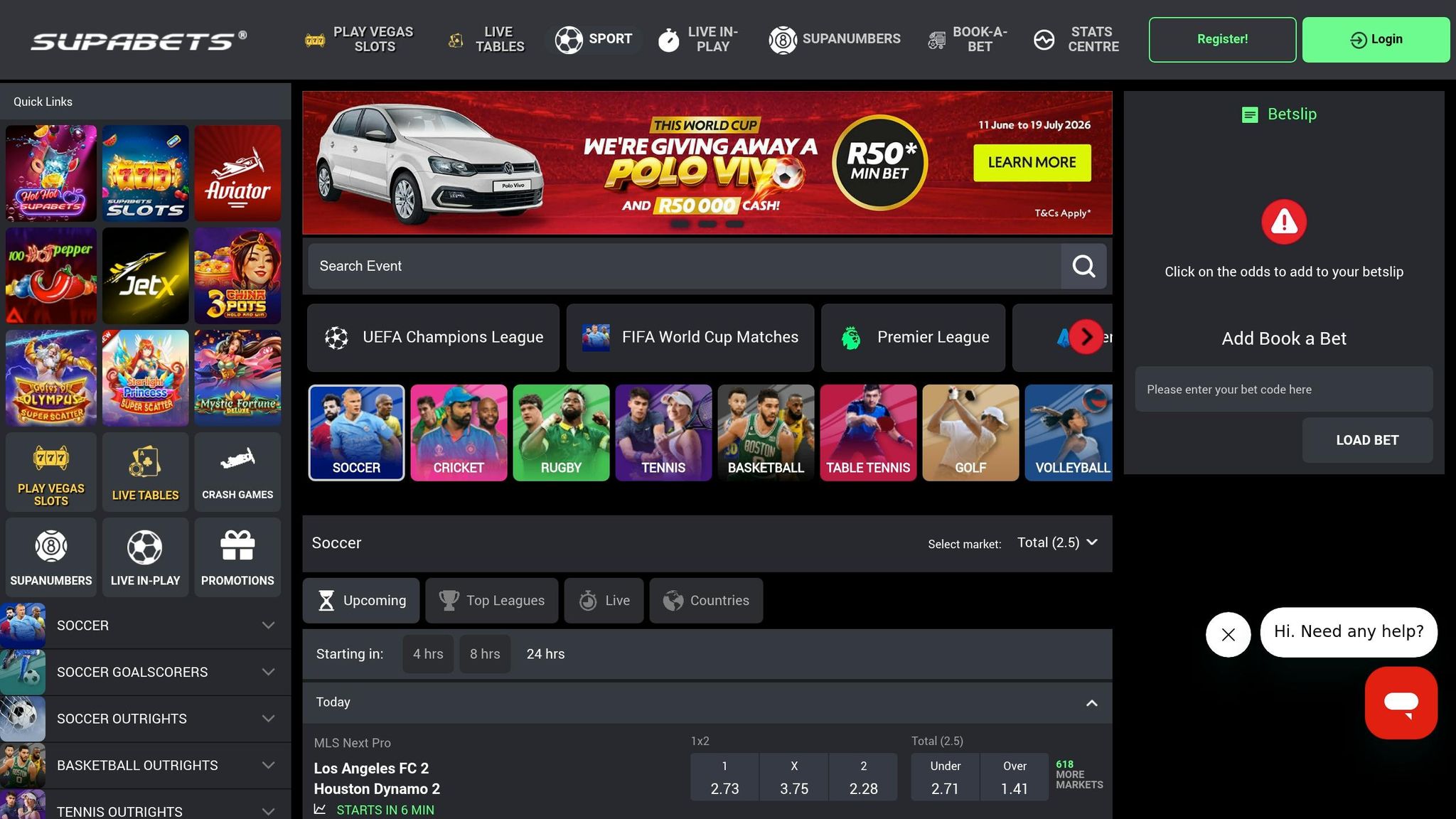
Use Supabets account settings to set your limits
Take the monthly, weekly, and session caps you worked out earlier and add them to your account. Log in to your Supabets account, open Account/Profile, then go to Responsible Gambling or Account Limits. Enter the exact rand amount you calculated and save the limit.
After that, log out and sign back in to make sure the changes are live. A lower limit often kicks in sooner, while a higher one may come with a waiting period. It’s best to set these before you start playing.
If you want a short pause, use Time-Out. If you need a longer break, use Self-Exclusion.
Add personal rules so you do not bypass your limits
Account limits help, but your own rules matter just as much. A simple move can make a big difference: put your gambling budget in a separate bank account or e-wallet before you play.
It also helps to draw a hard line around when you should NOT bet. That means:
- Don’t play when you’re stressed, upset, or drinking.
- When you hit your session loss limit, stop at once.
- Don’t use credit, loans, or borrowed money to keep playing.
These habits help keep your caps in place when the platform can’t do it for you.
Track your spending and review your caps regularly
Setting caps is only half the job. The other half is checking if they’re doing what they’re supposed to do.
Keep a simple rand-by-rand record of your play
Once your caps are in place, track your spending as you go. After each session, write down the date, game, deposits, stakes, wins, losses, and how long you played. Keep it simple. A basic note on your phone or a small spreadsheet can do the job.
You can also check your Transaction History in your Supabets account settings for a full transaction history of deposits and bets.
Then review your record every week against your monthly, weekly, and session caps. If you keep hitting the limit, that’s a sign the cap may still be too high, so lower it.
Know when to lower your limits or stop playing
Your notes should show whether your limits still fit the way you play. Pay close attention to warning signs like chasing losses, hiding what you’ve spent, or using credit or borrowed money. If gambling no longer feels under control, pause straight away.
Chasing losses is a clear sign to stop immediately. If you’re skipping bills or neglecting basics like rent or groceries, lower your caps at once. A safe budget is one you can afford to lose without missing essentials.
If your record shows repeated overspending, lower your caps before your next session. And if control feels like it’s slipping, use self-exclusion or call the NRGP toll-free on 0800 006 008 for confidential support.
FAQs
How do I calculate my disposable income?
Calculate your disposable income like this: take-home pay minus fixed expenses, savings, and your emergency fund contribution.
Fixed expenses include rent or bond repayments, utilities, transport, food, medical aid, insurance, and debt repayments. What’s left after all of that is your true disposable income.
A simple rule from experts: use no more than 5% to 10% of that amount for entertainment, including gambling.
What if I keep hitting my spending cap?
If you keep hitting your spending cap, stop and take stock. Walk away straight away. Chasing losses often leads to even more financial pressure.
Take a short break and look at whether your limit still fits your disposable income. If it feels too high, lower it in your Supabets account settings or contact support at support@supabets.co.za to ask for a temporary account suspension. You can also call the National Responsible Gambling Programme on 0800 006 008.
How do I set limits on my Supabets account?
Log in to your Supabets account, then head to My Account or My Profile to set spending controls such as:
- deposit limits
- weekly staking limits
- session time limits
If you need a hand, contact support through Live Chat, email support@supabets.co.za, or call 011 215 7000. Support can also help you place a temporary suspension on your account or set up self-exclusion.