Esports betting is hard to police because it mixes young audiences, offshore sites, fast in-play betting, virtual items, and old gambling laws. In South Africa, the biggest pressure points are under-18 access, match-fixing, skin betting, money laundering, cross-border enforcement, player harm, publisher control of data, and rules that lag behind the market.
If I had to sum it up in one line, it would be this: South Africa has KYC, AML, and self-exclusion rules for licensed operators, but it still has weak tools against offshore platforms and limited live oversight.
Here’s the article in plain terms:
- Young users are at risk: research cited in the article says 6,2% of adolescents aged 12–17 took part in skin betting in the past year.
- Integrity is a problem: if matches are fixed, bettors lose money and confidence drops.
- Skins and crypto add risk: virtual items can act like betting currency outside licensed systems.
- AML pressure is high: illegal offshore operators are said to pull about R50 billion in gross gambling revenue each year.
- Rules are split: national and provincial systems do not always line up.
- Player safeguards are uneven: licensed sites must follow rules, but offshore sites often do not.
- Publishers hold key data: without match and account data, live monitoring is weaker.
- The law is old: the main gambling framework was not built for esports betting.
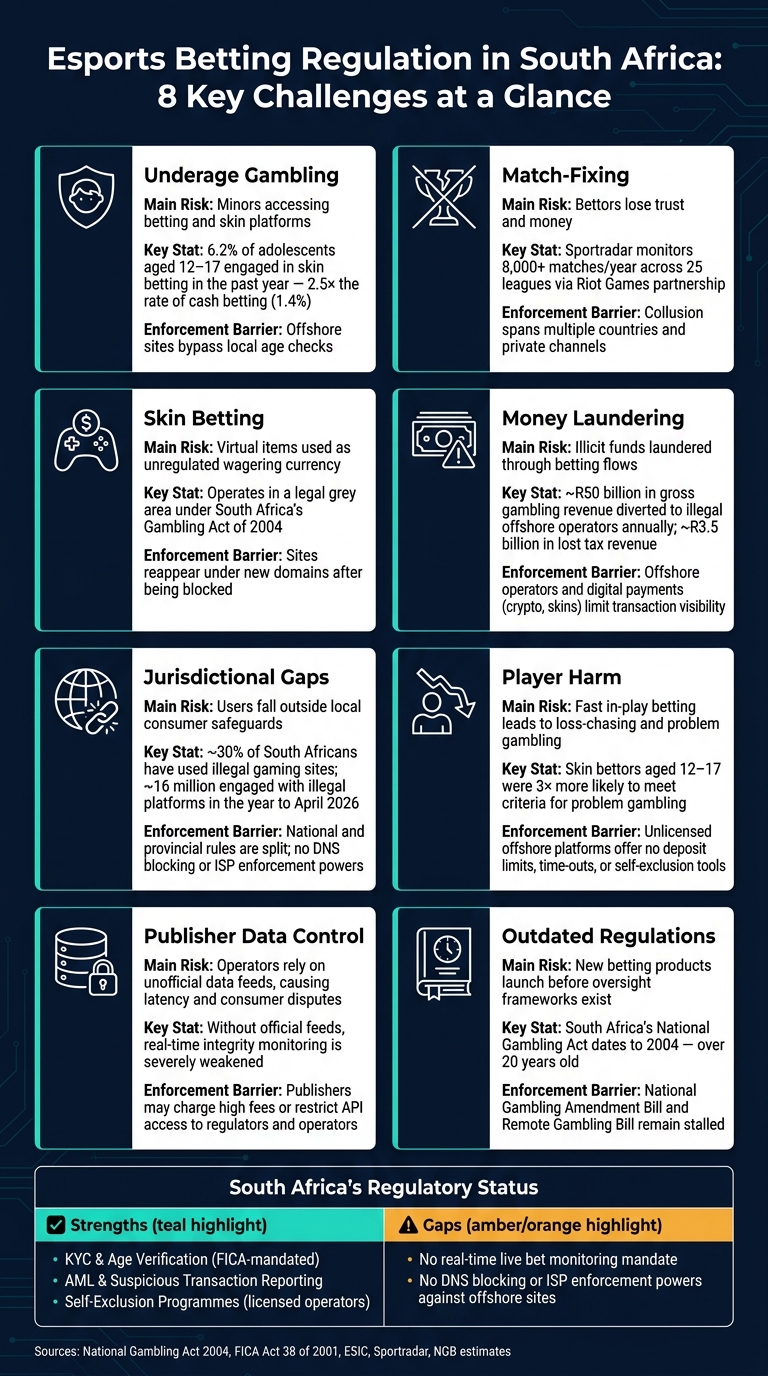
Esports Betting Regulation in South Africa: 8 Key Challenges at a Glance
Betting integrity in sports and esports
sbb-itb-00c3b18
Quick comparison
| Challenge | Main risk | Why it is hard to police in South Africa |
|---|---|---|
| Underage gambling | Minors get access to betting and skins | Offshore sites sit outside local checks |
| Match-fixing | Bettors lose trust and money | Activity can span many countries and private channels |
| Skin betting | Virtual items move like wagers | Legal grey areas and new domains make action hard |
| Money laundering | Dirty money can move through betting flows | Offshore operators and digital payments limit visibility |
| Jurisdiction gaps | Users fall outside local safeguards | National and provincial rules are split |
| Player harm | Fast betting can lead to loss-chasing | Unlicensed sites may not offer limits or self-exclusion |
| Publisher data control | Weak match data can lead to disputes | Operators may not get direct access to official feeds |
| Outdated rules | New betting products move ahead of the law | Reform has been slow |
For me, the core point is simple: better esports betting control in South Africa depends on tighter age checks, stronger FICA enforcement, live bet monitoring, data-sharing with publishers, and stronger action against offshore sites.
1. Underage Gambling and Youth Appeal
Esports draws a younger crowd than most sports, so gambling exposure can start much earlier. That alone puts minors at more risk.
Risk to Consumers and Minors
The biggest danger is how fast gaming can slide into gambling. Virtual in-game items, often called skins, are used like currency on third-party betting sites. And many of those sites do little, if anything, to check a user’s age.
The data is hard to ignore. Research found that 6,2% of adolescents aged 12–17 had engaged in esports skin betting in the past year – a rate 2,5 times higher than esports cash betting (1,4%). Skin bettors in that age group were also more than three times as likely to meet the criteria for at-risk or problem gambling.
That problem gets worse when betting happens on offshore platforms.
Difficulty of Enforcement Across Borders
Licensed operators can be pushed to meet strict rules. Offshore sites are another story. They sit beyond local enforcement, yet minors in South Africa can still reach them online. Without tools such as DNS blocking or ISP enforcement powers, it is hard to stop access to these sites.
Publishers and Operators Must Cooperate
Publishers control in-game accounts and digital items, so they can’t stand on the side-lines. They need to work with operators to share age-verification data, check accounts against verified customer records, and flag suspicious activity.
Advertising needs the same kind of joined-up oversight. Gambling ads and sponsorships should be kept away from peak youth viewing times, as the ARB has flagged locally.
Relevance to South African Licensing and FICA Compliance
In South Africa, each licensed gambling entity is an accountable institution under the Financial Intelligence Centre Act (FICA). That means strict identity and age checks must happen before a customer can place a bet. The legal gambling age is 18, so FICA compliance is one of the main safeguards against underage gambling on regulated platforms.
Weak age checks also leave space for fraud and match manipulation.
2. Match-Fixing, Fraud, and Competitive Integrity
Risk to Bettors and Market Integrity
When access controls fall apart, integrity problems don’t take long to show up. Match-fixing cuts into the one thing esports betting runs on: trust. If results are manipulated, bettors lose money, and confidence in the market starts to crack.
The ESIC says it clearly:
"Public confidence in the authenticity and integrity of any Match is vital. If that confidence is undermined, then esports and all of its stakeholders will suffer both reputationally and commercially."
These schemes often grow in unregulated channels, where anonymity makes collusion much harder to spot and track.
Difficulty of Enforcement Across Borders
Match-fixing in esports is usually hidden from view. It can happen through private messages, anonymous accounts, and people spread across several jurisdictions. That leaves obvious enforcement gaps.
South Africa’s National Gambling Act was passed in 2004, more than 20 years before the modern esports betting boom. That time gap makes cross-border corruption tougher to detect and punish. As Tebogo Sibidla, Director at Werksmans Attorneys, warns:
"Without reform, South Africa risks falling further behind on the regulation of digital gambling and continued offshore betting activity."
Need for Operator and Publisher Cooperation
Spotting suspicious betting activity takes data, and publishers hold a big share of it. Riot Games partnered with Sportradar to monitor betting integrity. As of 2026, that partnership covered over 8 000 matches per year across 25 sanctioned esports leagues and international competitions. Sportradar’s Universal Fraud Detection System (UFDS) also draws on data from more than 600 betting operators around the world.
The ESIC also requires participants to report any approaches or invitations to take part in corrupt conduct without unnecessary delay. It further requires disclosure of gifts or benefits valued at US$500,00 or more. Those rules mean little if publishers, operators, and integrity bodies aren’t sharing information in a steady way.
That same anonymity also feeds skin betting, which the next section covers.
Relevance to South African Licensing and FICA Compliance
South Africa still lacks real-time monitoring powers and workable tools to act against offshore operators. Current legislation does not yet include digital-first enforcement mechanisms, such as real-time monitoring mandates and ISP enforcement powers, that are needed to deal with esports-specific risks.
Modernising the framework to support controlled online licensing, along with stronger enforcement against offshore operators, would help close the biggest gaps.
The same unregulated item economy also feeds the next challenge.
3. Skin Betting, Virtual Items, and Unregulated Markets
Risk to Consumers and Minors
Skin betting runs on the same kind of anonymity that helps match-fixing. The difference is that, here, players use in-game items as wagers instead of cash.
In South Africa, the Gambling Act of 2004 leaves virtual assets in a grey area. That matters because many unregulated skin-betting sites operate without the age checks or consumer safeguards that licensed operators must have in place. For minors, that gap is a big problem. For consumers in general, it means fewer guardrails when things go wrong.
Difficulty of Enforcement Across Borders
A lot of these operators sit offshore, outside South African reach, and they can pop back up under new domain names after being shut down or blocked. It becomes a loop: a site disappears, another one appears, and the same risks keep moving around.
That makes enforcement feel a bit like playing whack-a-mole, with no clean fix in sight.
Need for Operator and Publisher Cooperation
Oversight only works if regulators and game publishers work together. Regulators need access to item-trading data and publisher records so they can spot odd skin movements and trace suspicious flows.
Without that co-operation, virtual items can move from account to account with very little visibility.
Relevance to South African Licensing and FICA Compliance
Licensed South African gambling operators are accountable institutions under FICA. That means they must carry out KYC checks and report suspicious transactions. If onboarding checks are weak, criminals can move value through skins without traceable controls.
There’s also a legal gap to deal with. National and provincial rules don’t always line up neatly, and grey-market operators can use that split to their advantage.
That makes virtual-item betting more than a gaming issue. It becomes a direct financial-crime risk.
4. Money Laundering, AML, and Financial Crime Risks
How Laundering Works in Esports Betting
Esports betting can draw criminal activity because fast digital payments and heavy betting volumes can make suspicious money flows harder to spot. If value is held in skins, crypto, or betting wallets, it can move much like cash. Virtual items and crypto can make that process even simpler.
A common pattern is straightforward: criminals deposit illicit funds, place low-risk bets, and then withdraw what remains as apparent winnings. They may also break one large deposit into many smaller transactions to avoid reporting thresholds.
South Africa has another problem here. The National Gambling Board still lacks effective tools to regulate offshore operators in places such as Curaçao, Malta, and the Philippines. At the same time, an estimated R50 billion in gross gambling revenue is diverted to illegal offshore operators each year.
Relevance to South African Licensing and FICA Compliance
In South Africa, licensed gambling operators are treated as accountable institutions under the Financial Intelligence Centre Act (FICA), 38 of 2001. That means they must use a risk-based approach to AML compliance. In practice, this includes customer identification, PEP and sanctions screening, transaction monitoring, and suspicious transaction reporting.
AML controls are stronger when operators and publishers share betting-pattern data. Without that, it becomes much harder to join the dots.
| FICA Requirement | What It Means in Practice |
|---|---|
| Customer Identification | Mandatory identity verification and KYC at onboarding |
| PEP/Sanction Screening | Accounts must be checked against global watchlists |
| Transaction Monitoring | Real-time detection of unusual betting behaviour or rapid fund movement |
| Suspicious Transaction Reports (STRs) | Must be filed with the Financial Intelligence Centre (FIC) |
The cost of getting this wrong can be severe. In 2017, the Federal Court of Australia ordered a record AUD 45 million civil penalty against Tabcorp, Australia’s largest gambling company, for failing to file suspicious transaction reports and maintaining an inadequate AML programme.
Crypto transactions must go through the same AML and FICA checks as any other payment method.
Because these money flows move across borders, the next issue is fragmented rules and jurisdictional gaps.
5. Fragmented Global Rules and Jurisdictional Gaps
Esports betting is global. Gambling law, on the other hand, is still mostly local.
That mismatch sits at the heart of the problem in South Africa. The National Gambling Act of 2004 has stayed largely the same, and it was never built for digital gambling or esports betting. As a result, offshore operators can slip into the gaps and target local users with far less friction than they should face.
Risk to Consumers and Minors
When local law leaves open space, offshore sites move in fast.
In South Africa, an estimated 30% of people have used illegal gaming sites, and about 16 million engaged with illegal gambling platforms in the year leading up to April 2026. That’s not a small leak in the system. It’s a wide-open door.
The trouble is these platforms sit outside local consumer safeguards and tax rules. They can also sidestep South African age-gating and advertising rules, which leaves users – especially minors – far more exposed.
Difficulty of Enforcement Across Borders
Stopping offshore operators is hard, even when the risk is plain to see.
Part of the challenge is South Africa’s provincial split, which weakens enforcement and leaves room for offshore operators to manoeuvre. One regulator may act, while another gap stays open. And when a site is based outside the country, things get even messier.
Some countries have gone further. Norway, for example, has used DNS blocking and ISP enforcement powers against unlicensed foreign sites. South African regulators have not yet adopted those tools. That’s a big part of the issue: the law on paper matters, but so do the tools used to back it up.
Need for Operator and Publisher Cooperation
Cross-border oversight also depends on data sharing.
Regulators need publishers to share integrity and account data so they can spot abuse, trace suspicious activity, and close gaps that broken-up legal systems leave behind. Without that flow of information, enforcement becomes a guessing game.
Denmark offers a useful example here. Its system requires licensed operators to use only locally licensed B2B software providers. That means the full supply chain is covered, not just the platform the customer sees.
In practice, that kind of setup helps regulators keep an eye on the whole stack, from software provider to operator account.
Relevance to South African Licensing
A controlled national licensing system for online gambling could help South Africa deal with this more directly. If that system were paired with technical tools such as DNS blocking, it could help keep more revenue onshore and reduce offshore capital flight.
It would also give regulators a firmer base for oversight, instead of relying on a legal framework that was written long before esports betting became part of the market.
These gaps also weaken player protection, which the next section covers.
6. Player Protection, Problem Gambling, and Mental Health
When betting is always a tap away and markets move at speed, harm can build fast. In esports betting, the danger is not just that people see betting more often. It’s that the whole setup can wear down the checks that usually help people stop, pause, or think twice.
Esports betting carries extra risk because in-play markets move in seconds, access is constant, and gaming and gambling can start to blur together. What begins as casual play can slip into compulsive betting without any clear break in the action.
Problem Gambling and Mental Health
Fast in-play markets can push harmful betting behaviour forward at a pace that’s hard to control. Odds change almost instantly, and that can tempt players to chase losses or place one more bet in the heat of the moment.
The fallout can be serious: stress, growing debt, and heavy mental health strain. In esports, those risks can hit harder because matches move fast and digital access never seems to switch off. There are fewer natural stopping points, so it becomes easy to keep going.
Difficulty of Enforcement Across Borders
Unlicensed platforms often strip away the basic guardrails people need. Many do not offer deposit limits, time-outs, reality checks, or self-exclusion tools. When betting starts to become harmful, players may have no safety net at all.
For some, that means there is no warning, no pause, and no intervention when betting patterns start looking dangerous.
Need for Operator and Publisher Cooperation
Protecting players in esports betting takes joint effort across the whole ecosystem. Regulators are pushing more strongly for real-time risk detection, with operators expected to step in the moment signs of financial harm appear.
Shared data between operators and publishers can help flag erratic betting patterns and fast fund depletion earlier. That matters because the warning signs often show up in behaviour long before a crisis becomes obvious.
"Esports regulation must cover several issues that are distinct from gambling laws, such as cheating, match-fixing, and player welfare." – Tebogo Sibidla, Director, Werksmans Attorneys
Relevance to South African Licensing and FICA Compliance
In South Africa, licensed operators must offer self-exclusion programmes, and a player who self-excludes must go through counselling before that exclusion can be lifted. Gambling adverts must also include health warnings and refer to the National Responsible Gambling Programme.
New norms and standards aimed at curbing gambling advertising are expected before July 2026. For esports, that matters a lot. Any ad rules need to fit the digital spaces where players actually spend time: watching streams, following matches, and sharing content online.
7. Intellectual Property, Publisher Control, and Data Access
Esports betting runs on publisher-owned data. Publishers control the feeds, APIs, and broadcast rights that operators need to price live odds. That creates a choke point for regulation. If operators and regulators can’t get direct access to official data, they often have to work with weaker sources instead.
Risk to Consumers and Minors
When operators can’t use official data feeds, some lean on unofficial third-party feeds. The problem is simple: those feeds can lag, and that can lead to consumer disputes.
Need for Operator and Publisher Cooperation
This isn’t only a business issue. It affects oversight in a very direct way. Formal data-sharing agreements between publishers and operators are more and more becoming a regulatory requirement. Without direct data access, real-time integrity monitoring becomes much harder. Suspicious betting patterns linked to match-fixing are also tougher to detect when operators depend on unofficial feeds instead of verified sources.
Some places have already started to act. Denmark, for example, now requires licensed operators to use only locally licensed B2B software providers. That brings the full data supply chain under regulatory oversight.
Relevance to South African Licensing and FICA Compliance
In South Africa, any wagering record-keeping software or online platform must come from a holder of a local Manufacturer Licence and be certified by a locally licensed Testing Agent against South African National Technical Standards. That means operators can face a split problem: official data may depend on cross-border agreements, while the software that processes that data must still meet local certification rules.
Operators also want access to Home Affairs data to strengthen age checks and FICA compliance. That matters a lot in esports, where the audience often skews younger and age verification can’t be treated as a box-ticking exercise.
| Regulatory Challenge | Impact on South African Market |
|---|---|
| Data Access | Operators may rely on unofficial feeds, leading to latency and consumer disputes. |
| FICA Compliance | Requires strong ID verification; operators seek Home Affairs database access to strengthen age verification and FICA compliance. |
That pressure grows as esports formats and betting products keep shifting. The next issue is keeping the rules current as esports changes.
8. Keeping Regulations Current as Esports Evolves
Data access is one issue. The bigger one is simpler: the rules are ageing too slowly.
Esports moves fast. Gambling law does not. New game titles, match formats, and betting products can hit the market long before regulation catches up. As Tebogo Sibidla, Director at Werksmans Attorneys, put it:
"Like many other sectors of the economy that rely on technology, online gambling, gaming and betting have grown much faster than lawmakers can respond."
Risk to Consumers and Minors
In South Africa, that gap is even harder to ignore because much of the legal framework was written before esports betting went mainstream. The National Gambling Act of 2004 is now more than 20 years old, and it was not built for the digital era. That matters. When rules fall behind, new betting products can spread before oversight is in place. In practice, that can leave minors and other at-risk users exposed to unlicensed offshore platforms.
Difficulty of Enforcement Across Borders
Once regulation falls behind, authorities often end up reacting after operators have already moved on. A site gets restricted, then the same operator pops up under a new domain. It becomes a game of catch-up, and regulators are left chasing traffic across borders instead of dealing with a stable local market.
Need for Operator and Publisher Cooperation
Technical standards also need to keep up with new game formats and content. That is why shared standards matter. Publishers, integrity bodies, and regulators need to work from the same playbook. If they do not, gaps open up fast, especially in a market built around live digital competition.
Relevance to South African Licensing and FICA Compliance
South Africa still does not have a joined-up national licensing regime for online betting. The stalled National Gambling Amendment Bill and Remote Gambling Bill have left that gap in place. Licensed operators are still bound by FICA, but the broader framework is lagging behind the market.
| Regulatory Gap | Current Status | Recommended Action |
|---|---|---|
| Outdated technical standards | SANS1718 needs a revamp | Align standards with international digital gaming realities |
| Offshore enforcement | Relies on payment controls rather than site restrictions | DNS blocking and ISP enforcement powers |
| Jurisdictional fragmentation | Separate national and provincial rules create confusion | Harmonise national and provincial laws |
| Youth exposure | Real-time age verification not yet required locally | Adopt stronger age verification and player protection measures |
Regulatory Tools at a Glance
No single tool fixes esports betting regulation. Regulators need layers of control because each risk looks different. One rule may help stop underage gambling, while another is aimed at match-fixing or player harm.
Here’s how the main tools line up with those risks:
| Regulatory Tool | Regulator’s Objective | Main Benefits | Key Limitations |
|---|---|---|---|
| Strict KYC & Age Verification | Prevent underage gambling and money laundering | Ensures only legal adults participate; creates a paper trail for financial crimes | Can cause slower onboarding; requires secure handling of sensitive personal data |
| Suspicious Bet Monitoring | Detect match-fixing and irregular wagering in real time | Identifies fraudulent patterns early; protects competitive integrity | High setup cost; requires sophisticated data-sharing between bookmakers and publishers |
| Self-Exclusion & Stake Limits | Protect vulnerable players from financial and psychological harm | Gives players a direct way to limit their own exposure | Can be bypassed on unlicensed offshore platforms |
| Publisher Data-Sharing Agreements | Verify match outcomes and detect cheating using official server data | Provides the most accurate data for identifying collusion or technical cheating | Publishers may charge high fees or limit access |
| Sanctions for Match-Fixing | Deter corruption and maintain public trust in esports | Provides legal grounds for prosecution and deters corruption | Hard to prosecute players across fragmented international jurisdictions |
South Africa is already in step on KYC, AML, and self-exclusion. That’s a solid start. But it still trails when it comes to real-time monitoring and formal rules for publisher data-sharing.
That gap matters. Without live betting oversight and access to official match data, regulators can spot some problems only after the damage is done.
The next section shows what that means in South Africa.
South Africa’s Regulatory Context for Esports Betting
These risks play out a bit differently in South Africa because gambling control is split between national and provincial bodies. In practice, an operator can get a licence from one provincial board and then take online bets across the country.
Licensed operators also sit under FICA as accountable institutions. That means they must run KYC and AML checks, file STR reports, verify that customers are 18+, show health warnings, take part in the NRGP, and follow no-credit rules.
The biggest weak spot is offshore operators. An estimated R50 000 000 000 in gross gambling revenue goes to unlicensed platforms each year, with about R3 500 000 000 lost in tax. South Africa still does not have DNS-blocking or ISP enforcement powers, so the NGB cannot block these sites itself. Instead, enforcement sits with the SARB and commercial banks, which use exchange control rules to block or seize payments tied to foreign operators. That gap is a big reason offshore betting remains a financial-crime problem, not just a licensing problem.
There is also still a dispute between national and provincial boards over whether some online contingency products count as legal betting or illegal interactive gaming. A private members’ bill is now before Parliament to deal with that gap.
That split helps explain why the risks above are still hard to control in day-to-day practice.
Conclusion
Esports betting sits at the crossroads of gambling law, digital assets, publisher control, and cross-border markets. That mix makes it harder to regulate than old-school sports betting. The risks don’t show up one at a time either. They overlap. So the rules can’t deal with just one problem at a time. They need layers. The main goals are clear: keep minors out, protect integrity, stop financial crime, and update the rules fast enough to keep up with the market.
In South Africa, the split between national and provincial systems leaves gaps that unlicensed operators can use.
On the ground, the strongest controls tend to come from a mix of licensing, data sharing, and player protection. Closing those gaps takes more than passing new laws. The NGB, provincial boards, publishers, integrity bodies, and licensed operators need to follow the same standards. Licensed operators that meet FICA, KYC, and real-time monitoring duties sit at the centre of a safer market. That depends on coordinated enforcement, clean data, and strict operator controls.
FAQs
Why is esports betting harder to regulate than sports betting?
Esports betting is harder to regulate because the space is still new, moves fast, and doesn’t have one main body setting the rules for everyone. That creates a problem straight away: it’s much tougher to apply the same standards across the board and keep a close eye on issues like cheating, match-fixing, and player welfare.
The challenge gets bigger when you look at how the scene is set up. Esports runs across fragmented leagues, often with less standardised data and odds than you’d see in more established sports. There are also underage participation risks, which makes oversight even more sensitive, and black-market betting adds another layer of trouble.
In South Africa, digital gambling laws are still developing. That means regulation can lag behind the market, leaving parts of the system outdated or incomplete.
How do offshore sites weaken player protection in South Africa?
Offshore betting sites weaken player protection because they operate outside South Africa’s regulated framework. Some display foreign licences, but those licences carry no legal weight in South Africa. That makes enforcement hard when things go wrong.
For players, the risks are higher. Non-payment, fraud and little recourse are all more likely. On top of that, these sites may skip safeguards that licensed South African operators are expected to follow, such as age verification and anti-money laundering checks. When those checks fall away, the risk of gambling harm and financial hardship goes up fast.
What would improve esports betting regulation in South Africa?
South Africa could tighten esports betting rules by updating gambling laws for online betting, setting up controlled licensing, and using real-time monitoring to spot match-fixing or cheating as it happens. It would also help to crack down harder on unlicensed foreign operators.
A dedicated esports framework could take this further by covering fair competition, player welfare, anti-corruption, and responsible gambling. That would give the sector clearer oversight and stronger integrity checks.