Crash games are fast-paced casino games where you cash out before a multiplier crashes. Their outcomes are shaped by RTP (Return to Player), which shows the percentage of wagers returned to players over time. For example, a 97% RTP means players get back R97 for every R100 wagered on average. Key points:
- Popular Games in SA: Aviator, JetX, Spaceman.
- RTP Importance: Higher RTP (e.g., 97%) means smaller long-term losses.
- Volatility: Affects short-term results; higher multipliers are riskier.
- Bankroll Management: Bet small (1%-2% of budget) and set clear limits.
- Each Round is Random: Outcomes are independent, guided by RNG.
Understanding RTP helps you plan better, but it doesn’t predict individual results. Stick to your strategy, manage your funds wisely, and check each game’s RTP before playing.
How RTP Works in Crash Games
Calculating RTP and House Edge
The house edge is calculated by subtracting the RTP (Return to Player) from 100%. For instance, if a game has an RTP of 97%, the house edge is 3%. This percentage represents the platform’s long-term earnings from total wagers.
Here’s an example: if you place a R1,000 wager on a game with a 97% RTP, you can expect to lose about R30 on average over many rounds. Keep in mind, this figure is based on millions of rounds, so individual outcomes can vary greatly.
The table below highlights the RTP and house edge for some popular crash games:
| Game Title | RTP | House Edge |
|---|---|---|
| Aviator | 97% | 3% |
| JetX | 97% | 3% |
| Spaceman | 96.5% | 3.5% |
RTP vs Volatility in Crash Games
It’s important to understand the difference between RTP and volatility. RTP reflects the long-term percentage of wagers returned to players, while volatility measures how much outcomes can vary in the short term.
For example, a high-volatility crash game might see numerous rounds with low multipliers before suddenly hitting a massive 20× multiplier. On the other hand, low-volatility games are more predictable, often crashing earlier and at smaller multipliers. This means short-term results can fluctuate significantly because volatility affects the pattern of payouts, not the overall return.
Your cash-out strategy also impacts the volatility of your returns. If you cash out at low multipliers, such as 1.5×, you’ll likely see more consistent but smaller wins. However, aiming for higher multipliers, like 10× or above, increases the risk of losing your wager before you cash out. Understanding this balance is crucial for managing your bets effectively.
Finding RTP Information on Supabets

When playing crash games on Supabets, it’s always a smart move to check the RTP of the game beforehand. This information is usually located in the game’s info panel – look for a small "i" icon or navigate through the settings menu. Some games also include RTP details in their help or rules sections.
Keep in mind that RTP figures can vary between operators. The RTP displayed in the game on Supabets is specific to their platform, so always confirm the figure for the exact title you’re playing rather than relying on generalised data.
sbb-itb-00c3b18
Crash Game Patterns and How RTP Shapes Them
Common Patterns in Crash Games
The RTP (Return to Player) plays a critical role in shaping how often crash points occur. Every round begins at 1.00× and climbs until it eventually crashes. Thanks to the house edge, lower multipliers appear much more frequently than higher ones. For instance, in a game with a 97% RTP, crashes between 1.01× and 2.00× are significantly more common compared to those that hit 10× or beyond. This is all part of the mathematical design that governs the game, applied consistently over millions of rounds.
How RTP Affects Game Patterns
RTP doesn’t just influence individual rounds – it also determines the overall distribution of outcomes in the long run. A higher RTP means slightly better returns for players over time. Even a small difference, like 96.5% versus 97%, can become noticeable when playing thousands of rounds. While RTP defines these long-term patterns, it’s important to note that it doesn’t affect the results of any single round.
Why Each Round Stands Alone
The outcome of each round is locked in by a random number generator (RNG) before the multiplier even starts climbing. This means that every round is independent, with no connection to previous or future results. Streaks of low multipliers are simply a result of random variance, not a pattern to be chased. This independence highlights why RTP is relevant for understanding long-term trends but not for predicting individual outcomes. Instead, focus on maintaining solid bankroll management to navigate the ups and downs effectively.
Exploring the Math Behind Crash | Roobet Cryptocurrency Casino Game

Using RTP Knowledge to Make Better Decisions
Crash Game Strategies: RTP, Risk & Cash-Out Targets Explained
Setting Your Cash-Out Target
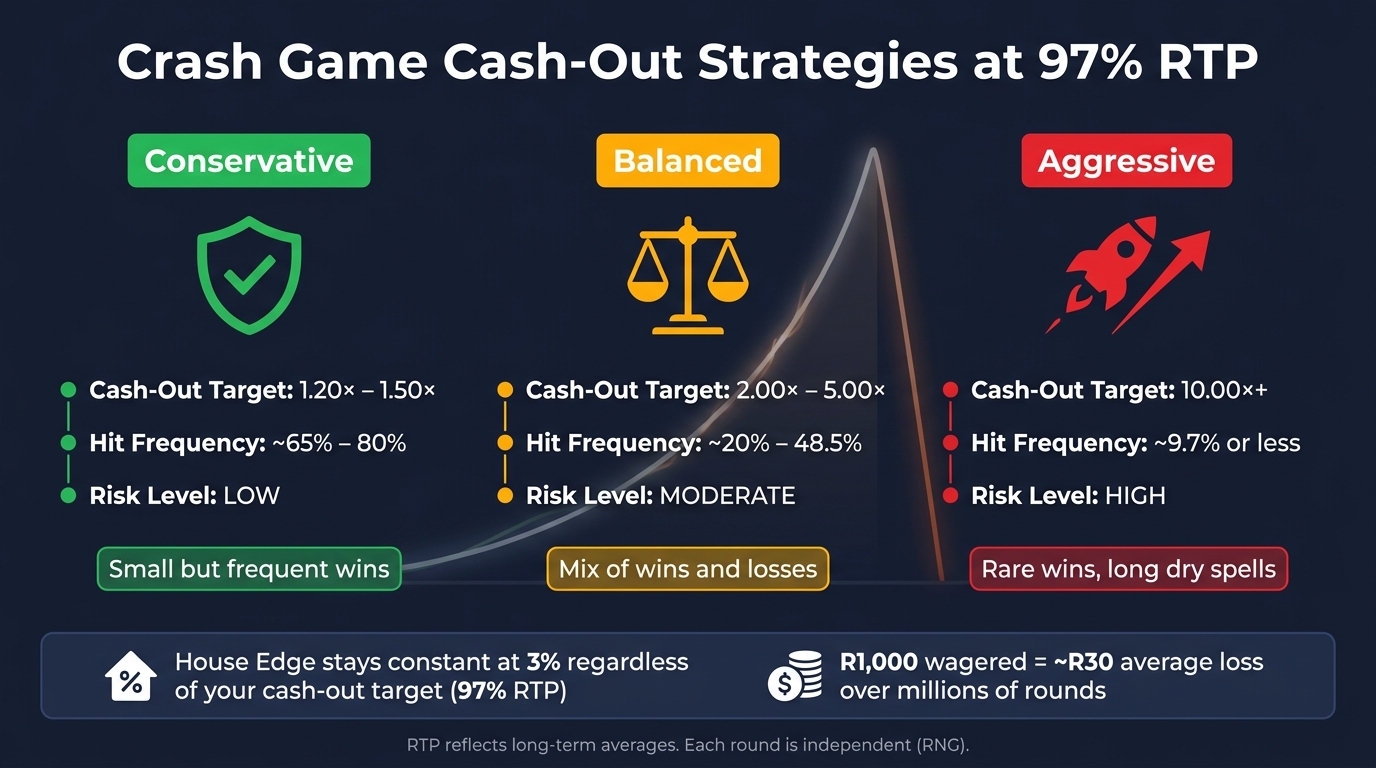
RTP helps you understand your risk before every round. Here’s the key takeaway: the house edge remains constant, regardless of the multiplier you aim for. In a game with 97% RTP, you’re effectively paying the same 3% "cost" whether you cash out at 1.5× or 10×. What changes is the frequency of wins and the size of payouts.
| Strategy | Cash-Out Target | Hit Frequency (97% RTP) | Risk Level |
|---|---|---|---|
| Conservative | 1.20× – 1.50× | ~65% – 80% | Low variance, small returns |
| Balanced | 2.00× – 5.00× | ~20% – 48.5% | Moderate variance |
| Aggressive | 10.00×+ | ~9.7% or less | High variance, long dry spells |
Choose your target based on the level of variance you can tolerate, rather than chasing what you think might be "due." Using the Auto Cash-Out feature on Supabets can help you stick to your chosen multiplier. This tool removes the temptation to hold out for just a little more and avoids any manual delays.
Once you’ve set your cash-out target, the next step is to align your betting strategy with your bankroll.
Planning Your Bankroll Around RTP
After deciding on your cash-out target, it’s time to manage your bets in line with the game’s RTP. With a 97% RTP, you can expect a long-term loss of 3%. For instance, wagering R1,000 would result in an average loss of R30. To keep your bankroll steady, limit each bet to 1%–2% of your total funds. If your session budget is R200, this means placing bets of R2 to R4 per round. This approach allows you to play through 50 to 100 rounds without exhausting your funds during a losing streak.
It’s also crucial to set clear goals for both profits and losses. For example, if you start with R200, decide to stop playing once you either double your money to R400 or lose your entire budget. This kind of structure helps prevent the house edge from wearing you down over extended play sessions.
Staying on Track During Streaks
Losing streaks are part of the game – they’re a result of variance, not a sign to change your strategy.
"RTP is the casino’s long-run guarantee, not your session forecast. Variance dominates 100 rounds; convergence to 97% needs 10,000."
- Karssen Avelar, iGaming expert
When you’re in a streak (winning or losing), it might feel tempting to increase your stakes or aim for a higher multiplier to "make up" for losses. Resist that urge. Raising your stakes or changing targets doesn’t alter the game’s inherent odds. Stick to your original plan: your consistency is the only thing you control, while the RNG (random number generator) determines the outcomes.
Conclusion: What RTP Tells You About Crash Games
RTP doesn’t predict the outcome of any single round. Instead, it reflects the long-term cost of playing a game. For instance, a 97% RTP means you’ll lose an average of R30 for every R1 000 wagered over time. This knowledge is key to shaping your game plan and managing your bankroll wisely.
Using RTP effectively allows you to compare the long-term costs of different games. Whether you prefer the steadiness of lower-multiplier cash-outs or the riskier swings of high-variance bets, RTP offers a way to align your strategy with your bankroll.
A simple but crucial tip: always check the "i" or "?" panel in games like those on Supabets before you start playing. Game operators can adjust the RTP below the game studio’s standard, meaning a game like Aviator might run at 97%, 96%, or even 94%, depending on the version. Knowing the exact RTP ensures you can plan your approach with accurate information.
While RTP won’t promise wins, understanding it helps you distinguish between short-term luck and long-term trends. This insight forms the backbone of disciplined and strategic gameplay.
FAQs
Can RTP change on Supabets?
The Return to Player (RTP) for crash games isn’t set in stone – it can differ depending on where you’re playing. While game developers usually set a baseline RTP, operators like Supabets have the ability to tweak these percentages for their platform.
It’s important to remember that RTP reflects a long-term average. This means it doesn’t guarantee how much you’ll win or lose in a single session, but rather gives an idea of how the game performs over time.
Before diving in, always check the in-game information panel on Supabets. This will give you the most up-to-date RTP for the game you’re about to play.
Does RTP affect my chances in a single round?
No, Return to Player (RTP) doesn’t affect your odds in a single round. RTP represents the long-term average payout over millions of rounds, not the outcome of one spin or hand. What really matters in a single round is variance, which dictates whether you win or lose. While games with higher RTP may have a smaller house edge in the long run, short-term results can swing dramatically, leading to big wins or losses.
Which cash-out target best matches my bankroll?
When deciding on a cash-out target, it’s all about your comfort with risk and how much variation you’re willing to handle. The expected value stays the same across all targets, thanks to the house edge. To keep your bankroll safe, aim to bet only 1%–2% of your total session bankroll per stake.
If you’re new to this, starting with a target of 1.5x–2x can be a smart move. It offers smaller, more frequent wins, which can help you build confidence. Also, make sure to set a strict session bankroll limit and a clear stop-loss point before you start playing on Supabets. These steps can help you stay in control and avoid unnecessary losses.