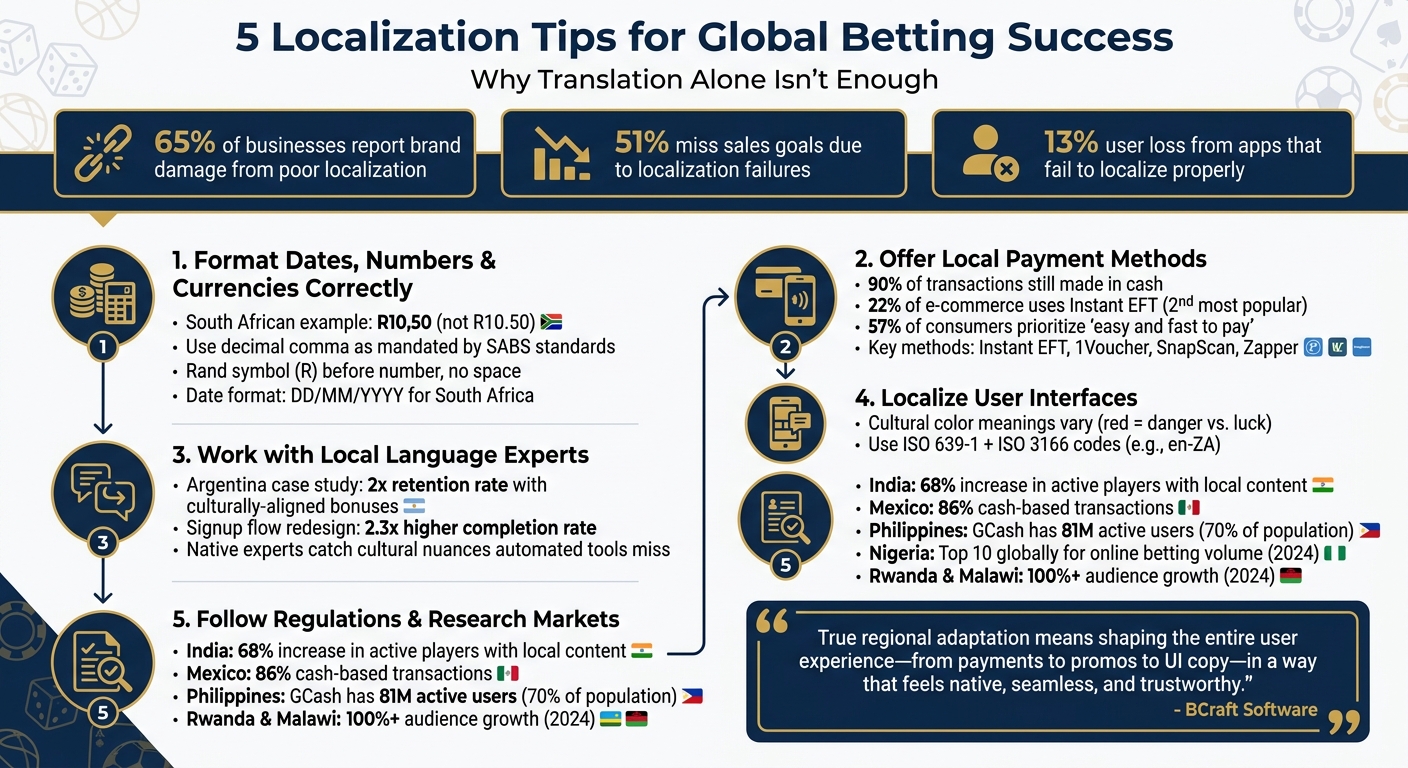
Want to succeed in global betting markets? Start with localisation. Translation alone doesn’t cut it. To truly connect with users in different regions, you need to reshape your platform to match local norms. This includes using local currencies, payment methods, and even tailoring the experience to the sports and games people care about most. The stakes are high – 65% of businesses report brand damage from poor localisation, and 51% miss sales goals because of it.
Here’s a quick breakdown of what works:
- Format dates, numbers, and currencies correctly: For example, South African users expect R10,50 (not R10.50) and proper use of the Rand symbol.
- Offer local payment methods: In South Africa, options like Instant EFT, 1Voucher, and SnapScan are crucial.
- Work with local language experts: Automated translations miss subtle details. Native speakers ensure your platform feels natural.
- Localise user interfaces: Beyond text, adapt visuals, colours, and layouts to meet local expectations.
- Follow regulations and research markets: Compliance builds trust, while market research ensures your platform aligns with user habits.
Platforms that localise effectively see measurable results, like doubling retention rates or boosting user engagement during regional events. If you’re targeting regions like South Africa or emerging markets in Africa, these tips aren’t optional – they’re your roadmap to success.
5 Essential Localization Strategies for Global Betting Platforms
1. Format Dates, Numbers, and Currencies Correctly
Local Conventions in South Africa (en-ZA Standards)
South Africa has its own specific formatting rules, and one of the most important is the use of a decimal comma instead of a decimal point. This is mandated by national standards and outlined in the South African Bureau of Standards (SABS) guide M 33a.
"The comma is the decimal mark for South Africa." – Robert MacLean, Software Developer
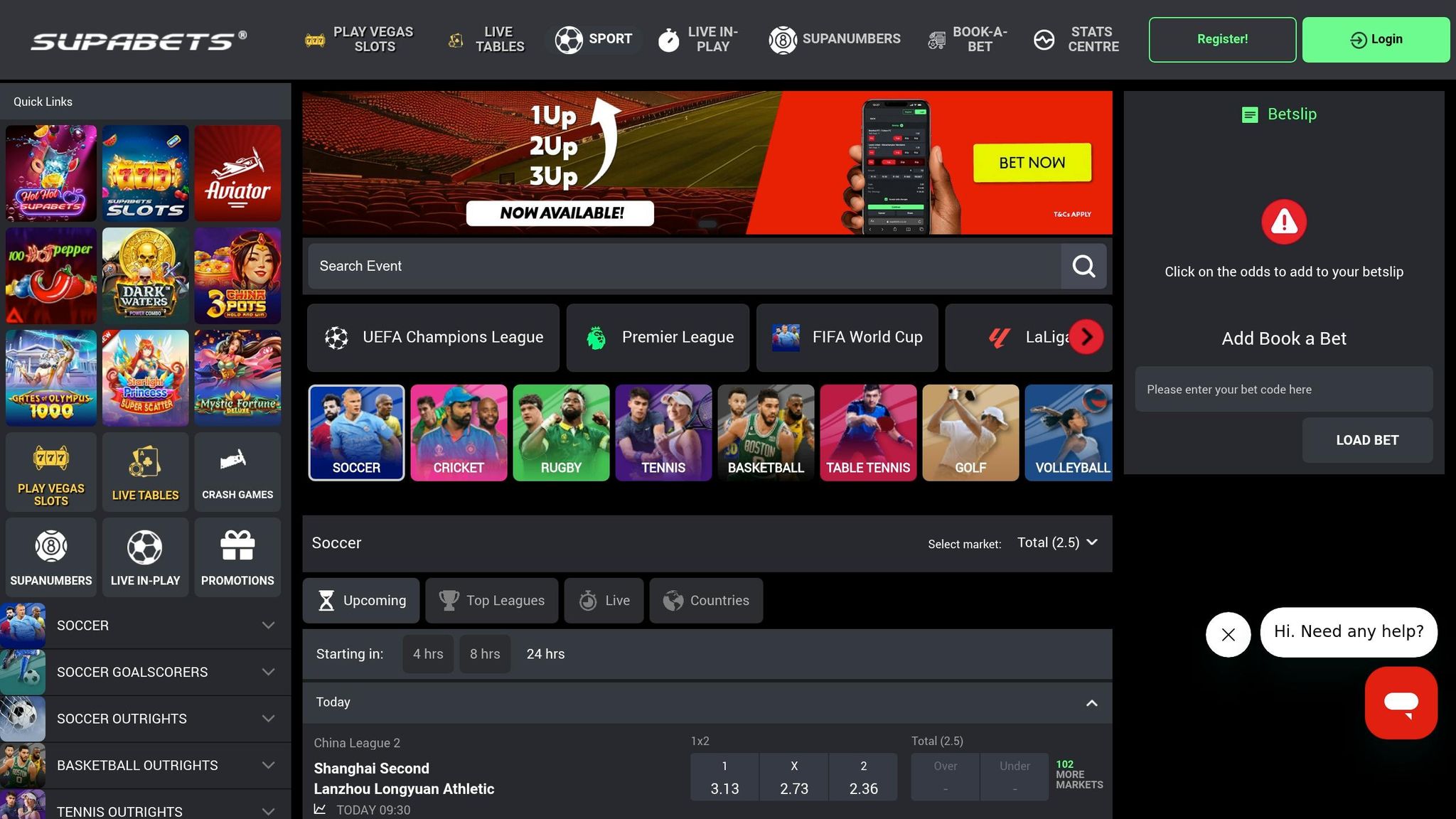
For betting platforms like Supabets, this means amounts need to be displayed correctly: R10,50 for stakes and R1 000 000 for jackpots. The Rand symbol ("R") always comes before the number, with no space in between. These details might seem small, but they play a big role in building trust with users, which directly impacts engagement.
Why Proper Formatting Matters for User Experience
Getting these details wrong can erode user trust. Research shows that apps failing to localise properly can lose up to 13% of their users. For example, if a South African user sees R100.50 instead of R100,50, the platform can feel unfamiliar or even unreliable.
"What feels familiar also feels reliable to customers." – Simona Rahmanova, Localazy
In betting, where users make quick decisions about stakes and payouts, even a small formatting error can lead to confusion, costly mistakes, or users abandoning the platform. Correct formatting not only prevents these issues but also reinforces the platform’s credibility.
How Betting Platforms Can Implement These Standards
The good news? Aligning with these standards isn’t complicated. Most programming languages offer built-in tools for localisation. For example:
- In JavaScript, you can use
Intl.NumberFormatfor the en-ZA locale. - Python offers the
localemodule for similar functionality. - Java has
NumberFormatto handle this automatically.
These libraries make it easy to format betting slips, account balances, and promotional offers correctly, without needing to hard-code every detail. By ensuring a seamless and locally-relevant interface, platforms can significantly improve the user experience and drive their betting success.
sbb-itb-00c3b18
2. Adapt Payment Methods and Symbols by Region
Align with Local Payment Conventions (en-ZA Standards)
Offering payment methods familiar to users is just as important as getting numeric formatting right. In South Africa, bettors expect options that reflect their everyday transactions. While about 85% of South Africans have bank accounts, a staggering 9 out of 10 transactions are still made in cash. This means betting platforms must integrate cash-based methods alongside digital payment solutions.
One standout option is Instant EFT, now the second most popular e-commerce payment method in South Africa, accounting for 22% of transactions – just behind card payments at 24%. Services like Ozow enable real-time transfers across major banks, including FNB, Absa, and Standard Bank. For platforms like Supabets, this translates to offering Instant EFT alongside prepaid vouchers (such as 1Voucher and OTT) and mobile apps like SnapScan and Zapper. Using local terms like Instant EFT instead of generic phrases like Bank Transfer also helps build trust.
Impact on User Experience and Engagement
Getting payment options right isn’t just a technical decision – it directly influences user behaviour. Research shows that 57% of South African consumers rank "easy and fast to pay" as the top reason for choosing one online platform over another. A good example of this is BusBud. Initially, they only accepted international payment methods and priced in USD, which eroded trust among local users. By partnering with Stitch to introduce Instant EFT and ZAR pricing, they quickly expanded their reach to the 20-40% of South African users who prefer paying directly from their bank accounts.
"For consumers coming across the brand for the first time, such shortcuts [using only international payment methods] can be obvious – limiting trust and loyalty while posing barriers to conversion or leading to cart abandonment." – Thea Sokolowski, Head of Marketing and Communications, Stitch
This demonstrates how adapting payment options can significantly improve user trust and engagement.
Ease of Implementation for Betting Platforms Like Supabets
Betting platforms can simplify the process by using payment orchestration platforms that integrate local methods (like Instant EFT, cards, vouchers, and cash-to-digital) through a single API. For larger transactions, manual bank transfers remain a useful option due to their higher deposit and withdrawal limits. It’s also essential to display all transactions in ZAR with proper local formatting and optimise mobile payment gateways to cater to on-the-go users.
3. Use Local Language Experts and Cultural Knowledge
Adaptation to Local Conventions (en-ZA Standards)
Automated translations often miss the subtle details that make content feel natural. True localisation requires a deep understanding of syntax, dialects, and colloquialisms – things that automated tools just can’t replicate. For instance, Brazilian Portuguese is vastly different from its European counterpart, and the same goes for Mexican and European Spanish. Even within English-speaking regions, humour and tone can vary widely; what works in the UK might not land the same way in the USA or Australia.
In South Africa, localisation isn’t just about using en-ZA spelling – it means tapping into authentic local idioms and even betting-specific slang. Platforms like Supabets, which operate in South Africa’s multilingual and culturally diverse context, benefit greatly from working with native experts. These experts ensure that local betting terminology and cultural references feel relatable to users. This kind of attention to detail fosters trust and encourages long-term engagement.
Impact on User Experience and Engagement
Using local expertise directly improves user engagement and retention. When content and experiences feel culturally relevant, users are more likely to stick around. For example, one operator in Argentina saw their retention rate double after replacing standard deposit-match bonuses with leaderboard-style competitions, which aligned better with their audience’s preferences. Similarly, redesigning a signup flow with native UX principles led to a 2.3x higher completion rate compared to a simple translation.
"We had one client in Argentina double their retention rate just by switching bonuses from deposit-match to leaderboard-style competitions. Culturally, it aligned better with their audience’s mindset." – BCraft CX Strategist
Design elements also need cultural sensitivity. Symbols and colours can carry different meanings across cultures. For instance, the "OK" hand gesture is offensive in some Arabic regions, while white symbolises purity in Western cultures but mourning in many Eastern ones. Local experts can spot these cultural nuances early, preventing potential missteps that could harm your brand.
Relevance to Global Betting Audiences
Cultural adaptation doesn’t stop at language; promotions tailored to local traditions and celebrations can significantly boost engagement. For example, platforms that tie bonuses to events like Carnival in Brazil or Diwali in India report stronger user interest [2, 14]. In South Africa, aligning promotions with major sporting events like the CAF Africa Cup of Nations or local football derbies can have a similar impact [2, 3]. These culturally relevant campaigns create a stronger connection with users, making them feel understood and valued.
4. Localise User Interfaces Beyond Text
Aligning with Local Conventions (en-ZA Standards)
When it comes to localising a user interface, it’s not just about translating text – it’s about reshaping the entire experience. For South African users, this means adapting key elements like date formats (DD/MM/YYYY), number formatting, and currency symbols to match en-ZA standards. Platforms such as Supabets can build trust by displaying dates correctly, using the right decimal separators, and showing the currency as R for Rand, with the symbol in the appropriate position.
Take number formatting, for example. While US conventions use commas for thousands (1,000.50), South African standards might use spaces or other delimiters to improve clarity. These small but critical adjustments ensure users don’t face confusion during important tasks like placing bets or reviewing balances. A well-localised interface bridges the gap between technical precision and a smooth user experience.
The Role of Visual Elements in User Engagement
Text isn’t the only thing that requires localisation. Colours, icons, and symbols carry different meanings across cultures. For instance, red may signify danger in Western contexts but is associated with luck in China. Similarly, white often represents purity in Western cultures but can symbolise mourning in many Eastern traditions. For platforms catering to global audiences, these subtle design elements can heavily influence user trust and engagement.
Simplifying Localisation for Platforms Like Supabets
Thanks to internationalisation frameworks, localising interfaces is more manageable than it might seem. Using systems like ISO 639-1 language codes paired with ISO 3166 country codes (e.g., en-ZA for South African English) allows platforms to systematically organise regional variations. Payment interfaces, in particular, benefit from geo-location-based adaptations, automatically showing users familiar currency symbols and payment methods based on their location. These tailored elements not only enhance usability but also lay the groundwork for meeting regulatory requirements and tapping into market-specific insights.
5. Follow Regulations and Conduct Market Research
Relevance to Global Betting Audiences
Adhering to regulations isn’t just a box to tick – it’s the backbone of long-term success in the global betting industry. Ignoring compliance can lead to severe consequences like bans, frozen accounts, or hefty fines. For South African operators such as Supabets, this means keeping up with the National Gambling Board‘s requirements while also navigating the rules of other target markets, like the Betting Control and Licensing Board in Kenya or Brazil’s Ministry of Finance.
Market research plays a critical role in understanding the local landscape. Take Mexico, for instance – around 86% of all transactions are cash-based, making brick-and-mortar integration a must for success. On the other hand, in the Philippines, GCash dominates with 81 million active users, representing more than 70% of the population. Without these insights, platforms risk implementing solutions that don’t align with local transaction habits.
Beyond compliance, thorough market research ensures that platform features are tailored to the specific behaviours and preferences of each market.
"Compliance with local regulations is business-critical." – BCraft Software
Impact on User Experience and Engagement
Sticking to local regulations does more than just keep penalties at bay – it builds trust with users. Regulatory compliance is a cornerstone of a solid localisation strategy, directly influencing the player experience. This includes integrating licensed Payment Service Providers, offering Terms & Conditions in the local language, and implementing region-specific responsible gaming tools like self-exclusion options and deposit limits. These features act as trust signals, reassuring players that the platform operates ethically and transparently.
The cost of non-compliance can be steep. Platforms that fail to meet local regulatory and cultural expectations risk losing user confidence and engagement. In South Africa, for example, it’s not enough to simply display amounts in Rand (R). Operators must also account for local payment habits, optimise for mobile data affordability, and create promotions that resonate with regional sporting events rather than generic global campaigns.
Conclusion
Localisation goes far beyond simple translation – it’s about crafting an experience that feels natural and intuitive for each specific market. The strategies highlighted here work together to build trust, eliminate barriers, and encourage user engagement. When platforms focus on the small details – like correctly formatting dates and currencies or incorporating local payment options such as M-Pesa or Pix – they evolve into brands that users see as their own. By fine-tuning everything from interface design to payment systems, platforms can create an experience that feels seamless and familiar.
In 2025, operators who embraced localisation saw impressive results. For instance, in India, integrating local game content and involving cultural ambassadors led to a 68% increase in active players. Similarly, in Argentina, one operator doubled their retention rate by shifting from deposit-match bonuses to leaderboard-style competitions that resonated better with local preferences. A redesigned signup process, built with native user experience principles, achieved a 2.3x higher completion rate compared to a straightforward translation. These examples highlight how impactful localisation can be when done thoughtfully.
"True regional adaptation means shaping the entire user experience – from payments to promos to UI copy – in a way that feels native, seamless, and trustworthy." – BCraft Software
For platforms like Supabets, adopting these localisation strategies is crucial to staying competitive as global markets continue to evolve. Instead of attempting a broad global strategy, focus on one to three high-potential regions, such as select African markets or Southeast Asia. Collaborate with local experts to understand regional preferences, incorporate a few key local payment options per market, and customise promotions around local events rather than relying on generic global campaigns.
The betting industry is changing rapidly, with Nigeria becoming one of the top 10 countries globally for online betting volume in 2024, and markets like Rwanda and Malawi experiencing audience growth of over 100% in the same year. Platforms that adapt to the unique culture, infrastructure, and regulations of each region are the ones that will succeed.
FAQs
How do I choose which markets to localise first?
When deciding which markets to localise for, concentrate on areas where it will have the greatest effect on user engagement and compliance. Several factors come into play, including language, cultural relevance, market potential, and the regulatory environment.
Focus on regions experiencing growth in internet access, mobile device usage, and where regulations are clearly defined. By understanding the nuances of local languages, cultural preferences, and legal frameworks, you can align your localisation efforts more effectively and ensure they resonate with the target audience.
What are the quickest localisation fixes that boost sign-ups and deposits?
- Language adjustment: Ensure translations are precise and reflect local expressions and idioms to resonate with users.
- Currency formatting: Display amounts in South African Rand (ZAR) with the correct use of decimal points and thousand separators for clarity.
- Cultural alignment: Use symbols, imagery, and rewards that feel relevant and relatable to South African players.
These simple updates can make users feel at home, increasing their confidence and encouraging more interaction.
How can Supabets stay compliant when expanding into new regions?
To operate smoothly in new regions, Supabets must prioritise compliance by understanding and adhering to local regulations. This includes securing the necessary licences, following advertising guidelines, and implementing responsible gambling measures. Partnering with local legal professionals can help the platform stay updated on changing laws.
The platform should also meet regional standards, such as data protection requirements, payment regulations, and respecting local customs. In South Africa, this involves using the correct currency format, following local date conventions, and ensuring all communication is culturally appropriate.