Betting odds are key to understanding sports betting. They reflect the likelihood of an event and potential payouts. The three main formats – Fractional (UK), Decimal (SA/Europe), and Moneyline (US) – present the same information differently. Here’s a quick breakdown:
- Fractional Odds: Common in the UK, written as ratios (e.g., 5/1). Shows profit relative to stake.
Example: R100 at 5/1 = R500 profit + R100 stake = R600 total return. - Decimal Odds: Popular in South Africa, shows total return per R1 staked.
Example: R100 at 2.50 = R250 total return (R150 profit + R100 stake). - Moneyline Odds: Used in the US, based on R100. Positive numbers (+150) indicate underdogs, while negative numbers (-200) show favourites.
Example: R100 at +150 = R150 profit + R100 stake = R250 total return.
Understanding these formats helps you calculate returns, assess probabilities, and compare odds effectively. Decimal odds are the most straightforward, making them widely used in South Africa. The article explains how to convert between formats, calculate implied probabilities, and find value bets.
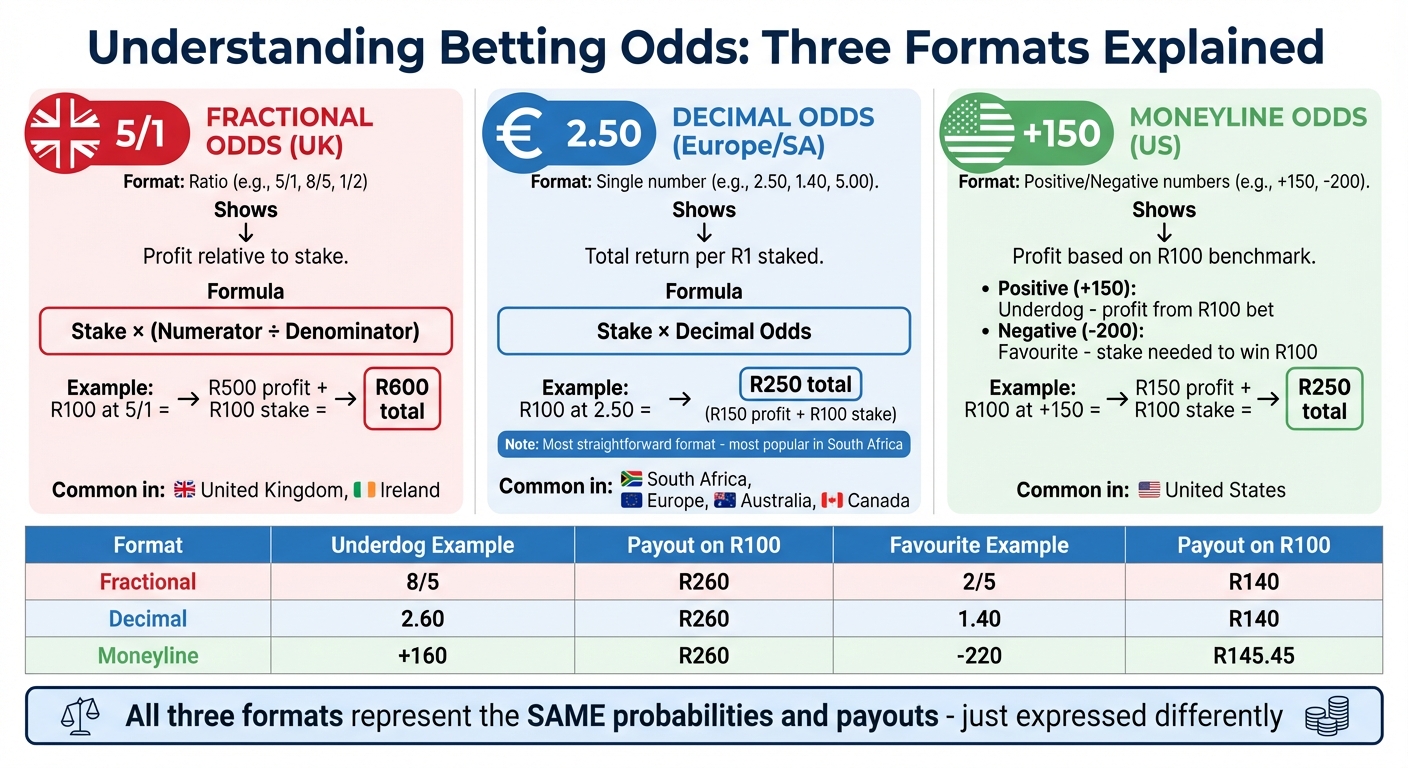
Betting Odds Formats Comparison: Fractional, Decimal, and Moneyline
Fractional Odds Explained
Fractional odds, often called British odds, are a traditional way of presenting betting odds in the UK and Ireland. You’ll typically see them written as two numbers separated by a slash (/) or a hyphen (-), like 5/1 or 5-1. This format has strong ties to British horse racing and remains popular today. Let’s break down how they work.
The first number (the numerator) shows your potential profit, while the second number (the denominator) indicates the stake you need to place to achieve that profit. Essentially, it’s a ratio of profit to stake. For instance, odds of 5/1 mean that for every R1 you bet, you could win R5.
How Fractional Odds Work
To calculate your potential profit, use this formula:
Stake × (Numerator ÷ Denominator).
Your total return will be the profit plus your original stake.
Fractional odds fall into three main categories:
- Odds-against: When the numerator is larger than the denominator (e.g., 5/1). This means you stand to win more than your stake, typically marking the selection as an underdog.
- Even money: Written as 1/1 or "evens", where your profit matches your stake.
- Odds-on: When the denominator is larger than the numerator (e.g., 1/2). Here, your potential win is less than your stake, indicating a favourite.
"The beauty of fractional odds is that they offer a very simple way to calculate your potential profits or losses." – ACGCS Staff
Fractional Odds Examples
Let’s see how this works with some practical examples using the South African Rand:
- If you bet R100 at 5/1, your profit would be:
R100 × (5 ÷ 1) = R500,
giving you a total return of R500 profit + R100 stake = R600. - For an odds-on bet, say you wager R100 at 1/2:
R100 × (1 ÷ 2) = R50,
resulting in a total return of R50 profit + R100 stake = R150.
Here’s a quick comparison table:
| Fractional Odds | Type | Stake | Profit | Total Return |
|---|---|---|---|---|
| 5/1 | Odds-against | R100 | R500 | R600 |
| 8/5 | Odds-against | R50 | R80 | R130 |
| 1/1 | Even money | R100 | R100 | R200 |
| 1/2 | Odds-on | R100 | R50 | R150 |
A good rule of thumb: start with "evens" (1/1) as your baseline. If the numerator is bigger, it’s odds-against (underdog). If the denominator is bigger, it’s odds-on (favourite). This simple method helps you quickly identify whether a selection is a favourite or an underdog. Up next, we’ll see how fractional odds compare to other formats.
sbb-itb-00c3b18
Decimal Odds Explained
Decimal odds offer a more straightforward approach to calculating betting returns compared to fractional odds.
Also known as European or continental odds, this format is widely used in regions like Europe, Australia, and Canada, and it’s a standard on platforms such as Supabets. Bettors favour decimal odds because they simplify the process of understanding potential returns, while still reflecting the implied probability of an event’s outcome.
The standout feature? Decimal odds show your total return for every R1 staked, with the original stake already included. For instance, odds of 2.50 mean a R1 bet would return R2.50 in total – not just R2.50 in profit. This clarity makes them especially popular on betting exchanges and international sportsbooks.
How Decimal Odds Work
To calculate your total return, simply multiply your stake by the decimal odds. To find the profit, subtract your original stake from the total return. The formula looks like this:
- Total Return = Stake × Decimal Odds
- Profit = Stake × (Decimal Odds – 1)
The number 2.00 holds special significance, representing "even money" or a 50% implied probability. Odds below 2.00 indicate a favourite, while higher odds suggest an underdog.
Here’s a quick breakdown:
| Decimal Odds | Stake | Total Return | Profit | Type |
|---|---|---|---|---|
| 1.40 | R100 | R140 | R40 | Favourite |
| 2.00 | R100 | R200 | R100 | Even Money |
| 2.60 | R100 | R260 | R160 | Underdog |
| 5.00 | R100 | R500 | R400 | Longshot |
Why Decimal Odds Are Easy to Use
"Decimal odds are the simplest format to understand." – OddsIndex
One of the biggest advantages of decimal odds is their consistency. Unlike American odds, which use different calculations for favourites and underdogs, decimal odds rely on a single, universal formula. This makes them easier to grasp, even for beginners, and speeds up decision-making.
When comparing odds across various markets on platforms like Supabets, the decimal format makes it simple to identify better value. For example, you can instantly see that odds of 1.95 offer a higher return than odds of 1.91 – no need for extra calculations. This clarity is why decimal odds remain a go-to choice for many bettors. Next, we’ll explore how these formats differ and the specific advantages each one offers.
Moneyline Odds Explained
Moneyline odds, also known as American odds, are based on a R100 baseline. While they’re most common in the United States, they’re also useful for anyone betting on American sports or using platforms that support this format.
Here’s how it works: negative numbers (like -200) represent the favourite and show how much you need to bet to win R100 in profit. On the other hand, positive numbers (like +150) represent the underdog and show how much profit you’d make from a R100 bet. If you win, you’ll get back your original stake along with the profit.
"American, British, and European odds are three different ways of expressing the same thing and can be converted from one to another." – Investopedia
Positive vs Negative Moneyline Odds
The positive and negative signs are key to understanding moneyline odds. Negative odds (-) indicate the favourite, or the outcome that’s more likely to occur. The number tells you how much you need to wager to win R100. For instance, at -400 odds, you’d need to bet R400 to make R100 in profit. This reflects an implied probability of 80%.
Positive odds (+), on the other hand, refer to the underdog – the less likely outcome. The number shows how much profit you’d make on a R100 bet. For example, at +300 odds, a R100 wager would give you R300 in profit, with an implied probability of 25%. The higher the positive number, the greater the potential reward, but the chances of winning decrease.
Calculating Moneyline Payouts
The method for calculating returns depends on whether the odds are positive or negative.
- For positive odds: Profit = Stake × (Odds ÷ 100)
- For negative odds: Profit = Stake × (100 ÷ |Odds|)
Here’s an example: if you place a R100 bet at +120 odds, the calculation would be R100 × (120 ÷ 100), resulting in R120 profit. Your total return would then be R220 (profit plus your original stake).
For negative odds, let’s say you bet R400 at -400 odds. The calculation would be R400 × (100 ÷ 400), giving you R100 in profit. Your total return would be R500.
Take this real-world example: in an April 2026 MLB game between the New York Yankees and Los Angeles Angels, OddsIndex showed the Yankees as favourites at -500. This means you’d need to bet R500 to make R100 in profit. The Angels, as underdogs at +400, would yield R400 in profit from a R100 bet.
Comparing the Three Odds Formats
Let’s break down how these three odds formats differ, even though they all lead to the same payout. Decimal odds combine your stake and profit into one number, fractional odds show profit as a ratio to your stake, and moneyline odds use positive and negative figures to reflect returns on a R100 bet. Here’s a closer look at how they stack up.
In South Africa, decimal odds are the most common format. Whether you’re betting on the Springboks or the Orlando Pirates, you’ll usually encounter odds like 2.60 or 1.85. Meanwhile, fractional odds are the go-to in the UK and Ireland, and moneyline odds dominate in US sports betting.
"The majority of betting agencies use the decimal/European format of writing odds."
Decimal odds are particularly appealing to professional bettors because they make comparisons a breeze. For instance, it’s much easier to compare 3.75 and 3.60 in decimal format than to figure out which is better between fractional odds like 11/4 and 13/5. This simplicity is a big reason why decimal odds are the global standard outside of the UK and the US.
Odds Format Comparison Table
| Odds Format | Example (Underdog) | Payout on R100 Stake | Common Usage |
|---|---|---|---|
| Decimal | 2.60 | R260 (R100 × 2.60) | South Africa, Europe, Australia, Canada |
| Fractional | 8/5 | R260 (R160 profit + R100 stake) | United Kingdom, Ireland |
| Moneyline | +160 | R260 (R100 stake + R160 profit) | United States |
The same principle applies when looking at odds for favourites.
| Odds Format | Example (Favourite) | Payout on R100 Stake | Common Usage |
|---|---|---|---|
| Decimal | 1.40 | R140 (R100 × 1.40) | South Africa, Europe, Australia, Canada |
| Fractional | 2/5 | R140 (R40 profit + R100 stake) | United Kingdom, Ireland |
| Moneyline | -220 | R145.45 (R100 stake + R45.45 profit) | United States |
No matter the format, one thing remains consistent: lower odds indicate the bookmaker’s favourite. This helps bettors quickly identify which outcome is deemed more likely to happen.
How to Convert Between Odds Formats
Understanding how to switch between odds formats is a handy skill, especially when comparing prices across platforms or dealing with odds in formats you’re unfamiliar with.
Odds Conversion Formulas
Each type of conversion has its own formula. Let’s break them down:
- Fractional to Decimal: Divide the numerator by the denominator, then add 1.
Example: For 5/1, the calculation is(5 / 1) + 1 = 6.00. - Decimal to Fractional: Subtract 1 from the decimal odds and express the result as a fraction.
Example: Decimal odds of 2.50 become2.50 - 1 = 1.50, which simplifies to 3/2. - American to Decimal:
- For positive American odds, use
(American / 100) + 1. - For negative American odds, use
(100 / Absolute Value of American) + 1.
Example: +500 converts to(500 / 100) + 1 = 6.00, while -150 becomes(100 / 150) + 1 = 1.67.
- For positive American odds, use
- Decimal to American:
- For odds of 2.00 or higher, use
(Decimal - 1) * 100. - For odds below 2.00, use
-100 / (Decimal - 1).
Example: Decimal odds of 2.50 convert to(2.50 - 1) * 100 = +150.
- For odds of 2.00 or higher, use
"Check the Sign: Always verify if American odds are positive or negative before applying a formula, as using the wrong one will result in significant calculation errors."
If you’re working with spreadsheets, you can automate American-to-decimal conversions with this Excel formula:
=IF(A2 > 0, (A2/100)+1, (100/ABS(A2))+1) This eliminates manual errors and saves time.
Conversion Examples
Here are some real-world examples relevant to South African sports betting:
- Fractional to Decimal: Converting 5/1 to decimal, the formula
(5 / 1) + 1 = 6.00. Its equivalent moneyline (American odds) is +500:(5 / 1) * 100 = +500 - American to Decimal: A favourite priced at -150 converts to decimal as
(100 / 150) + 1 = 1.67. This corresponds to fractional odds of 2/3. - Decimal to American: Decimal odds of 2.50 convert to American using
(2.50 - 1) * 100 = +150. - NFL Spread Example: Standard odds of -110 convert to 1.91 in decimal and 10/11 in fractional format. A R100 stake at these odds returns R190.91 total (R90.91 profit plus your R100 stake).
These conversions make it easier to compare and evaluate betting options across different formats. Up next: using these odds to calculate implied probabilities.
Understanding Implied Probability
When it comes to odds formats, grasping implied probability is crucial for understanding how bookmakers estimate the likelihood of an event happening.
On Supabets, every set of odds essentially reflects a probability statement. Implied probability translates these odds into a percentage that represents the bookmaker’s view of an outcome’s likelihood. This percentage serves as a "break-even" point: if your own estimation of probability is higher than the bookmaker’s implied probability, you may have found a potential value bet.
"Every price on a betting slip represents a calculated probability – and understanding how bookmakers arrive at those numbers is the single most important skill a bettor can develop." – Steffen Fonvig, Founder & Editor-in-Chief, StatsBet
The relationship between odds and probability is straightforward: higher odds suggest a lower probability, while lower odds indicate a higher probability. For instance, decimal odds of 1.50 imply a 66.7% chance of winning, whereas odds of 10.00 imply just a 10% chance. This understanding shifts your perspective from focusing purely on payouts to considering the actual likelihood of an event.
Bookmakers also include a profit margin, known as the "overround" or "vig", within their odds. This means the total implied probabilities for all possible outcomes in a market will exceed 100%. For major football matches, margins typically range from 2% to 4%, while standard markets tend to have margins of 5% to 8%. If the implied probabilities for a market exceed 110%, it’s often better to avoid it, as higher overrounds reduce potential returns.
How to Calculate Implied Probability
The formula for calculating implied probability depends on the odds format:
- Decimal odds: Divide 1 by the odds and multiply by 100. For example, decimal odds of 2.50 convert to (1 / 2.50) × 100 = 40%.
- Fractional odds: Use the formula: Denominator / (Numerator + Denominator) × 100. For example, 5/2 odds are calculated as 2 / (5 + 2) × 100 ≈ 28.6%.
- Moneyline odds: The method varies for positive and negative odds:
- Positive odds (e.g., +200): 100 / (Odds + 100) × 100 = 33.3%.
- Negative odds (e.g., -150): Absolute Odds / (Absolute Odds + 100) × 100 = 60%.
Here’s a quick reference table:
| Odds Format | Formula | Example | Result |
|---|---|---|---|
| Decimal | (1 / Odds) × 100 | (1 / 2.50) × 100 | 40.0% |
| Fractional | Denom / (Numerator + Denom) × 100 | 2 / (5 + 2) × 100 (for 5/2) | 28.6% |
| Moneyline (+) | 100 / (Odds + 100) × 100 | 100 / (200 + 100) × 100 (for +200) | 33.3% |
| Moneyline (-) | Absolute Odds / (Absolute Odds + 100) × 100 | 150 / (150 + 100) × 100 (for -150) | 60.0% |
Just as converting odds formats helps clarify payouts, calculating implied probability reveals where potential value lies in a bet.
Using Implied Probability to Find Value
Implied probability is a powerful tool for spotting value in betting markets. A value bet occurs when your estimated probability of an outcome is higher than the bookmaker’s implied probability. For example, if you believe a team has a 50% chance of winning, but the odds of 2.50 suggest only a 40% chance, you’ve identified a 10% edge.
To calculate value, use this formula: Value = (Your Estimated Probability × Decimal Odds) – 1
If the result is positive, the bet might offer value. For instance, if you estimate a 55% chance of an outcome and the odds are 2.00, the calculation is (0.55 × 2.00) – 1 = 0.10, indicating a 10% edge.
Before placing bets on Supabets, it’s a good idea to check the overround by converting all outcome odds to implied probabilities and summing them. For example, in a 1X2 market with odds of 2.10 (Home), 3.40 (Draw), and 3.60 (Away), the total implied probability is approximately 104.81%, showing a 4.81% overround. Markets with significantly higher totals tend to reduce profitability, so aim for those with margins between 102% and 108%.
Conclusion
Fractional, decimal, and moneyline odds all represent the same probabilities and potential returns, just in different formats. Decimal odds show your total return (your stake plus profit), fractional odds focus on the profit relative to your stake, and moneyline odds – based on a R100 benchmark – highlight favourites and underdogs using positive and negative signs. Each format has its niche: decimal odds are widely used on Supabets and other African platforms, fractional odds are a staple in the UK, and moneyline odds dominate American sports betting.
Understanding these formats not only makes the numbers less intimidating but also gives you an edge in refining your betting strategy. Knowing how to convert odds and calculate implied probabilities can help you spot value bets – situations where the bookmaker may have underestimated an outcome. As LCB explains:
"Understanding betting odds is essential for making informed choices. They help you see the risk, compare potential winnings, and spot value bets."
Being familiar with various odds formats is especially helpful when following global betting tips, wagering on US-focused sports like the NFL or MLB, or comparing odds across platforms. With Supabets defaulting to decimal odds, assessing potential returns becomes straightforward. Keep in mind, odds are constantly shifting – they respond to factors like injuries, team updates, and betting trends. Mastering these formats ensures you can track line movements and make smarter decisions by clearly evaluating the balance between risk and reward.
FAQs
Which odds format should I use on Supabets?
Decimal odds are the go-to choice for South African players on Supabets. They’re straightforward to grasp and work seamlessly with local betting habits and the rand currency. To figure out your potential returns, just multiply your stake by the decimal odds. Although fractional and moneyline odds are also an option, decimal odds stand out because they’re easier to use and make more sense in the South African betting scene.
How do I convert odds quickly without making mistakes?
To work with odds efficiently, it’s essential to understand the main formats – American, decimal, and fractional – and how to switch between them. Here are a couple of quick conversion tips:
- American to decimal: For negative odds, divide 100 by their absolute value, then add 1. For positive odds, divide the odds by 100 and add 1.
- Decimal to fractional: Subtract 1 from the decimal, then express the result as a fraction and simplify where possible.
Taking time to practise these formulas can help you avoid making mistakes.
How do I check if a bet is value using implied probability?
To determine whether a bet holds value, you need to compare the bookmaker’s implied probability of an outcome with your own assessment of its actual likelihood. Start by converting the odds – whether fractional, decimal, or moneyline – into implied probability using the appropriate formula.
If your calculated probability for the outcome is higher than the bookmaker’s implied probability, the bet has a positive expected value. This signals a potentially favourable betting opportunity.