Sports betting can be fun, but without a clear plan, it’s easy to lose money. Whether you rely on strong instincts or daring predictions, success in betting comes down to having a system. Here’s what you need to know to get started the right way — and learn expert sports betting strategies that actually work:
- Manage Your Bankroll: Set aside money you can afford to lose and bet only 1–5% of it per wager.
- Understand Betting Odds: Learn how odds work and how they reflect probabilities to make smarter bets.
- Do Your Research: Study team form, injuries, and head-to-head records to make informed decisions.
- Compare Odds: Always look for the best odds on platforms like Supabets to maximise your returns.
- Stick to Familiar Sports: Focus on sports and leagues you know well to avoid unnecessary risks.
- Use Unit Sizes: Bet a consistent percentage of your bankroll to stay disciplined.
- Avoid Chasing Losses: Don’t increase bets to recover losses – it usually leads to bigger problems.
- Track Your Bets: Keep records of your wagers to understand your performance over time.
- Try Live Betting Wisely: Use real-time insights to find opportunities but avoid impulsive decisions.
- Set Limits and Stay Disciplined: Stick to your budget, take breaks, and use tools to control your betting.
These sports betting strategies focus on discipline, research, and consistent decision-making to help you enjoy betting responsibly while improving your chances of success. Every win and every loss teaches you something — and the pros know that a long-term betting strategy beats guesswork every time.
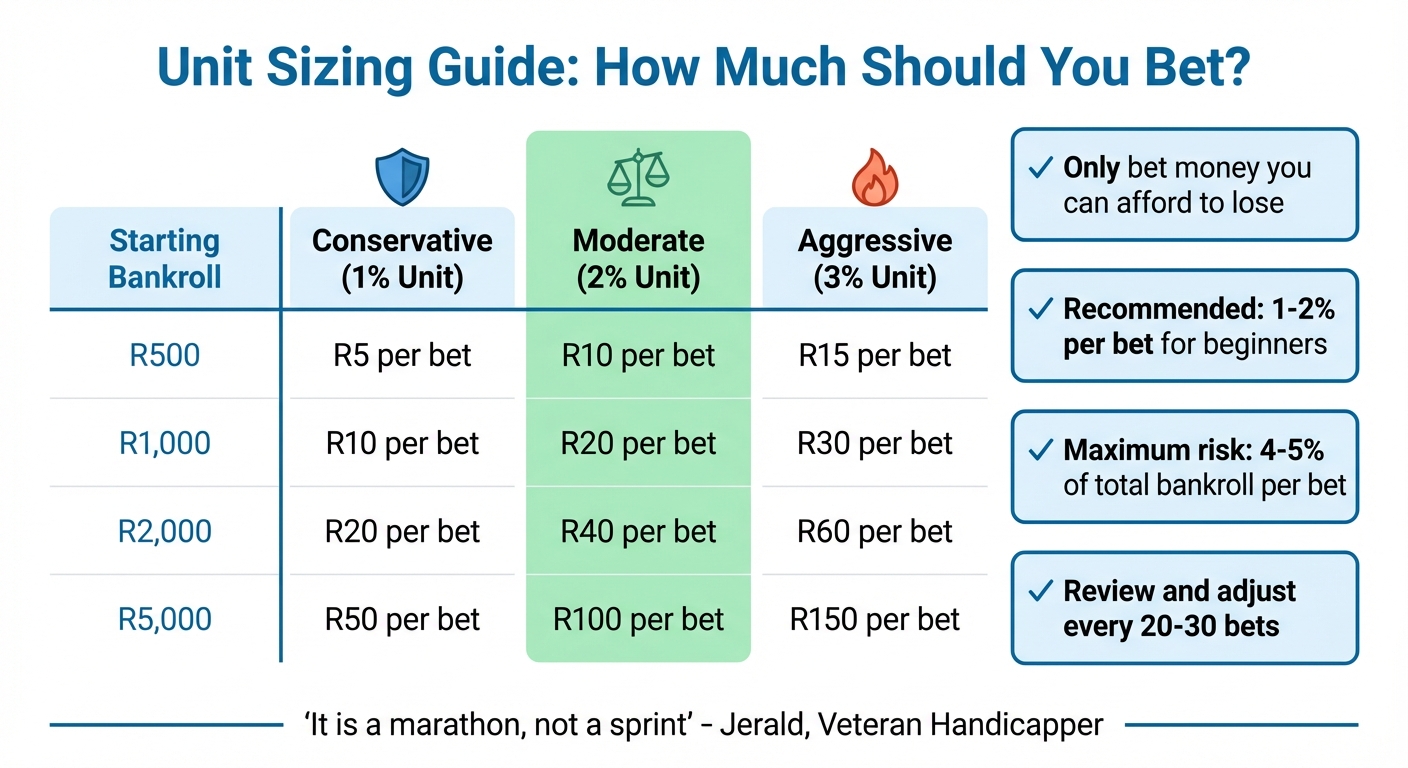
Sports Betting Unit Sizing Guide: Conservative vs Moderate vs Aggressive Bankroll Strategies
Top 5 Sports Betting Tips for Beginners
sbb-itb-00c3b18
1. Master Bankroll Management
Why Bankroll Strategy Protects Your Money and Manages Risk
Bankroll management is all about setting aside a specific amount of money exclusively for betting and sticking to strict rules to protect it. Think of it as a separate pool of funds, entirely distinct from your daily living expenses. The golden rule? Only allocate money you can afford to lose – if losing it all wouldn’t disrupt your everyday life, you’re on the right track. There is no shortcut here; proper risk management is one of the most important betting strategies used by experienced bettors to stay profitable.
Once your bankroll is set, the next step is determining your unit size, the amount you’ll wager per bet. This is sometimes called fixed sizing or position sizing, and experts generally suggest betting 1% to 2% of your total bankroll on each wager. For example, with a R1,000 bankroll, a 1% unit would be R10, while a 2% unit would be R20. It’s also wise to cap your risk per bet at no more than 4% to 5% of your total bankroll. Some pros even apply the Kelly Criterion, a formula that adjusts your wager based on your perceived edge, but for beginners, flat fixed sizing keeps things simple and consistent.
| Starting Bankroll | 1% Unit (Conservative) | 2% Unit (Moderate) | 3% Unit (Aggressive) |
|---|---|---|---|
| R500 | R5 | R10 | R15 |
| R1,000 | R10 | R20 | R30 |
| R2,000 | R20 | R40 | R60 |
| R5,000 | R50 | R100 | R150 |
This structured approach to unit sizing ensures your betting decisions remain consistent and controlled. There are many betting systems out there, but disciplined bankroll management is the one strategy that underpins them all.
To see this in action, take the example of Jerald, a seasoned handicapper from Predictem. In April 2025, he started with a $2,750 bankroll (around R52,250) and used a 2% unit size ($55 per game). Over time, he achieved a 60% win rate with 72 wins and 48 losses. Despite those losses, his disciplined approach earned him a net profit of $960 (roughly R18,240), growing his bankroll to $3,710. His success proves that betting with a system — rather than on strong instincts alone — leads to more consistent profit.
“I feel that it is almost as important to implement good money management tactics as it is to pick winners. Always remember that it is a marathon, not a sprint, and the best way to grow our bankroll is to grind out profits over a period of time.” – Jerald, Veteran Handicapper, Predictem
It’s also important to regularly revisit your unit size. Every 20–30 bets or once a month, evaluate your performance. If your bankroll takes a 25% hit, adjust your unit size downward. On the flip side, consider increasing it only after a 50% gain. This kind of risk management separates casual bettors from those who treat betting as a long-term game.
2. Understand Betting Odds
Once your bankroll is set, the next step is getting a handle on how odds influence your betting decisions. Understanding odds is there at the heart of every successful betting strategy, and it’s one of the first things bettors must learn.
Odds do two key things: they show the potential payout of your bet and indicate the likelihood of an outcome. Shorter odds usually mean a favourite with a smaller payout, while longer odds suggest an underdog with higher potential returns. Smart bettors compare odds across betting markets to find the best lines before placing any wager.
In South Africa, decimal odds are the most widely used and easiest to understand. To calculate your total return, simply multiply your stake by the odds. For instance, a R100 bet at odds of 2.50 would give you a total return of R250 – your R100 stake plus R150 profit. Odds of 2.00 double your money, while odds of 1.50 return R1.50 for every R1 wagered.
| Decimal Odds | R100 Bet Total Return | Profit | Implied Probability |
|---|---|---|---|
| 1.50 | R150 | R50 | 66.7% |
| 2.00 | R200 | R100 | 50% |
| 2.50 | R250 | R150 | 40% |
| 3.00 | R300 | R200 | 33.3% |
One detail many beginners miss is that odds also reveal the implied probability of an outcome. To work this out, divide 1 by the decimal odds and multiply by 100. For example, odds of 2.50 imply a 40% chance of success. This is a powerful tool for identifying value bets, and it’s one of the core betting strategies used by pros to gain an edge. If you estimate a team’s chances of winning at 50%, but the odds suggest only 40%, that bet might offer value.
“Implied probability is the mathematical foundation that separates informed bettors from casual punters.” – OddsIndex
It’s worth noting that sportsbooks include a vig (or juice), which means the total implied probabilities often exceed 100%. Understanding this margin is essential for any bettor looking to win consistently.
Converting odds into percentages before betting is a simple but effective way to shift from guessing to making calculated decisions. With a solid understanding of odds, you’re ready to dive into researching teams and players to uncover opportunities for value bets.
3. Research Teams and Players Thoroughly
Once you’ve nailed bankroll management and grasped the odds, the next step is digging deep into team and player research. This kind of preparation can uncover opportunities others might miss, and it’s there where disciplined bettors separate themselves from casual punters making daring predictions without data.
Start by analysing a team’s recent form. Look at their last five to ten matches to get a sense of their momentum and confidence. For instance, a team riding a three-game winning streak likely has a different energy compared to one on a losing skid. But don’t just stop at wins and losses, examine goal margins, as they often reveal the real story behind a team’s performance.
Home and away records are another key factor. Some teams thrive in front of their home crowd but falter when they hit the road. If you spot a trend of poor away results, it’s worth taking note, as the venue can heavily sway outcomes. This is exactly the kind of research that turns a casual wager into a well-informed betting decision.
Injuries and suspensions can also shake things up. It’s not just about whether a player is missing, it’s about who is missing and their role in the team. For example, losing a top centre back could be disastrous against an attacking opponent. Stay updated by checking reliable social media or journalist reports an hour before kickoff, as last-minute changes might not yet be reflected in the odds. Spotting these shifts early is one of the sports betting strategies that gives sharp bettors a real advantage.
Beyond current form, historical matchups can provide valuable insight. Head-to-head records often reveal recurring patterns, like psychological or tactical advantages that might not be obvious from recent games. For instance, some teams consistently struggle against certain opponents. Motivation also plays a huge role, teams fighting relegation or chasing a title often bring extra intensity. A single game can come down to factors that no betting system can predict, which is why thorough research matters.
To gather all this information, turn to trusted platforms like LiveScore, Flashscore, SofaScore, and WhoScored. They offer detailed stats to help you make well-informed picks before placing your bets on any sportsbook.
4. Shop for the Best Odds on Supabets
How Pros Use Odds Comparison to Find Profit
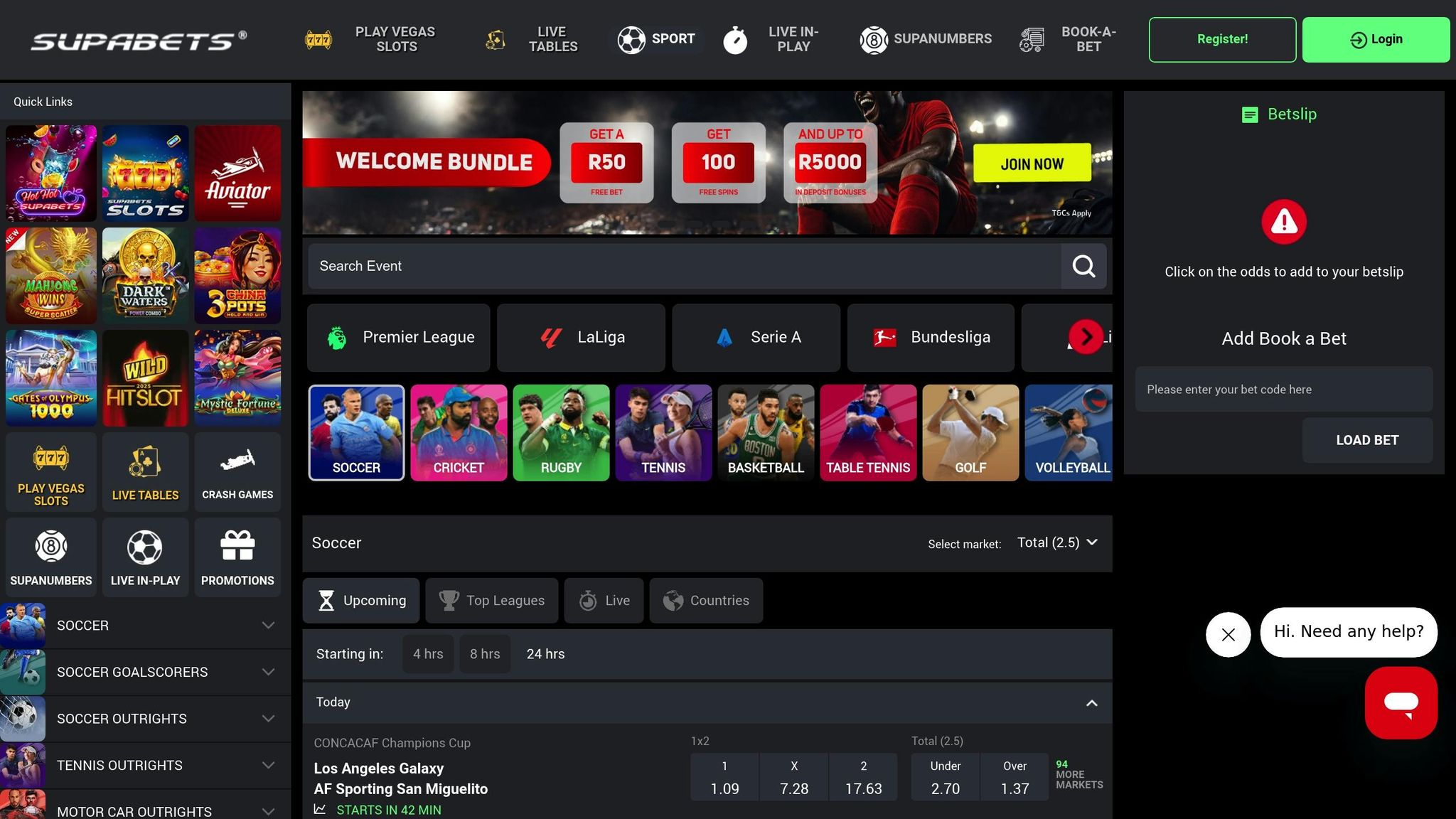
Once you’ve grasped how odds work, the next step is to ensure you’re getting the most out of your bets. Comparing betting markets on Supabets can make a big difference. Even small variations in odds can significantly affect your returns, and shopping for the best lines is one of the easiest betting strategies to adopt.
Take this example: for the same match, Moneyline odds might sit at 2.10, while Point Spread or Asian Handicap odds could offer 2.50 for essentially the same prediction. If you place a R100 bet at 2.10, your return would be R210. But at 2.50, that same R100 would yield R250 – an extra R40 in your pocket. This simple comparison shows why it’s worth taking the time to evaluate all available markets. Over a season of wagers, those small differences add up to meaningful profit.
The real trick is spotting value bets – situations where the odds are better than the event’s actual likelihood. For instance, if you believe a team has a 60% chance of winning but the odds suggest only a 50% probability, that’s your opportunity. Concepts like arbitrage betting and matched betting also revolve around exploiting odds differences, though they require more experience. Over time, these value bets can lead to better returns and fewer losses.
Odds can also shift due to factors like team updates, injuries, or betting trends. Keep an eye on Supabets, especially as kickoff approaches, for any movements that might open up new opportunities. For example, if an underdog’s odds improve unexpectedly, it could indicate that the favourite is being overestimated.
To refine your bets, use the previously discussed method to calculate implied probability. If your analysis shows a higher likelihood than the odds suggest, you’ve found a smart bet. This habit of comparing odds not only increases your chances of success but also works hand-in-hand with solid bankroll management. Betting just 1–5% of your bankroll per wager can help you stay in control while you search for the best odds on your sportsbook.
5. Bet on Familiar Sports Only
When it comes to betting, your best strategy is to focus on sports you know inside and out. This is where your experience and understanding can give you a real edge — far more than relying on strong instincts or daring predictions alone.
If you’re just starting, stick to sports you already follow closely. Your knowledge of teams, players, and strategies can be a game-changer. The betting strategies used by winning bettors almost always start with deep expertise in one sport.
“Pick a sport to bet on that you know inside and out. One where you are fully invested in each team’s makeup, historical performance, and management – on and off the pitch.”
Take the DStv Premiership, for example. If you’ve been a fan for years, you probably know which teams struggle away from home, how coaching changes affect gameplay, and how injuries to star players can shift the balance. These details often aren’t fully factored into the odds, which is where your research gives you an edge over the sportsbook.
Even in international leagues, this approach holds up. For instance, during the 2020 NFL season, favourites went 119-149 against the spread (ATS), showing that even high-profile teams require careful analysis.
Focusing on one sport allows you to develop a deeper understanding, which makes it easier to identify trends. Beginners often spread their bets across multiple sports, but this can dilute their ability to spot meaningful patterns. Instead, concentrate on a single league or even a specific conference. This way, you can stay on top of injury updates, form changes, and tactical adjustments — information that helps you win more of your wagers over time.
One important tip: avoid betting on your favourite team. It’s tough to stay objective when your emotions are involved, and bias can cloud your judgement. If you can’t analyse your team’s performance impartially, it’s better to skip those matches altogether.
Lastly, steer clear of betting on sports you don’t understand just for the sake of variety. Placing bets on unfamiliar games increases your risk and turns your decisions into guesses rather than informed choices. Stick to what you know, and wait for opportunities where your expertise can truly make a difference.
6. Use Unit Betting Sizes
To keep your betting consistent and disciplined, using unit sizes is a smart strategy. A unit is simply a standard measure, tied to a fixed percentage of your bankroll, that determines how much you wager on each bet. It’s one of the simplest yet most effective betting strategies for controlling risk.
Here’s how it works: choose a percentage of your bankroll to represent one unit. Most experienced bettors stick to a unit size of 1% to 3% of their total bankroll. For example, if you have R1,000 set aside for betting and decide on a 2% unit size, each unit equals R20. Every bet you place will then be a multiple of this amount, whether you’re placing a single wager or exploring multiple betting markets in a game.
Why does this matter? It helps remove emotions from your betting decisions. As Jimmy Boyd from BoydsBets puts it:
“Units provide a psychological edge. By thinking in units instead of dollars, you take some emotion out of betting.”
Instead of focusing on how much money you’re winning or losing, you’re tracking your performance in a structured way. This makes it easier to stick to your strategy and avoid impulsive decisions, a lesson that pros learn early in their betting careers.
Here’s a quick look at how different unit sizes work with varying bankrolls:
| Total Bankroll | 1% Unit (Conservative) | 2% Unit (Moderate) | 5% Unit (Aggressive) |
|---|---|---|---|
| R500 | R5 | R10 | R25 |
| R1,000 | R10 | R20 | R50 |
| R2,000 | R20 | R40 | R100 |
| R5,000 | R50 | R100 | R250 |
For best results, stick to flat betting, this means wagering one unit per match consistently. It simplifies your risk management and helps you evaluate your performance over time. Resist the urge to adjust your unit size after a win or loss. Any changes to your bankroll should follow the careful strategies outlined earlier.
This unit-based system works hand-in-hand with disciplined bankroll management, ensuring you stay on track and in control. There is no magic betting system that guarantees profit, but consistent position sizing gives every bettor a fighting chance.
7. Avoid Chasing Losses
Betting Strategies Used by Bettors to Avoid a Loss Spiral
Chasing losses is one of the quickest ways to drain your bankroll. It often leads to larger, riskier bets in an attempt to recover previous losses, which can spiral out of control. Even seasoned bettors can fall into this trap, and it rarely ends well. Understanding why this happens is one of the most important sports betting strategies you can learn.
Imagine losing R100. You might feel tempted to double your next wager to recover the loss. But if that second bet loses (at typical odds of -110), you’re now R300 in the hole. To recover from that, you’d need to risk about R330 on your next bet. This cycle of impulsive decisions can snowball, wiping out your funds while clouding your judgement. One loss leads to another, and there is no quick recovery when your betting system breaks down.
This behaviour is driven by loss aversion, the psychological phenomenon where losses hurt about twice as much as wins feel good. This emotional sting can push you to make irrational bets, hoping to erase the pain of losing.
It’s worth noting that even professional bettors, who win only about 54% to 55% of their bets, avoid letting emotions guide their decisions. The pros treat every wager the same, regardless of whether the previous bet was a win or a loss. As Jeff Edelstein from Sports Handle wisely says:
“Tilting leads to chasing, chasing leads to losing.”
To break free from this cycle, discipline is essential. Just as proper bankroll management is crucial, so is resisting the urge to make recovery bets. One effective strategy is setting a strict stop-loss limit. For instance, if you lose 10% of your bankroll within a day or week, stop betting for that period. Another helpful tactic is implementing a cooling-off period. After a loss, wait at least an hour – or even up to two days – before placing another bet. This pause allows you to regain a clear head and make more rational decisions, rather than acting out of frustration or “tilt.” Learning to handle losses calmly is there among the betting strategies that separate successful bettors from those who blow their bankroll.
8. Track All Your Bets
Keep a detailed record of every bet you place. Why? Because relying on memory alone can give you a skewed view of your betting history. Big wins tend to stick in your mind, while smaller, consistent losses often fade into the background. For instance, you might vividly remember winning R500 on the Springboks but forget about the three R100 losses on midweek football. Tracking every wager in a spreadsheet gives you accurate data to refine your betting strategy, spot patterns, and learn from each outcome — whether it was a win or a loss.
9. Leverage Live In-Play Betting Features
How to Win with In-Play Betting and Smart Wagers on Your Sportsbook
Live betting allows you to place wagers while the match is in progress, using real-time insights into momentum shifts, tactics, and player conditions to identify opportunities before the odds adjust. Just like pre-match betting, success here requires discipline and a solid understanding of how odds work. In-play betting has become one of the most popular betting markets, and the strategies you apply there can make a real difference to your profit.
One key strategy is to look beyond the scoreboard. For instance, if the Springboks concede an early try but dominate possession and territory, their odds might lengthen, creating a potential value opportunity. Similarly, a limping player or a crucial substitution could signal a shift in momentum before the market reflects it. Observing these subtleties can help you make well-timed, informed bets as the game unfolds — and it’s exactly the kind of approach that pros use to find an edge.
Timing matters – a lot. Avoid making bets in the first few minutes when emotions often cloud judgment. Instead, wait 20–30 seconds after major events like goals or red cards to let the market settle. Halftime is also an ideal moment to reassess your strategy without the pressure of live play.
Keep in mind that broadcast streams can lag by 20–40 seconds behind the actual action. To avoid outdated information, rely on live stats feeds. In fast-paced sports, even a small delay can significantly impact the value of your bets and the accuracy of your picks.
If you’re new to live betting, consider starting with lower-risk options like Draw No Bet, Double Chance, or Asian Handicap markets. These provide a layer of protection against sudden, unpredictable swings late in the game. Above all, stay disciplined – watch the action closely and avoid placing impulsive bets driven by frustration over recent losses. By blending these live betting techniques with your broader betting strategy, you can stay sharp and in control throughout the match.
10. Stay Disciplined and Set Limits
Discipline is the cornerstone of turning betting from a casual pastime into a more structured and responsible activity. Before placing your first wager, decide how much money and time you’re willing to invest, and stick to those boundaries. Importantly, your betting bankroll should come solely from disposable income, never from money needed for essentials like rent, groceries, or bills. A practical guideline is to allocate only 1% to 2% of your monthly income to sports betting. This complements earlier strategies like bankroll management and unit sizing, and it’s one of the betting strategies used by every responsible bettor.
Expert insight:
“A disciplined bankroll strategy removes emotion from the equation and replaces it with consistency, patience, and smart unit sizing that allows your edge to play out over time.” – LJ Blut, Professional Handicapper
Take advantage of responsible gambling tools available in most betting platforms. Use features like deposit, loss, and session limits to keep your wagering in check. For instance, if you lose 20% to 25% of your bankroll, take a break from betting for at least 48 hours to reassess. This kind of structure helps you maintain control and evaluate your performance effectively.
Treat each bet as a long-term investment. Keep a simple spreadsheet to track your wagers, noting details like the date, event, stake, odds, and outcome. This not only keeps you accountable but also provides a clear picture of your betting habits. If you find that betting starts to affect your finances, relationships, or overall wellbeing, consider using self-exclusion programmes immediately. Remember, discipline isn’t about winning every bet; it’s about protecting your funds and ensuring a sustainable approach to sports betting.
Conclusion
Build Your Betting Strategy with Research and Bankroll Discipline
By sticking to clear, step-by-step strategies, anyone can refine their betting approach. Each technique in this betting guide builds on the last, creating a structured system that replaces guesswork with informed decision-making. As Ethan Moore explains, “A well-crafted betting system aims to shift the advantage that the bookmaker typically holds over to the player”. This shift happens when you rely on data-driven research and consistently apply proven methods, not on strong instincts or daring predictions alone.
The secret to success is treating betting like a business rather than a casual pastime. Focus on sports or leagues you truly understand, whether it’s the PSL, European football, or cricket, and keep meticulous records of your bets. This habit not only highlights what’s working but also helps you recognise patterns in your choices, allowing you to adjust your strategy based on facts rather than emotions. There is no substitute for doing the work, and the best bettors know that every win and every loss is part of a bigger picture.
Key elements like value betting, comparing odds, and steering clear of common mistakes are essential for building a sustainable, long-term approach. Concepts like arbitrage betting, matched betting, and the Kelly Criterion might seem advanced, but they all share one thing in common: they’re grounded in research, disciplined bankroll management, and statistical insights. These methods create a betting system designed for steady progress. The aim isn’t to win every bet, that’s unrealistic, but to make smarter choices that protect your bankroll and improve your chances of success over time.
Stick to these sports betting strategies, use responsible gambling tools, and never wager money you can’t afford to lose. With patience, discipline, and a commitment to learning, you can develop the skills to approach sports betting as a balanced and enjoyable activity. Start small, stay disciplined, and let these principles guide every bet you place. Learn expert sports betting strategies one step at a time, and remember: the pros didn’t get there overnight.
FAQs
How Do I Pick My First Unit Size for Bankroll Risk Management?
Choose a fixed percentage of your bankroll – typically between 1% and 5% – as your unit size, depending on how much risk you’re comfortable with. For instance, if your bankroll is R10,000 and you decide on 1%, your unit would be R100. Stick to this unit size consistently and only consider adjusting it if your bankroll changes significantly, such as increasing or decreasing by 25%. This approach helps you stay disciplined and manage risk wisely. Whether you’re betting on one game or across multiple betting markets, this fixed sizing method keeps your wagers under control.
How Do I Spot a Value Bet Using Implied Probability and Odds?
To identify a value bet, you need to compare your own estimated probability of an outcome with the market’s implied probability. The implied probability can be calculated from decimal odds by dividing 1 by the odds and then multiplying the result by 100. If your estimated probability is greater than the implied probability, it indicates the market might be undervaluing that outcome, potentially making it a worthwhile bet. This is one of the key sports betting strategies that experienced bettors rely on to gain an edge, and it works across every sportsbook and every sport.
What Should I Track in a Betting Spreadsheet to Improve Your Picks?
When setting up a spreadsheet to track your bets, make sure to record the essential details that will help you analyse your performance and fine-tune your approach. These should include:
- Date of the bet: Keep a record of when the wager was placed.
- Sport and event: Specify the sport and the particular game or event you bet on.
- Bet type and odds: Note whether it was a single, accumulator, or another type of bet, along with the odds.
- Amount wagered: Log how much money you staked.
- Outcome (win or loss): Clearly indicate whether you won or lost the bet.
- Profit or loss: Calculate and record the financial result.
You might also want to include extra columns for details like teams, players, bookmakers, or personal notes. These can help you spot patterns and make smarter betting choices in the future. Over time, tracking your picks builds a data-driven foundation that separates informed bettors from those relying on guesswork.