If I had to cut advanced soccer betting down to one line, it’s this: I only bet when my price is better than the market price.
That means I’m not betting because a team is “due”, on a hot streak, or a big name. I’m checking four things first:
- price vs probability
- stats like xG and shot volume
- the right market for the match
- fixed staking, such as 1% of bankroll
In plain terms, this article says advanced betting is less about picking winners and more about finding bad prices. It also shows where markets like Draw No Bet, Double Chance, BTTS, Over/Under, and Asian Handicap fit best. And it keeps risk in check with simple bankroll rules, like a daily stop-loss of 5 units and a weekly stop-loss of 15 units.
A few takeaways stand out straight away:
- If I back a team in 1X2, a draw means I lose the full stake.
- If I use Draw No Bet, a draw means my stake comes back.
- If I use Double Chance, I cover 2 of 3 outcomes, but the odds are shorter.
- If I use Asian Handicap, I can shape risk more tightly than with a straight win bet.
- If I stake R50 from a R5 000 bankroll, that’s 1 unit at 1%.
Sharpen Your Football Betting with These 10 Proven Strategies
sbb-itb-00c3b18
Quick comparison
| Area | Basic approach | Advanced approach |
|---|---|---|
| Main focus | Picking winners | Finding price gaps |
| Data used | Form, table position, club name | xG, shot data, team news, venue splits |
| Market use | Mostly 1X2 | DNB, Double Chance, BTTS, totals, AH |
| Staking | Random or emotional | Fixed units in Rand |
| Risk control | Little to none | Stop-loss rules and bet tracking |
So before I place any soccer bet, I want a simple process: rate the match, compare my number to the odds, choose the best market, and keep the stake level. That’s the whole idea here.
Core Markets and How to Use Them Better
Once you’ve found the value, the next move is simple: pick the market that fits the match.
Match Result, Draw No Bet and Double Chance
A standard 1X2 bet is easy to understand, but it’s also the most exposed. If you back a team to win and the game finishes level, your full stake is gone. Two markets deal with that problem in different ways: Draw No Bet (DNB) gives you your stake back on a draw, while Double Chance lets you cover two outcomes.
Draw No Bet (DNB) takes the draw out of the picture. If the match ends level, your stake is refunded. It’s a good option when you fancy the stronger side but don’t want a draw to wreck the bet.
Double Chance covers two of the three possible results. If you back 1X, for example, you win if the home side wins or if the match ends in a draw. The catch? Lower odds. More experienced punters often use Double Chance in multi-bets, especially when they want to avoid one draw blowing up the whole slip.
Goals Markets and Both Teams to Score
Over/Under goals and Both Teams to Score (BTTS) shift the focus away from picking the winner. Instead, you’re betting on how the match is likely to play out. That’s why these markets work well with stats.
For Over/Under bets, combined xG and shot volume usually tell you more than recent scorelines. A side may have let in very few goals over the last few matches, but if the underlying defensive numbers look poor, that spell might not continue. Teams that press hard and break fast often produce messy, open periods in matches. Those are often better spots for Over 2,5 goals. In the PSL, tighter games often lean more toward Under 2,5 goals or BTTS No.
BTTS Yes stays alive until full time, which is part of what makes it so popular.
Handicap Markets, Including Asian Handicap
If the total number of goals matters less than the winning margin, handicap markets make more sense.
Standard handicaps can still end in a draw on the line. If you back a team at -1 and they win by exactly one goal, the handicap pushes and your stake is returned.
Asian Handicap (AH) removes the draw from the bet, which gives you a cleaner two-way market. A half-ball line such as -0,5 or +1,5 means there are only two outcomes: win or lose. Quarter-ball lines split your stake across two nearby lines, so one part of the bet can win while the other part pushes. That gives you more control when backing favourites or underdogs, without having to settle for a straight-win price that’s too short.
| Market | Draw Result | Best Used When |
|---|---|---|
| 1X2 (Match Result) | Stake lost | High-conviction pick with a clear winner |
| Draw No Bet | Stake refunded | Stronger team, but a draw is a real risk |
| Double Chance | Bet wins if covered outcomes land | Defensive play in accumulators |
| Asian Handicap (half-ball) | No draw possible | Removing draw entirely from the equation |
| Asian Handicap (quarter-ball) | Partial refund or half-win | Precise position on favourites or underdogs |
These core markets are available on the Supabets soccer page.
Data-Driven Analysis Before You Place a Bet
Once you’ve picked the market, the next edge comes from a solid pre-match process. Advanced betting is built on a routine you can repeat, not gut feel.
Form, Team News and Match Context
Start with the last five or six matches, but don’t just scan the scorelines. Look at goal difference, defensive record, and who those results came against. Three wins over bottom-half teams don’t carry the same weight as three wins over top-six sides.
Home and away splits matter more in the PSL than many punters think. A team’s overall record can hide a big gap in performance – good at home, poor away, or the other way around. Venue, travel, and even pitch type can shift how a side plays.
Injuries and suspensions can move the price in a big way, especially if a first-choice goalkeeper or main striker is out. Check club updates and press conferences before you bet, because markets are often priced before confirmed team news is out.
Fixture congestion is another thing to watch, especially with continental matches. If Mamelodi Sundowns or Orlando Pirates played a midweek CAF fixture, rotation in the weekend game becomes more likely, mainly if the travel load was heavy.
Match context matters as well. Title races, relegation scraps, and teams saving players ahead of a cup final can all change how a match is played.
Results show one side of the picture; chance quality shows the other.
Using xG and Key Performance Indicators
xG measures chance quality, not just goals. For betting, it becomes useful when you compare it with actual results. If a team keeps winning while posting lower xG than its opponents, it may be getting help from short-term variance. The opposite also applies: if a side keeps making good chances but isn’t finishing them, it could be due for positive regression.
For Over/Under and BTTS markets, combined xG across both teams is often a steadier guide than one match with a lot of goals. Defensive xG matters too. A team that has let in only a few goals but is allowing high xG against may just be getting a lift from strong goalkeeping form that may not last. For handicap bets, the xG margin between the two teams can back up – or question – the gap suggested by the odds.
The more leagues you follow, the harder it gets to keep your reads sharp.
Why Focusing on Fewer Leagues Pays Off
Too many leagues can water down your edge. If you focus on the PSL and one or two major overseas leagues, like the English Premier League, you start spotting patterns that casual bettors miss. You learn which teams sit on a lead, which sides press hard and leave gaps, and how squads react when fixtures pile up. That sort of knowledge is tough to build from a quick scan of a league you hardly watch.
Smaller or more familiar leagues can also be easier to price when you know the teams well. That depth of knowledge is what helps turn analysis into a steady betting edge.
Bankroll Control, Staking and Live Betting Discipline
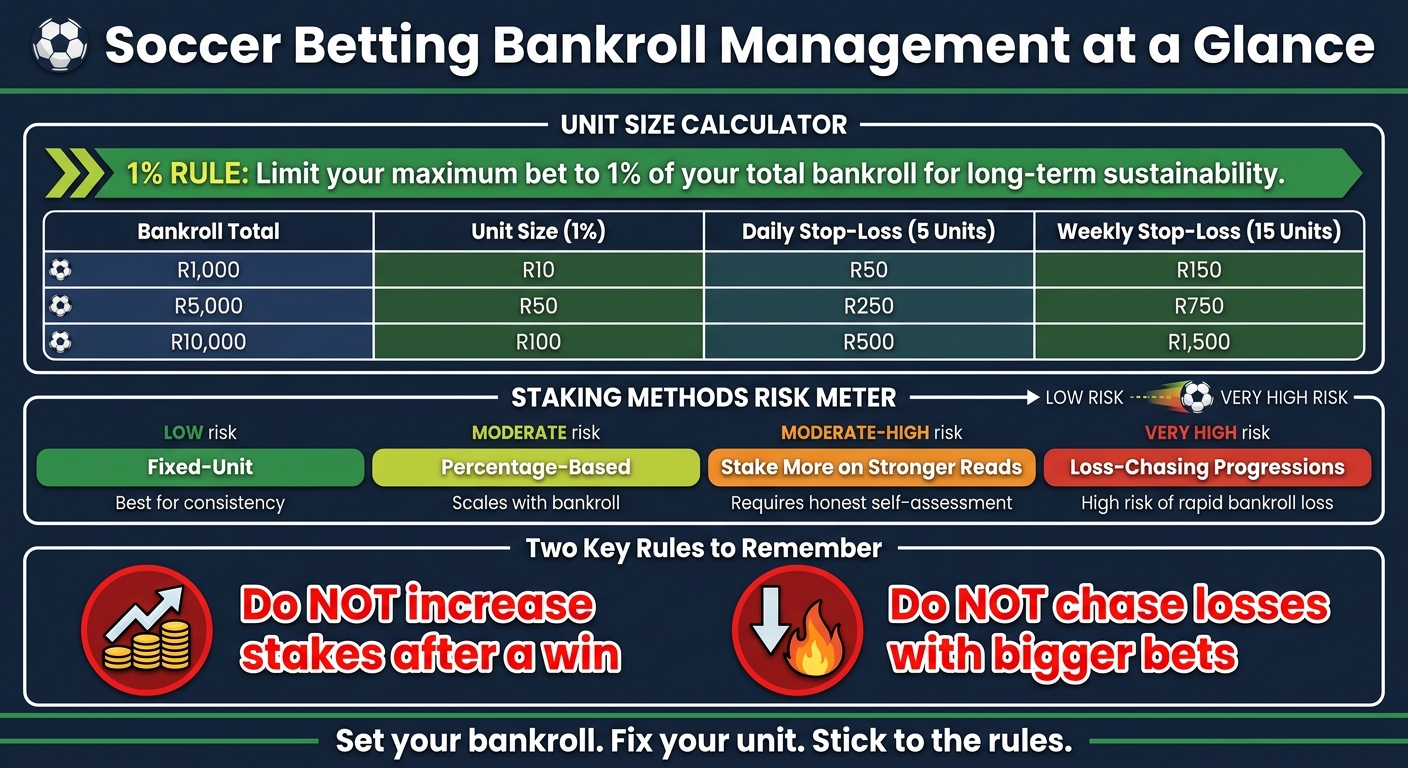
Soccer Betting Bankroll Management: Unit Sizes & Stop-Loss Rules by Bankroll Size
Picking the right market is only part of the job. Bankroll rules decide whether your edge sticks around. Even when your read is good, poor money management can undo it fast.
Setting a Bankroll and Unit Size in Rand
Your betting bankroll should be a fixed amount of money set aside ONLY for betting. It must stay separate from rent, groceries, school fees, or savings.
Once that amount is set, make 1 unit equal to 1% of your bankroll.
Here’s what that looks like in Rand:
| Bankroll Total | Unit Size (1%) | Daily Stop-Loss (5 Units) | Weekly Stop-Loss (15 Units) |
|---|---|---|---|
| R1 000 | R10 | R50 | R150 |
| R5 000 | R50 | R250 | R750 |
| R10 000 | R100 | R500 | R1 500 |
This sounds simple, but that’s the point. A clear unit size takes emotion out of the call.
Two habits wreck bankrolls fast:
- increasing stakes after a win
- chasing losses with bigger bets
Both feel tempting in the moment. Both can drain a bankroll before you know it.
Staking Methods Compared
There are a few common staking methods, and the gap in risk between them is massive over time.
| Staking Method | Simplicity | Volatility | Risk of Bankroll Loss | Long-Term Discipline |
|---|---|---|---|---|
| Fixed-Unit | High | Low | Low | Best for consistency and beginners |
| Percentage-Based | Moderate | Moderate | Moderate | Good balance; scales with bankroll |
| Stake More on Stronger Reads | Low | High | Moderate to High | Requires accurate self-assessment |
| Loss-Chasing Progressions | Medium | Very High | Very High | High risk of rapid bankroll loss |
Fixed-unit staking keeps your bet size level from one wager to the next. Percentage-based staking moves with your bankroll, so your stake changes as your balance changes.
Staking more on stronger reads sounds smart, but it asks for honest self-rating every time. That’s harder than it seems. Loss-chasing progressions sit at the other end of the scale. They carry the most danger and can burn through a bankroll in a short spell.
How to Plan Live In-Play Bets With Stricter Limits
The same discipline matters even more in-play. Live markets move fast, prices change in seconds, and markets can suspend during goals or red cards. That speed makes impulse betting far more likely.
Set a fixed live-betting cap before kick-off and do not go past it. Your live stakes should also be smaller than your normal pre-match unit. The faster the market moves, the less room you have to think clearly.
A better approach is to enter live markets only when a pre-set trigger appears, not when emotion kicks in. That trigger could be:
- a goal
- a red card
- a clear tactical shift
The key idea is simple: your live bet should still come from the same read as your pre-match analysis, only at a different price.
A red card can push odds out of line more than it changes the actual edge. On the other hand, a clean tactical shift often matters more than a short burst of pressure that looks dramatic but fades after a few minutes.
Set a hard daily stop-loss, and once you hit it, stop. No exceptions. That limit is there to stop the kind of chasing that turns one poor session into serious bankroll damage.
Those limits keep the approach repeatable instead of emotional.
Building a Personal Strategy and Final Takeaways
Advanced Strategy Styles Compared
Once you’ve got your core markets, data points, and staking rules sorted, the last piece is picking a style that matches your schedule and your appetite for risk. Each approach uses value, data, market selection, and bankroll control a bit differently.
| Strategy Style | Required Data | Complexity | Best-Fit Markets | Strengths | Limitations |
|---|---|---|---|---|---|
| Value Betting | Implied vs. True Probability | High | 1X2, Match Result | Best when your model consistently beats market price. | High variance; needs many bets |
| xG-Based Analysis | Shot quality, xG trends | Medium | Over/Under, BTTS | Best for totals and BTTS spots. | Can ignore game state/tactics |
| Handicap Specialisation | Team strength/Home-Away splits | Medium | Asian Handicap | Best when one side has a clear strength edge. | Requires deep league-specific knowledge |
| Live In-Play Strategy | Live game state, injuries, and red cards | High | Next Goal, In-Play Result | Best only with strict pre-set triggers. | Fast-paced; high emotional risk |
There’s no one-size-fits-all option here. The best style for you comes down to two things: how much time you can put into research, and how comfortable you are with swings in results.
How to Build a Repeatable Betting Framework
After you choose a style, turn it into a fixed process. Don’t use one method for Saturday’s derby and another for Sunday’s underdog play. That usually gets messy fast.
A repeatable framework has four parts: selection rules, staking rules, analysis rules, and review rules. Put them in writing. If your process only lives in your head, it’s much easier to bend the rules when pressure kicks in.
Set a fixed unit size in Rand. For most bettors, that means risking one fixed unit per bet, usually 1% of bankroll. If you want to specialise, stick to one league and one main angle. For example, you might focus on xG-based analysis in the PSL. That makes it easier to read team news, current form, and market movement with more confidence.
Your entry rules also need to be crystal clear. Only bet when your number beats the market price. That gap is where value sits.
Track every bet in a log. Include:
- Date
- Event
- Market
- Odds
- Stake in Rand
- Result
- CLV
Then review that log every 30 days or after at least 100 bets, whichever comes first.
One advanced check worth using is Closing Line Value (CLV). Compare the odds you took with the closing odds just before kick-off. If you keep beating the closing price, that’s a strong sign your process is working, even if a few short-term results go against you.
Conclusion: The Key Points That Matter Most
Advanced soccer betting comes down to four things: finding value, using data well, picking the right market, and protecting your bankroll. Apply these principles on the Supabets soccer section.
FAQs
How do I calculate value in soccer betting?
Calculate value by comparing the bookmaker’s implied probability with your own estimate of the outcome’s true chance. To get implied probability from decimal odds, divide 1 by the odds.
Then use EV: (Win Probability × Decimal Odds) – 1. If the result is above zero, the bet has value.
Which market suits a low-scoring match best?
For a low-scoring match, the Under 2.5 goals market is often the best fit. It covers games that finish with two goals or fewer.
If you have a very specific result in mind, Correct Score can work too. Both Teams To Score (No) is another good option if you think at least one side won’t find the net.
Why does CLV matter if my bet loses?
CLV matters because it tracks the quality of your decision, not the short-term outcome of a single match. In soccer, even a smart bet can lose. That’s just variance and randomness doing their thing.
If you beat the closing line on a regular basis, it usually points to a sound process. And over time, positive CLV gives you a solid way to judge long-term performance, separate from the luck of any one result.