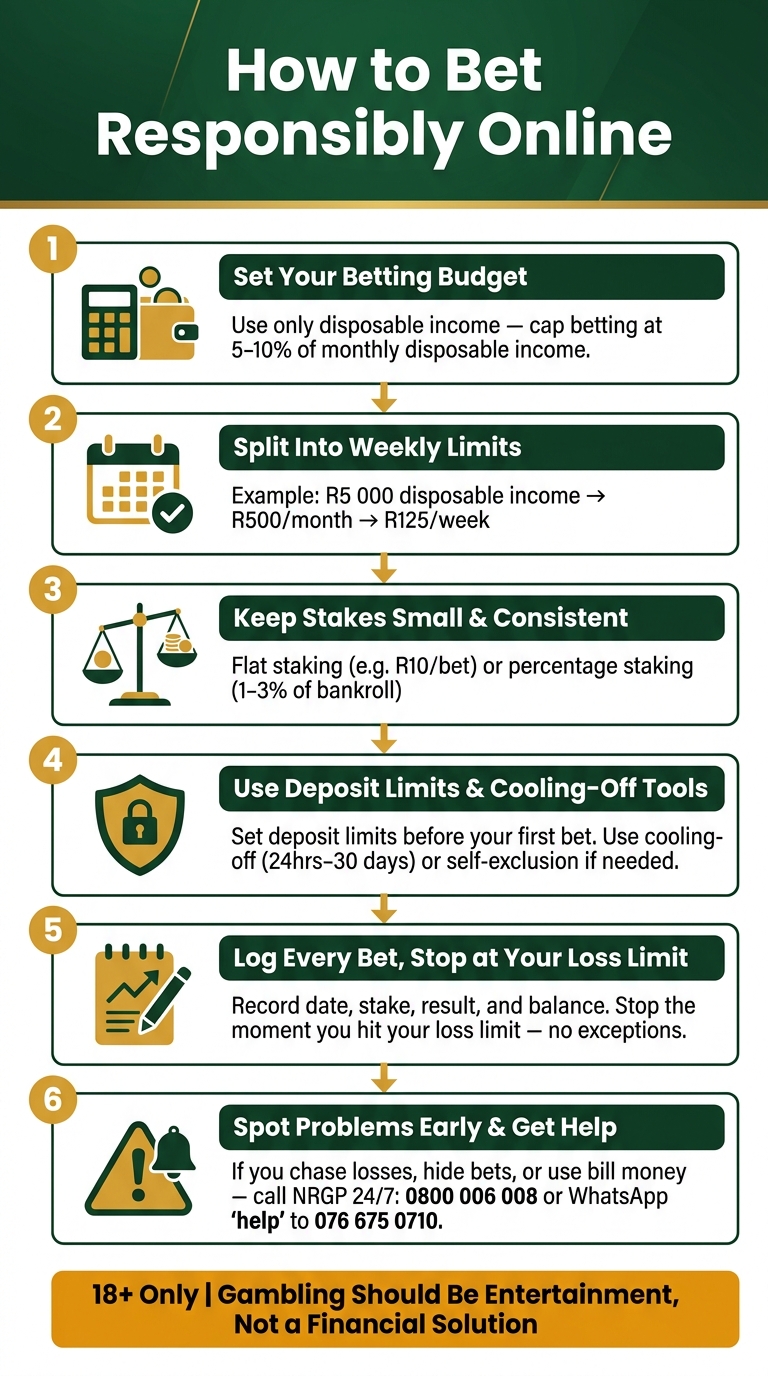
If I want to bet online without losing control, I keep it simple: set a fixed budget in rand, keep each stake small, stop at my loss limit, and never use bill money or borrowed money. Betting is 18+ only, and it should stay a fun spend – not a way to pay for rent, groceries, transport, or debt.
Here’s the short version:
- I treat betting like paid entertainment
- I use only disposable income
- I cap betting at about 5% to 10% of monthly disposable income
- I set deposit limits before I start
- I avoid chasing losses after a bad run
- I take breaks when I’m stressed, tired, or upset
- I get help early if my betting starts affecting money, work, or family life
A few numbers make this clear. If my monthly disposable income is R5 000, then a 10% betting budget is R500 a month, or about R125 a week. If I hit that limit, I stop. No top-ups. No “just one more bet”.
My rule is simple: if losing the money would hurt my month, it’s too much. That means small, steady stakes, a bet log, session limits of 30 to 60 minutes, and account tools like deposit limits, cooling-off, or self-exclusion when needed.
If I spot warning signs – like hiding bets, borrowing money, or using grocery cash – I stop and get support. In South Africa, I can contact the NRGP 24/7 on 0800 006 008 or WhatsApp “help” to 076 675 0710.
This article boils down to one idea: bet less, track more, and stop early.
How to Bet Responsibly Online: A Step-by-Step Guide
Set A Betting Budget And Bankroll In Rand
Once you know what you can afford to lose, turn that amount into a fixed bankroll in rand before you place a single bet.
Choose A Weekly Or Monthly Betting Limit
Start with your take-home pay. Take away rent, food, transport, airtime, debt payments, and other must-pay costs. What’s left is your disposable income. From that amount, set aside no more than 5–10% for betting.
Here’s what that can look like at different income levels:
| Monthly Disposable Income | Max Betting Budget (10%) | Weekly Limit |
|---|---|---|
| R3 000 | R300 | R75 |
| R5 000 | R500 | R125 |
| R10 000 | R1 000 | R250 |
| R15 000 | R1 500 | R375 |
Breaking a monthly budget into weekly limits helps a lot. It stops you from burning through your full bankroll in one weekend and then dipping into money meant for other things.
Keep Stakes Small And Consistent
Once your bankroll is set, keep each bet small and steady. The goal is simple: stay in control.
You can use one of these two staking methods:
| Method | How It Works | Best For | Risk |
|---|---|---|---|
| Flat Staking | Bet the exact same rand amount every time, for example R10 per bet. | Small to medium bankrolls, such as R200–R500 | Does not adjust for bankroll growth or losses |
| Percentage Staking | Bet a fixed percentage of your current bankroll, typically 1–3%. | Larger bankrolls, such as R1 000+ | Stakes shrink during losing runs, protecting your balance |
For most beginners, flat staking is the safer starting point. It’s easy to follow and keeps your spending easy to predict. If your bankroll is R500 and you bet R10 each time, you have 50 bets before that budget is gone.
Don’t bump up your stake after a win. And don’t try to win back losses by betting more. That’s how small slips turn into expensive ones.
Track Every Bet And Stop At Your Loss Limit
After you’ve set your stakes, track every bet. If you don’t track it, it’s easy to think you’re doing fine when the numbers tell a different story.
A simple log is enough. Use your notes app or a basic spreadsheet. Write down:
- the date
- the stake
- the result
- your updated bankroll balance after each bet
This takes less than a minute per bet, and it shows you exactly where your money is going.
Set a hard loss limit before each betting session too. For example, you might cap losses at R100 for the week. The moment you hit that limit, stop. No “one last bet”. No trying to chase your money back. The odds don’t get better just because you’re down, and chasing losses is one of the fastest ways to overspend.
sbb-itb-00c3b18
Use Supabets Controls To Stay In Charge
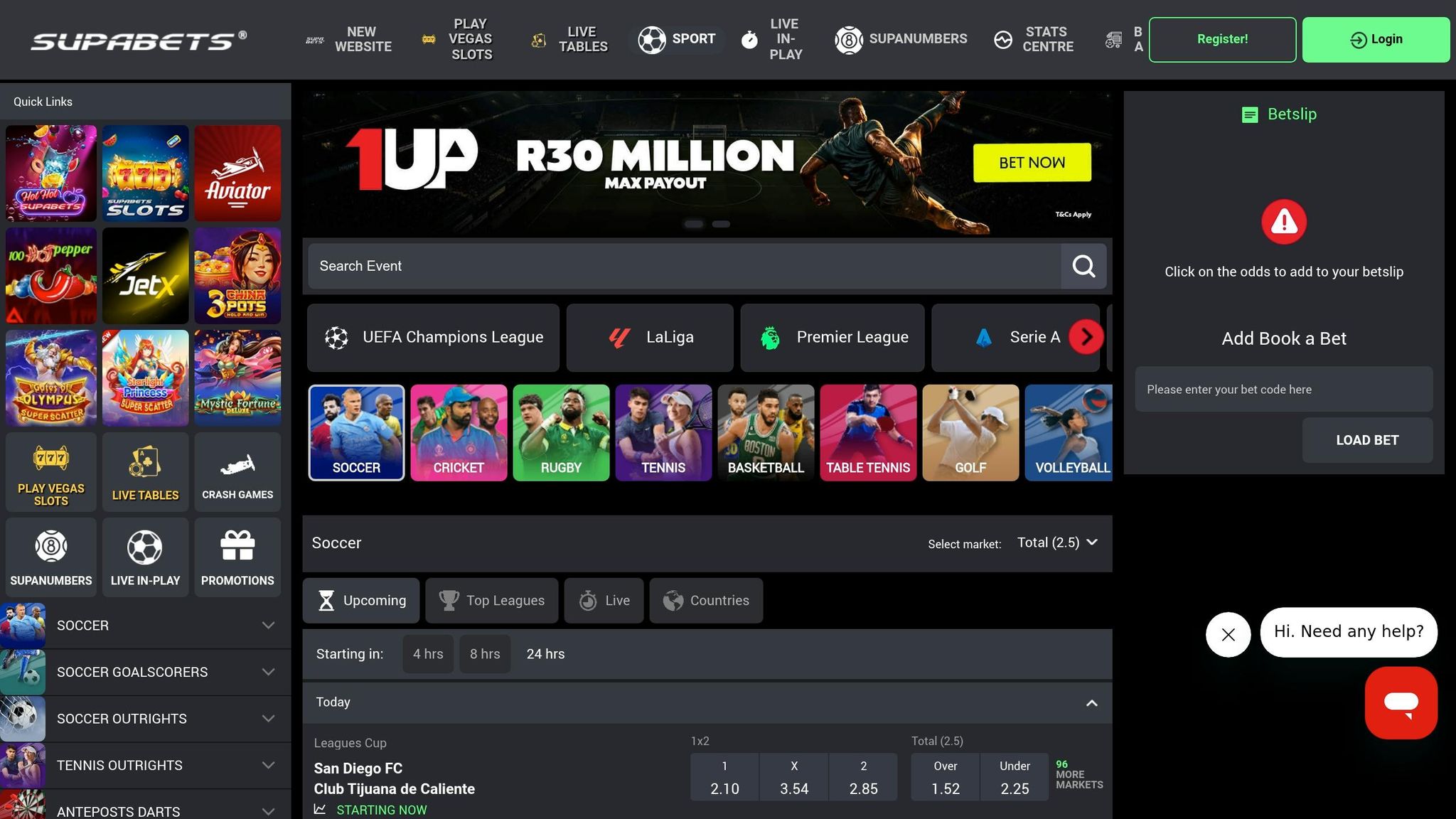
Once you’ve set your bankroll, the next step is simple: add account limits so your plan still holds up when your judgement starts to wobble.
Set Deposit Limits Before You Start
The best time to set a deposit limit is straight after registering, before you place your first bet. When you’re calm, you’re far more likely to make clear money decisions. In the middle of a losing streak, that gets much tougher.
On Supabets, you can set daily, weekly, or monthly deposit limits in your account settings under Responsible Gambling or Deposit Limits. The key is to match that limit to the rand budget you’ve already worked out. So if your weekly betting budget is R125, set your deposit cap at R125.
Here’s a quick look at the main controls and when each one makes sense:
| Control Tool | What It Does | How to Use It | When It’s Most Useful |
|---|---|---|---|
| Deposit Limits | Caps how much rand you can deposit daily, weekly, or monthly | Account Settings > Responsible Gambling | Before you start betting, to stay within your budget |
| Cooling-Off Period | Pauses your account for 24 hours to 30 days | Contact Supabets support or select "Take a Break" in settings | After a stressful session, repeated losses, or emotional betting |
| Self-Exclusion | Locks your account for 6 months, 1 year, or permanently | Contact support via live chat or email at support@supabets.co.za | When you keep breaking your own rules or chasing losses |
If you feel that urge to top up after a loss, don’t feed it. Use a break instead.
Take A Break When Emotions Run High
Long betting sessions and repeated losses can wear down your judgement more than people think. When you’re frustrated, tired, or stressed, it’s much easier to place impulsive bets that have nothing to do with your plan.
A cooling-off period is the practical answer here. It’s a short-term pause on your account, from 24 hours to 30 days, that stops you from betting while you reset. You can request one through Supabets customer support.
Do not chase losses.
If you notice that you’re betting to escape stress or boredom, not for entertainment, that’s your clearest sign to step back for a bit.
If short breaks aren’t enough, move to self-exclusion.
Use Self-Exclusion If You Lose Control
Self-exclusion is for the point where you can’t stick to your limits. Contact Supabets through live chat or email at support@supabets.co.za to request it. Once you make that request, stop betting at once.
Spot Warning Signs And Protect Yourself
If your limits are starting to slip, pay attention to the signs. Most betting problems don’t show up all at once. They build bit by bit, and spotting them early can make a big difference.
Common Signs Of Unhealthy Betting
There are three main types of warning signs to watch for:
- Financial: spending past your limit, using rent or grocery money, borrowing money or selling possessions to fund bets, or hiding how much you’ve spent from a partner or family member.
- Behavioural: chasing losses, betting longer than planned, lying about time or money spent, or neglecting work and social plans to keep a session going.
- Emotional: feeling guilty or ashamed after a session, stressing about debts, mood swings tied to wins and losses, or betting to escape stress or boredom.
Take these signs seriously. If any of this sounds familiar, tighten your session rules now.
Build Safer Betting Habits Online
Set a 30- to 60-minute session limit before you open the app. When the time is up, log out. It sounds simple, but that small break can stop a bad session from dragging on.
Try to avoid betting late at night when you’re tired. Also, don’t bet when you’re stressed, upset, or drinking. Those are the moments when people make rushed calls. Another smart move: remove saved payment details and app shortcuts so it takes a bit more effort to deposit on impulse.
Act Early If You Notice A Problem
If the signs are already there, act now. If you’ve lost money you can’t afford to lose, stop betting. More bets won’t win it back. Lower your deposit limit in your account settings. If that doesn’t do enough, use a cooling-off period or ask for self-exclusion. Tell someone you trust so you’re not dealing with it on your own.
For free, confidential support available 24/7, contact the National Responsible Gambling Programme (NRGP) on 0800 006 008, or WhatsApp "help" to 076 675 0710. If you want a full ban across all licensed South African operators, apply to the National Register of Excluded Persons through the National Gambling Board.
| Warning Sign | Recommended Action |
|---|---|
| Using rent or bill money on bets | Lower your monthly deposit limit in account settings |
| Chasing losses after a bad session | Use a cooling-off period to step away |
| Betting while emotional or under the influence | Set a 30-minute session alarm and stop when it rings |
| Hiding betting activity from family | Call the NRGP helpline (0800 006 008) for confidential support |
| Borrowing money or selling items to fund bets | Request self-exclusion via support@supabets.co.za |
| Neglecting work or family responsibilities | Register with the National Register of Excluded Persons for a full ban across all licensed South African operators |
Conclusion: A Simple Responsible Betting Routine
Responsible betting is pretty simple: treat it like entertainment, set your budget first, keep your stakes small, and stop when you hit your limit. If you catch yourself chasing losses or hiding what you’re doing, stop right away.
Use these rules as your default:
- 18+ only – you must be at least 18 years old to have a Supabets account
- Disposable income only – use money left after bills, savings, and your emergency fund are covered
- No chasing losses – never increase your stake to try to win back losses
- No borrowing – never use credit, loans, or borrowed money to fund bets
- Take regular breaks – set a 30- to 60-minute timer and log out
- Set your deposit limit before your first bet
That keeps betting where it belongs: in the entertainment lane.
If things start to slip, contact the NRGP on 0800 006 008 or WhatsApp "help" to 076 675 0710.
FAQs
How do I calculate disposable income?
Subtract your fixed monthly obligations from your total take-home pay. In plain terms, that’s your take-home pay minus fixed costs, savings, and emergency fund contributions.
That should include the basics:
- rent or bond repayments
- utilities
- transport
- groceries
- medical aid
- insurance
- debt repayments
What’s left after that is your true disposable income. A good rule of thumb is to use no more than 5% to 10% of that amount for entertainment, including betting.
What if I keep breaking my betting limits?
If you keep going past your betting limits, act now to get things back under control. Stop gambling straight away and contact the Supabets support team at support@supabets.co.za to ask for a temporary or permanent account closure (self-exclusion).
You can also contact the National Responsible Gambling Programme on 0800 006 008 or WhatsApp HELP to 076 675 0710 for confidential support. Put basics like rent and bills first, ahead of gambling.
When should I self-exclude?
Consider self-exclusion if you can no longer control your gambling, or if deposit and loss limits aren’t enough to keep your play in check.
If gambling stops being fun or starts causing harm, self-exclusion gives you space to step back and regain control. You can do this at any time by contacting our support team.