Home advantage is real, but I would not bet on the home team for that reason alone. In the 2025/26 South African Premier Division, home sides won 41% of matches, away sides won 27%, and the rest were draws. That tells me the edge exists. But team-level numbers show it does not work the same way in every fixture.
If I want to judge home advantage properly, I look at three things first:
- Home vs away PPG
- Travel and altitude
- Whether the odds already account for the venue
That matters because some teams got less from playing at home than many bettors would expect. Orlando Pirates posted 2,20 PPG at home and 2,40 away. Kaizer Chiefs managed 1,67 at home and 1,93 away. So if I back a side just because it is at home, I can end up on the wrong side of the numbers.
I’d keep the process simple:
- Check if the team’s home PPG is higher than its away PPG
- Compare that split with the league home win rate of 41%
- Add match context like Johannesburg/Pretoria altitude above 1 300 m, travel load, injuries, and rest days
- Work out if the price still leaves room for value with 1 ÷ decimal odds
A few fixtures do deserve more weight on venue. For example, a coastal side travelling inland on a short turnaround can tire late. But in many matches, the market has already built standard home edge into the odds.
My bottom line: I use home advantage as one input, not the whole bet. If the split is weak, the squad is changed, or the price is too short, the home label means very little.
| Check | What I look for | What it tells me |
|---|---|---|
| Team split | Home PPG vs away PPG | Whether this team gains from home fixtures |
| League baseline | 41% home wins in PSL 2025/26 | Whether the team beats the norm |
| Match context | Travel, altitude, schedule, team news | Whether the edge still applies today |
| Market price | 1 ÷ decimal odds | Whether the odds leave any value |
If I do those checks before I bet, I have a much better read on when home advantage matters and when it is just noise.
How Do Match Analytics Measure Home Advantage in Sports?
sbb-itb-00c3b18
What Home Advantage Actually Means in Modern Soccer
Home advantage is the pattern where teams do better and pick up more points at home than they do away. That shifts the odds, which is why it matters for betting if you measure it the right way. The next step is figuring out how big that edge is in practice.
The numbers that describe home advantage
Three metrics tell most of the story: home win rate, Points Per Game (PPG), and goals per match.
Of the three, PPG is the clearest signal because it shows how often a team turns home displays into actual league points. A side can score plenty at home and still let points slip if it cannot hold a lead. PPG picks that up.
The goals-per-match split adds one more layer. In the South African Premier Division’s 2025/26 season, home teams averaged 1,13 goals per match while away teams averaged 0,90. The gap is not massive, but over a full season, it adds up.
| Metric | Home | Away |
|---|---|---|
| Goals Per Match (PSL 2025/26) | 1,13 | 0,90 |
Why the home edge differs across leagues and stadiums
Home advantage does not look the same in every league. In the Egyptian Premier League, home sides win 50–55% of matches. In the South African Premier Division, the 2025/26 home win rate was 41%. That gap comes from things like travel distances, league parity, and how much the crowd changes the feel of a match.
Crowds can still sway marginal calls and lift the home side’s intensity. Familiarity with the venue matters too. Home players know the pitch, the routine, and the setting in ways visiting teams do not. That is why home advantage should be judged by league, venue, and team, not just by the fixture label alone.
The key question is whether that edge is already priced in.
Why Bettors Misjudge Home Advantage
Common mistakes when overrating the home side
Once you’ve defined the home edge, the next job is figuring out when the numbers mean something and when they don’t.
The biggest mistake is simple: backing the home side without checking whether that home record is actually strong or just padded by recent results. What matters is whether that record can hold up again, not whether it looks good at first glance.
A strong home PPG can point you in the wrong direction if it was built against weak opponents or lifted by late goals and penalties. That’s why underlying performance matters more than the final score. Look at chance quality, defensive shape, and expected goals. Those indicators usually tell you more about what the team is than the result alone.
Team news matters too. Injuries and tactical changes can shift the picture fast. A weakened home side is not the same side that built that record, even if the badge and stadium are the same.
And here’s where many punters get caught: a compact away setup can make the home team look in control without changing the actual balance of the match. More possession. More territory. More noise from the crowd. But not always more threat.
Even then, the price matters just as much as the pattern.
When the betting market already prices in the home edge
The next step is asking whether the odds already reflect that edge.
Bookmakers already bake standard home advantage into the price, so the obvious angle often gives you nothing extra. Backing a short-priced home favourite just because it’s playing at home usually offers little value.
Where value can show up is in specific spots, such as:
- unusual travel demands on the away side
- a packed fixture schedule
- a midweek tie that leaves the away team flat or short on recovery
That’s where the gaps can appear. Not in the plain, obvious home edge, but in the extra strain around it.
How to Evaluate Home Advantage Before Placing a Soccer Bet
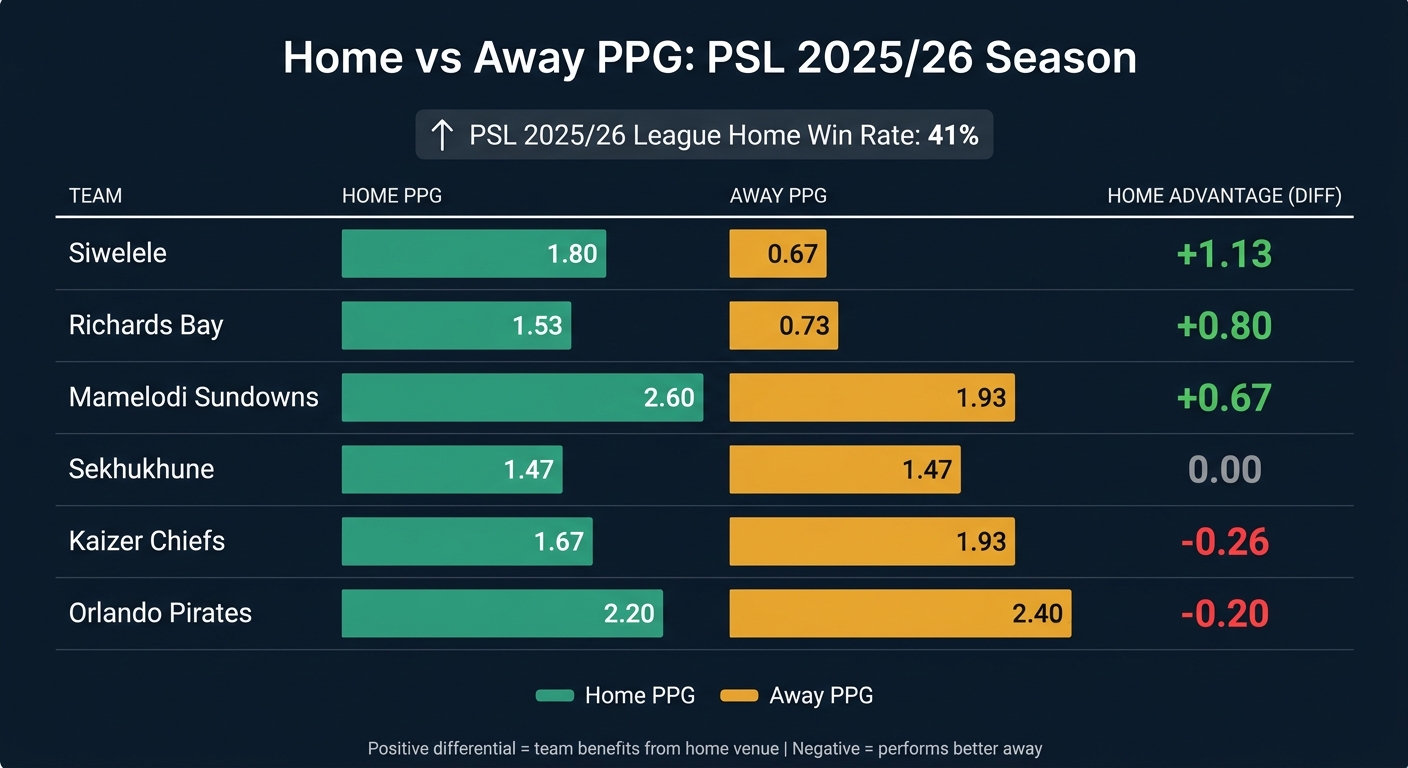
Home vs Away Advantage by PSL Team (2025/26)
Step 1: Check league and team home-away splits
Once home advantage stops being just a label, the next job is simple: see if the numbers support it.
Start with each team’s home and away splits. Take a team’s away PPG and subtract it from its home PPG. If the result is positive, that team tends to do better at home. If it’s negative, the so-called home edge may not mean much. The PSL 2025/26 data shows this clearly:
| Team (PSL 2025/26) | PPG Home | PPG Away | Home Advantage |
|---|---|---|---|
| Siwelele | 1,80 | 0,67 | +1,13 |
| Richards Bay | 1,53 | 0,73 | +0,80 |
| Mamelodi Sundowns | 2,60 | 1,93 | +0,67 |
| Sekhukhune | 1,47 | 1,47 | 0,00 |
| Kaizer Chiefs | 1,67 | 1,93 | -0,26 |
| Orlando Pirates | 2,20 | 2,40 | -0,20 |
That table tells a blunt story. Siwelele and Richards Bay get a clear lift at home. Sekhukhune look neutral. Kaizer Chiefs and Orlando Pirates have, at least in this sample, done better away than at home.
It also helps to compare a team’s home win rate with the league average. If that figure is close to the norm, or below it, the venue itself should matter a lot less in your bet.
Step 2: Add match context before trusting the numbers
Raw splits show a pattern. Context tells you if that pattern is still live for this match.
Travel matters. A coastal side going to Johannesburg or Pretoria, both more than 1 300 m above sea level, can fade late in the game. That can show up in slower recovery runs, less pressure off the ball, and tired defending in the final stages. For live betting, that matters.
The schedule matters too. If a team is playing its third match in a week, there’s a fair chance the press won’t be as sharp and the legs won’t be as fresh. Add suspensions or injuries, and the picture can change fast. One missing key player can shift the odds in a big way.
That’s why it’s smart to check the official starting XI about an hour before kick-off. The home-away split may look good on paper, but the team sheet tells you whether the same edge still applies.
Step 3: Apply the analysis to soccer markets on Supabets

If the split still points to an edge, line it up with the market that suits it best.
For example:
- A strong home PPG edge with a high draw rate can make Double Chance (1X) a sensible option.
- If a strong home team is facing a weaker away side, the handicap market may price that edge better than the standard match result market.
Before placing your stake, work out the implied probability using this formula: 1 ÷ decimal odds. If the market is pricing the outcome at a lower chance than your own read of the match, you may have value.
Then match that edge to the right market on Supabets.
Strong vs Weak Home Advantage: How to Tell the Difference
After you’ve checked the home-away splits, the next step is to sort each match by venue strength. That matters because not every home fixture brings the same edge. Some grounds give a team a clear lift. Others barely move the needle.
When home advantage deserves more weight
Home advantage matters more when a few things line up at once. A strong home record across the last five to 10 matches tells you more than one good result ever could. Then add a tight, noisy stadium and strong crowd backing, and the edge gets stronger.
In South African football, location can change the picture fast. When a coastal side travels to Johannesburg or Pretoria, both more than 1 300 m above sea level, the away team can fade late because of fatigue. If that same side is also playing on a short turnaround, the home edge grows again. Altitude, travel, and fixture pressure can all shift the probabilities.
When other factors matter more than venue
Home advantage should drop into the background when the drivers behind it just aren’t there. A neutral venue wipes it out, but the market can still drift towards the nominal home side. That’s a trap worth watching. Big stadiums with running tracks also weaken crowd influence. And poor home form is another red flag – instead of lifting the team, the crowd can add pressure.
Strong away teams can shrink the venue edge too, especially when they travel with a clear away-game plan and stick to it. Use the checklist below to judge how much weight the venue should carry.
| Factor | Strong Home Advantage | Weak Home Advantage |
|---|---|---|
| Home record | High xG and pressing intensity at home | Poor recent home form; crowd frustration |
| Away travel | Long-distance travel or cross-province travel | Local derby or short travel distance |
| Crowd effect | Tight, noisy stadium | Neutral venue or stadium with running tracks |
| Schedule | Fresh home team vs fatigued away side | Both teams on equal rest, or home side rotating its squad |
When those conditions show up, give the venue more weight. When they don’t, lean harder on form, squad depth, and matchups. That split helps you judge how much the venue should affect the price.
Conclusion: Use Home Advantage as One Input, Not the Whole Bet
Home advantage is real, but it’s not the same in every league or every match. Its impact shifts with the competition, the teams, and the setting. And most of the time, that home edge is already baked into the odds. Bookmakers account for standard home advantage, so it’s better to treat the venue as a pricing check, not a reason to place a bet on its own.
That said, the picture can change fast. Team news, late injuries, travel issues, weather, and other match conditions can cut into the home edge before kick-off. What looked like a strong home spot in the morning can look very different a few hours later.
That’s why home advantage works best as one part of the bigger picture. Use it alongside form, xG, team news, and fixture load when betting the soccer markets on Supabets.
FAQs
How many matches should I use for home-away splits?
Avoid overreacting to small samples. With limited data, you’re often looking at noise, not a clear signal of how a team performs.
A single season gives you 19 home and 19 away matches. That’s not much to work with. Because of that, many analysts look across multiple seasons and apply decay weights so recent results matter more than older ones.
If you want a read on current form and squad makeup, the last 10 to 15 matches per venue are a solid guide. If you’re looking for longer-term trends, pair that short-run view with multi-season data.
When does altitude affect a soccer bet?
Altitude tends to matter most when a visiting side goes from sea level to higher ground, like the South African Highveld. The thinner air can cut aerobic capacity and make it harder to recover between hard sprints.
You often see the effect most clearly in the last 20 to 30 minutes of a match, above all when the away side is on short rest. Pressing can lose bite, legs can go heavy, and the team may be more open to late goals.
How do I know if the home edge is already in the odds?
Assume the home edge is already built into the odds. Bookmakers treat home advantage as public information, so it’s baked into the opening line.
Your job isn’t to notice that home advantage exists. Your job is to decide whether the market priced it correctly for that specific match.
That means looking at things like:
- venue splits
- crowd impact
- current form
Then compare those factors with your own probability estimate.
If your number is different from the market’s number, that’s where the edge may be. Not in the simple fact that a team is playing at home, but in whether the price on that home team is too short, too long, or about right.