Esports betting has become a massive industry in 2026, with a global market value projected at USD 17.5 billion. Key trends include mobile-first platforms, live in-play betting, and advanced AI-driven systems for real-time odds and personalisation. Popular games like League of Legends dominate the space, while South Africa’s market is growing at a CAGR of 12.49%, driven by mobile adoption and improved payment systems like PayShap. Regulatory changes and responsible gambling tools are shaping a safer betting environment, while innovations like virtual esports and embedded in-stream betting are keeping users engaged 24/7.
Key Highlights:
- Global Growth: Esports betting revenue exceeded USD 2.8 billion in 2025, with over 60% of wagers placed via smartphones.
- South Africa’s Market: Valued at USD 33.01 million in 2025, projected to reach USD 94.71 million by 2034.
- Top Games: League of Legends leads globally (70% market share), while CS2 dominates in South Africa.
- Tech Advancements: AI has improved odds accuracy by 15–20%, and real-time data APIs now refresh odds every 10 seconds.
- New Formats: Combo bets surged by 72.1% in Q1 2026, and virtual esports offer 24/7 betting opportunities.
- Responsible Gambling: Tools like deposit limits, session timers, and self-exclusion are helping address problem gambling.
Esports betting is reshaping the industry with fast-paced, data-driven innovations and a focus on mobile and interactive experiences.
iGaming Product Growth: Why E Leagues are the 2026 Trend 📈🌐
sbb-itb-00c3b18
Market Growth and Emerging Trends in Esports Betting
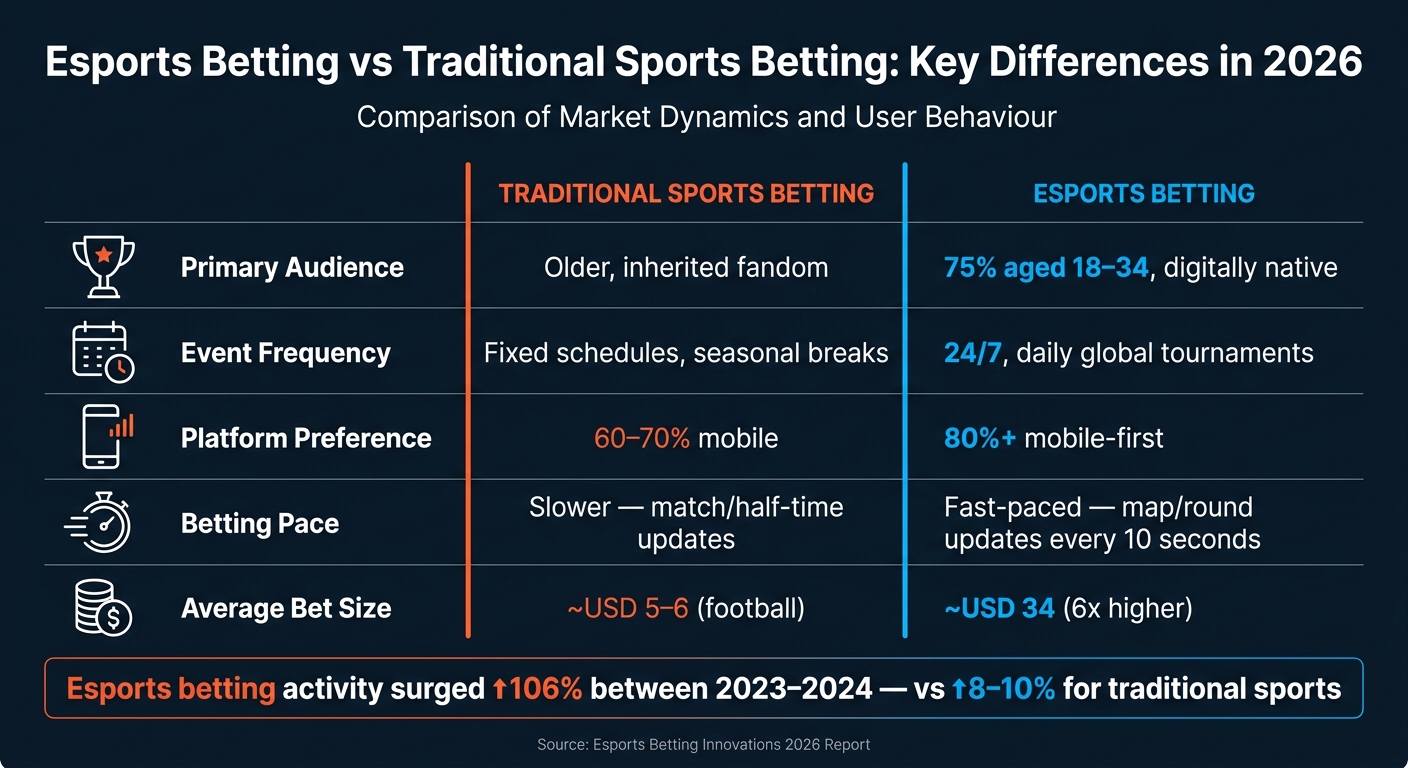
Esports Betting vs Traditional Sports Betting: Key Differences in 2026
Global Growth Drivers
Esports betting is growing at an incredible pace. By 2025, global esports betting revenue hit USD 2.8 billion, with projections exceeding USD 3 billion by the end of 2026. Betting activity on top esports titles surged by 106% between 2023 and 2024 – far outpacing the 8–10% growth seen in traditional sports during the same period. Combo (parlay) bets alone jumped 72.1% in Q1 2026 compared to Q1 2025.
This growth stems from three main factors: a younger audience, major international tournaments, and advancements in real-time betting technology. A whopping 87% of esports bettors are either Gen Z (44%) or Millennials (43%). These tech-savvy, mobile-first bettors prefer more dynamic wagers, such as multi-leg bets across maps or rounds, rather than sticking to straightforward match-winner bets.
Tournaments also play a massive role in driving engagement. For example, the M7 World Championship in early 2026 hit a peak of 5.68 million concurrent viewers, with TikTok alone drawing 2.42 million live viewers. This highlights how esports audiences are deeply connected to mobile platforms, making it clear that smartphones are the primary gateway for both watching and betting on esports.
These global trends are also shaping local markets, including South Africa, where unique factors further fuel the growth of esports betting.
Trends Shaping South Africa’s Esports Betting Market
South Africa’s esports betting scene mirrors international trends while leveraging local strengths like high mobile adoption and innovative payment systems. With widespread smartphone use and affordable data plans, mobile betting has become the go-to option for South Africans.
Among esports titles, CS2 (formerly known as CS:GO) dominates the local market, generating USD 13.02 million out of South Africa’s total USD 33.01 million esports betting market in 2025. Specialist esports betting platforms also stand out, contributing USD 15.79 million in revenue during the same year. This suggests that South African bettors value platforms with a deep focus on esports-specific options.
Payment systems are another key driver. Instant payment solutions like PayShap and Capitec Pay have made deposits and withdrawals faster and more accessible, particularly for younger and lower-income bettors. This speed is crucial in esports, where betting markets can shift rapidly. Platforms such as Supabets, which offer live in-play betting alongside esports, are perfectly positioned to meet this demand. On a broader scale, Africa is preparing for its first multi-country regulatory framework in 2026, aiming to standardise practices around responsible gambling, payments, and integrity. This could significantly boost both operator confidence and consumer trust.
Esports Betting vs Sports Betting
Comparing esports betting to traditional sports betting reveals just how much the former is reshaping the landscape. Here’s a quick look at some of the differences:
| Feature | Traditional Sports Betting | Esports Betting |
|---|---|---|
| Primary Audience | Older, inherited fandom | 18–34 year olds (75%), digitally native |
| Event Frequency | Fixed schedules, seasonal breaks | 24/7, daily global tournaments |
| Platform Preference | 60–70% mobile | 80%+ mobile-first |
| Market Dynamics | Stable rules and rosters | Frequent game updates and roster changes |
| Betting Pace | Slower (match/half-time updates) | Fast-paced (map/round updates) |
One striking difference is the average bet size. Esports bettors typically wager around USD 34 – about six times higher than a standard football bet. This reflects the analytical mindset of esports enthusiasts, who delve into patch updates, player stats, and map-specific data before placing their bets.
Traditional sports fandom often runs in families – people back the same teams their parents supported. In contrast, esports fans build their loyalties around individual players, streamers, and online communities. As one industry expert noted:
"The shift is happening inside the youth demographic because esports fits how younger people watch, talk about, and consume competition."
- PlayCasino
Technologies Changing Esports Betting in 2026
AI, Data Analytics, and Real-Time Odds
Esports betting is evolving rapidly, thanks to advancements in AI and data analytics. AI now processes vast amounts of structured data – like kill counts, pick-ban rates, map win rates, and tempo shifts – to simulate thousands of potential outcomes. This has resulted in odds that are 15–20% more accurate compared to those set by humans. In micro-betting markets, such as predicting the next teamfight winner or the first blood within three minutes, prediction accuracy has leapt from about 20% to over 40%.
Real-time API data is another game-changer. It delivers in-game events in under 500 milliseconds, allowing odds to refresh every 10 seconds. Take DraftKings as an example: they expanded their live betting options from 124 per game in 2022 to an impressive 517 by early 2026. As noted by MobileMall Blog:
"Nobody is managing 517 markets shifting simultaneously by hand across dozens of matches running at the same time, that’s just not a human operation anymore." – MobileMall Blog
For South African bettors using ZAR, these technologies help cut through the noise of fast-paced tournaments, identifying value in markets that might otherwise be too volatile to navigate effectively. These advancements pave the way for even deeper integration with live streaming.
Live Streaming and Interactive Betting Features
Live streaming has taken esports betting to a whole new level by embedding betting features directly into broadcasts. In April 2026, DATA.BET introduced "In-Stream Betting", which allows users to view and place bets without leaving the stream. This feature, accessible via a mobile broadcast overlay, lets players toggle the bet slip on or off seamlessly. Following its launch, DATA.BET saw gross gaming revenue nearly double year-over-year, with a 70.6% increase in turnover and a 33.2% rise in total bets placed.
"In-Stream Betting is designed to meet players where their attention already is – inside the broadcast." – Rostyslav Likhtin, Head of Product, DATA.BET
Interactive viewers, who can engage directly with streams, tend to watch 33% longer than passive viewers. Live wagering now makes up about 70% of all betting activity during major esports tournaments. Platforms like Supabets, which combine real-time game stats with live in-play betting, are perfectly positioned to cater to this growing demand.
Personalisation and Gamification
Esports betting platforms are also focusing on personalisation and gamification to keep users engaged. AI plays a key role here, analysing user behaviour – such as betting patterns, session times, and market preferences – to offer tailored promotions and market suggestions. By 2026, DraftKings had shifted 70% of its promotional budget to AI-driven systems.
Gamification is another powerful tool. Features like bet builders, which let users create custom parlays by combining multiple legs of a single match, have become essential for retaining users. Delasport, for instance, introduced "SuperPot" (a jackpot-style feature) and "Betiator" (event-driven gameplay) in 2026 to keep users engaged even during slower moments in a match. Borrowing elements from video game design, these features make the betting experience more interactive and fun.
"The line between viewer, analyst, and participant becomes progressively more fluid." – Steve Marshall, Author
For South African bettors, ZAR-denominated promotions and markets tailored to local tournaments add a personal touch. With 94% of African gambling participants using mobile phones for betting, platforms must also offer lightweight, fast-loading interfaces that perform well even under less-than-ideal network conditions.
New Betting Formats and Products in Esports
New Esports Betting Markets
Esports betting has grown far beyond the traditional "match-winner" approach. By 2026, bettors can wager on highly specific in-game outcomes. For instance, you might bet on "Win First Half + Win Map" in Rainbow Six or try a "Total Over + Win" combination, where multiple conditions are tied into a single bet. These micro-markets thrive on the fast-paced, dynamic nature of esports, keeping fans deeply engaged.
The demand for more complex betting options is skyrocketing. Combo bets, for example, surged by 72.1% in Q1 2026 compared to the same period in 2025. Meanwhile, niche esports games are proving to be highly profitable, with a 245% increase in profits during the first quarter of 2026 alone. Even games like Rocket League saw an 85.3% increase in turnover quarter-on-quarter, despite the absence of major global tournaments during that time.
This shift towards specialised and intricate betting formats reflects the ever-evolving landscape of esports wagering.
Virtual Esports and 24/7 Betting
One of the most exciting developments in esports betting is the rise of virtual esports – simulated matches that run around the clock. Companies like BETER and SIS are leading the charge by creating extensive content pipelines to fill the gaps between live professional matches. BETER‘s eHockey series, for instance, generates over 2,400 matches each month, offering bettors up to 50 different markets per game and an operator margin exceeding 7.5%. Their eFootball content is even more prolific, with more than 4,200 matches added monthly as of April 2026, strategically timed to build excitement ahead of the World Cup.
Similarly, SIS’s eSoccer product features over 400 matches daily during peak periods. The appeal of virtual esports is undeniable: there are no off-seasons, no time zone issues, and no need to wait for scheduled fixtures. As Paul Witten, Managing Director EMEA at SIS, puts it:
"Our commitment to quality means that it’s just as important for us to be perfect at 3 o’clock in the morning as it is at 3 o’clock in the afternoon."
Virtual sports are gaining traction fast. In 2025, active users grew by 68%, and the vertical’s gross gaming revenue (GGR) rose by 21%. Turnover from virtual esports content alone jumped by 168% between Q1 2025 and Q1 2026. For South African bettors, this means access to competitive betting action at any time, whether it’s a late-night session or an early morning wager.
Esports Betting Across Platforms
Esports betting has become part of a broader, unified gaming experience. In 2026, modern platforms are creating ecosystems where a single account and wallet connect esports betting, traditional sports betting, casino games, slots, crash games, and live tables. GR8 Tech‘s Hyper Turnkey platform is a prime example, integrating sportsbook and casino offerings into one seamless environment. This approach has resulted in a 15% increase in cross-product conversion rates.
This integrated model fits perfectly with how South African bettors engage with these platforms. By 2026, over 80% of all betting activity takes place on smartphones, making a smooth, user-friendly experience essential. Platforms like Supabets exemplify this integration by offering live in-play betting alongside casino games, slots, and virtual options, allowing users to switch effortlessly between activities. Interestingly, the average esports bet is around €29 (approximately R570), compared to just €5 for football bets. This highlights the high engagement levels of esports bettors and underscores the importance of providing an intuitive, all-in-one platform.
Integrity, Responsible Gambling, and What Comes Next
Keeping Esports Betting Markets Fair
The issue of integrity in esports betting has become a pressing concern. In the first quarter of 2026, the Esports Integrity Commission (ESIC) reported 15 suspicious alerts – four times the number recorded during the same period in 2025. Interestingly, the focus of manipulation has shifted from fixing match outcomes to targeting micro-markets, such as round handicaps and player kill lines.
Take, for example, the case of Ukrainian CS2 player Dmytro "nifee" Tediashvili. In April 2026, he was handed a four-year ban after irregular kill patterns involving molotovs at ESL Pro League Season 22 were flagged by machine learning systems. These anomalies coincided with unusual betting activity from high-value accounts. Similarly, team NOMERCY faced a provisional suspension after a massive R1.1 million multi-bet on a –9.5 handicap raised alarms.
To combat these challenges, sportsbook provider BETBY became a Tier One partner of ESIC in November 2025. This partnership allows BETBY to provide live odds, transaction logs, and datasets for ESIC’s real-time monitoring system. Leonid Pertsovskiy, CEO of BETBY, emphasised the importance of this collaboration:
"Integrity has always been at the heart of BETBY’s values. This cooperation is another important step towards ensuring that esports competitions remain fair, credible, and sustainable."
In South Africa, the National Gambling Board (NGB) launched its "Verified Operators" portal in April 2026. This public register helps banks and tax authorities block payments to unlicensed offshore sites. With 62% of online gambling in South Africa reportedly happening on unlicensed platforms, according to the South African Bookmakers Association (SABA), local bettors are encouraged to use this portal to confirm a platform’s licensing status before depositing funds.
Responsible Gambling in Esports Betting
As the industry clamps down on integrity issues, protecting vulnerable players has become just as critical. In South Africa, problem gambling rates have surged alarmingly – from 5.8% in 2017 to 31% in 2024/25. This has pushed responsible gambling measures to the forefront, with 37% of industry professionals now prioritising it as a key engineering focus.
Platforms like SOFTSWISS have introduced machine learning systems that monitor user behaviour in real time. These systems can automatically cap losses for players deemed at risk, based on behavioural scoring. Mariia Halaida, Head of Business Development at SOFTSWISS, highlighted the industry’s evolving approach:
"By treating protection as a technical frontier to be mastered rather than a legal burden to be carried, the industry is paving the way for a more sustainable ecosystem."
Licensed platforms in South Africa now offer tools designed to encourage responsible gambling. These include deposit and loss limits, session timers, cooling-off periods, and self-exclusion options. Here’s a breakdown of how these tools function:
| Tool | Duration Options | What It Does |
|---|---|---|
| Deposit Limit | Daily / Weekly / Monthly | Caps the total funds transferred to your account |
| Loss Limit | Daily / Weekly / Monthly | Blocks betting once the net loss cap is reached |
| Session Limit | 60 mins, 2 hours, etc. | Automatically logs you out after the time expires |
| Cooling-Off | 24h, 7 days, 30 days | Temporarily suspends all account access |
| Self-Exclusion | 6 months to 5 years | Adds you to the National Register, banning access for the specified period |
To discourage impulsive decisions, increasing deposit or loss limits generally involves a mandatory 24- to 72-hour cooling-off period.
The Future of Esports Betting
As integrity and responsible gambling measures strengthen, the next wave of esports betting advancements will likely focus on predictive AI and mobile-first innovations. Instead of reacting to problems, the industry is moving towards identifying risk signals – like sudden deposit spikes or patterns of loss-chasing – before they escalate.
The rise of fraud, particularly deepfake-linked scams, is another pressing issue. In 2025, over half of all iGaming verification fraud cases were attributed to deepfakes, while synthetic identity fraud increased by 329%. Richy Emah, Regional Director for North/West Africa at Sumsub, stressed the urgency of staying ahead:
"The only viable response is to fight AI with more advanced AI, ensuring that detection and prevention systems evolve at the same pace as the risks they are designed to address."
On the payment front, innovations like PayShap and Capitec Pay are reshaping transactions in South Africa, making mobile-first integration a must for platforms. With licensed online sports betting revenue projected to reach between R18 billion and R25 billion in 2026, platforms such as Supabets, which offer a mix of live betting, casino games, and virtual sports, are well-positioned to cater to the evolving demands of esports bettors as the market continues to grow.
FAQs
How does AI set esports betting odds in real time?
AI plays a crucial role in setting real-time esports betting odds by processing massive datasets. It evaluates factors like kill counts, control over key objectives, and shifts in momentum. Through machine learning, it runs simulations of potential match outcomes and updates odds on the fly as live events unfold – whether it’s a team winning a round or a player disconnecting. By comparing live game data to historical performance trends, AI not only ensures precise odds but also handles risk management much faster than traditional, manual approaches.
What’s the difference between in-play esports betting and micro-betting?
In-play betting and micro-betting both fall under the umbrella of live wagering, but they cater to different aspects of the game. In-play betting typically revolves around larger match outcomes, like predicting the winner of a map or the total number of kills in a game. Micro-betting, however, hones in on smaller, rapid-fire events that are decided in seconds, such as which tower will fall next or which hero will be eliminated. This creates a fast-paced, high-engagement experience throughout the match.
How can I check if an esports betting site is licensed in South Africa?
To check if an esports betting site is licensed in South Africa, start by looking for licensing details on the site’s home page or within its terms and conditions. You can also cross-check this information on the National Gambling Board’s operator portal. For added assurance, reach out to provincial regulators, such as the Mpumalanga Economic Regulator, and use their verification tools, like SMS codes, to confirm the licence’s validity.