BTTS is simple: I only ask whether both teams will score at least one goal in 90 minutes plus stoppage time. The winner of the match does not matter. On Supabets, I will see this market as GG/NG – GG means both teams score, and NG means at least one team blanks.
Before I place a bet, I focus on a few basic checks:
- How BTTS settles: only the official score after 90 minutes + added time counts
- What counts: own goals and late goals before full-time
- What does not count: extra time and penalty shootouts
- How to read the market: GG = Yes, NG = No
- What to review first: home/away scoring trends, clean sheets, team news, and price
- Typical pricing: BTTS Yes often sits around 1.65 to 1.90 in strong scoring fixtures
- Simple payout example: a R250 stake at 2.00 returns R500 total
- Supabets minimum stake: R1
A few scorelines show the market fast:
- 1-1, 2-1, 3-2 = GG wins
- 0-0, 1-0, 2-0 = NG wins
I also keep match context in mind. If both teams have hit BTTS in 70%+ of their last 10 relevant home or away games, that can support GG. If one side keeps many clean sheets, NG may make more sense.
This guide breaks down the rules, the scoreline logic, the main checks before betting, and how I can find the GG/NG market on Supabets without overthinking it.
Both Teams to Score Explained: Simple Betting Guide (BTTS)
sbb-itb-00c3b18
How Both Teams to Score Bets Work
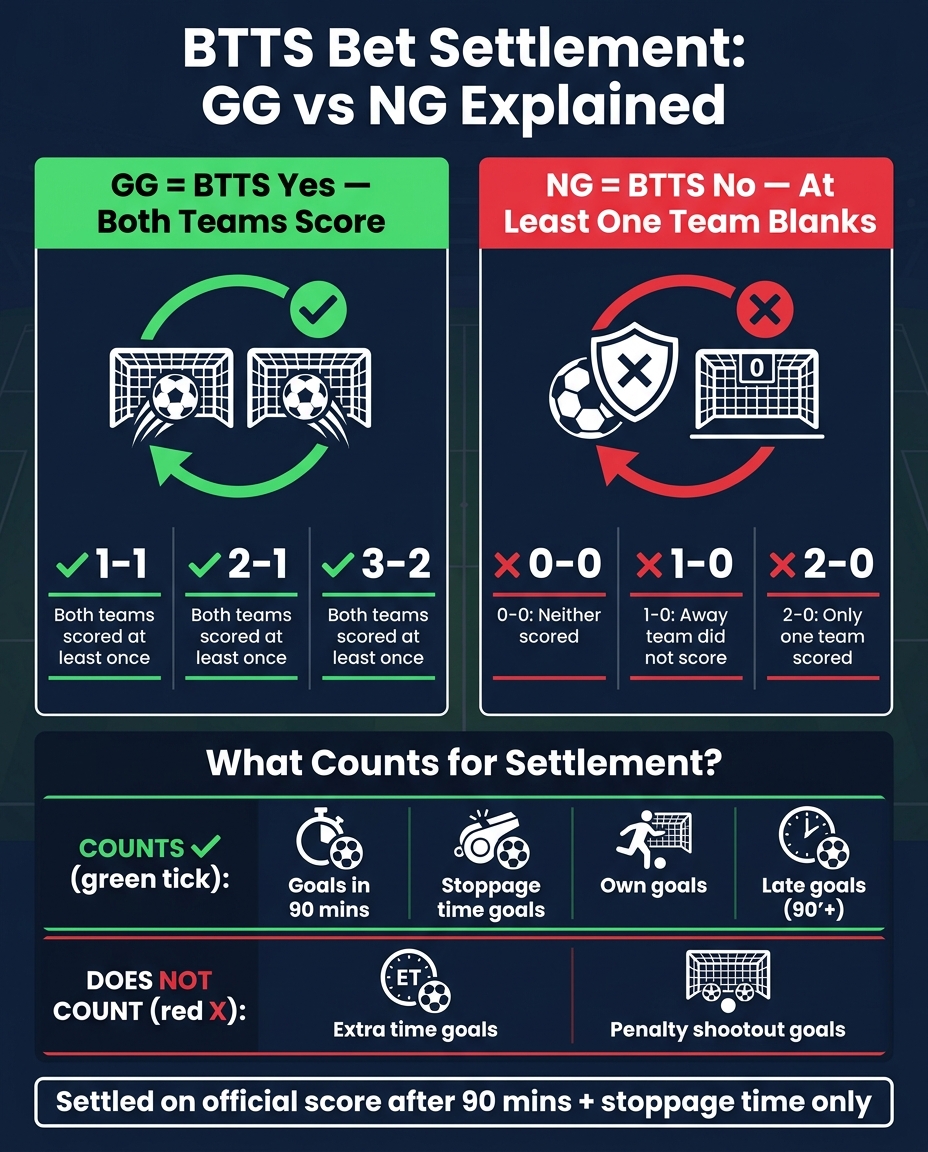
BTTS Bet Settlement: GG vs NG Explained
BTTS has only two outcomes: Yes (GG) or No (NG).
Once the match is settled, one side wins and the other loses. There’s no push, and there’s no refund on a BTTS bet.
With that out of the way, here’s how BTTS is settled.
BTTS Yes and BTTS No Explained
BTTS Yes (GG) wins when both teams score at least once.
BTTS No (NG) wins when at least one team does not score.
How Scorelines Settle the Bet
The examples below show how some common scorelines are settled.
| Scoreline | BTTS Yes (GG) | BTTS No (NG) | Reason |
|---|---|---|---|
| 1-1 | Win | Loss | Both teams scored at least once. |
| 2-1 | Win | Loss | Both teams scored at least once. |
| 3-2 | Win | Loss | Both teams scored at least once. |
| 0-0 | Loss | Win | Neither team scored. |
| 1-0 | Loss | Win | The away team did not score. |
| 2-0 | Loss | Win | Only one team scored. |
What Counts When Settling a BTTS Bet
BTTS is settled using the final official score only, so the exact timing of goals matters.
Regular Time, Stoppage Time, and the Official Scoreline
BTTS bets are settled on the official scoreline after 90 minutes plus stoppage time. That means goals scored during normal time and added time count.
Extra time and penalties are a different story. They do not count for BTTS settlement.
Own Goals, Late Goals, and Match Events
A few match events can still shape how a BTTS bet is settled.
Own goals count for BTTS. So if one side puts the ball into their own net, it still goes on the official scoreline and still matters for the bet.
Red cards don’t settle the bet on their own, but they can change how the game plays out. A sending-off can open a match up or shut it down completely.
| Event | Counts for BTTS Settlement? |
|---|---|
| Goals in 1st/2nd half stoppage time | Yes |
| Own goals | Yes |
| Late goals (90’+) before final whistle | Yes |
| Goals in extra time (30 mins) | No |
| Penalty shootout goals | No |
If a match is abandoned, settlement follows the official market rules.
How to Assess a Match Before Placing a BTTS Bet
Now that you know how BTTS settles, the next step is working out whether a match actually fits this market. You don’t need a deep spreadsheet or hours of research. A quick check of a few key areas is usually enough to build a clear view.
Check Scoring and Conceding Trends
Start with the last 10 matches, but split them properly into home and away form. That matters more than many punters think. If both teams have landed BTTS in 70% or more of those relevant games, the case for BTTS Yes looks much stronger.
Defensive form matters just as much as attacking output. Clean sheets can spoil a BTTS bet in a hurry. If either side is keeping opponents out on a regular basis, that weakens the argument for BTTS Yes.
When the form points in the right direction, the next thing to check is the price. Good stats alone don’t make a bet worth taking.
Read the Odds and Stake in Rand
On strong fixtures, BTTS Yes odds will often sit between 1.65 and 1.90. If both sides look likely to score and the odds are still above 2.00, there may be value in the market.
Working out your return is simple with decimal odds. Multiply your stake by the odds to get the total payout. So, a R250 stake at 2.00 returns R500 in total. That includes your R250 stake back, plus R250 profit.
On Supabets, the minimum stake is R1. That gives you room to start small and get used to how the market behaves before staking more.
Use Match Context Before Placing the Bet
Stats help, but match context can change everything. Confirmed line-ups, usually checked 30 to 60 minutes before kick-off, can shift the picture fast. If a first-choice centre-back is out through injury or suspension, that team’s chance of conceding goes up.
Head-to-head results are also worth checking. If a fixture has produced BTTS Yes in four of the last five meetings, that’s a useful signal. On the other hand, big relegation battles often turn into tense, cagey matches where teams play it safe. In that kind of game, BTTS No can be the smarter option.
How to Place a BTTS Bet on Supabets and Key Takeaways
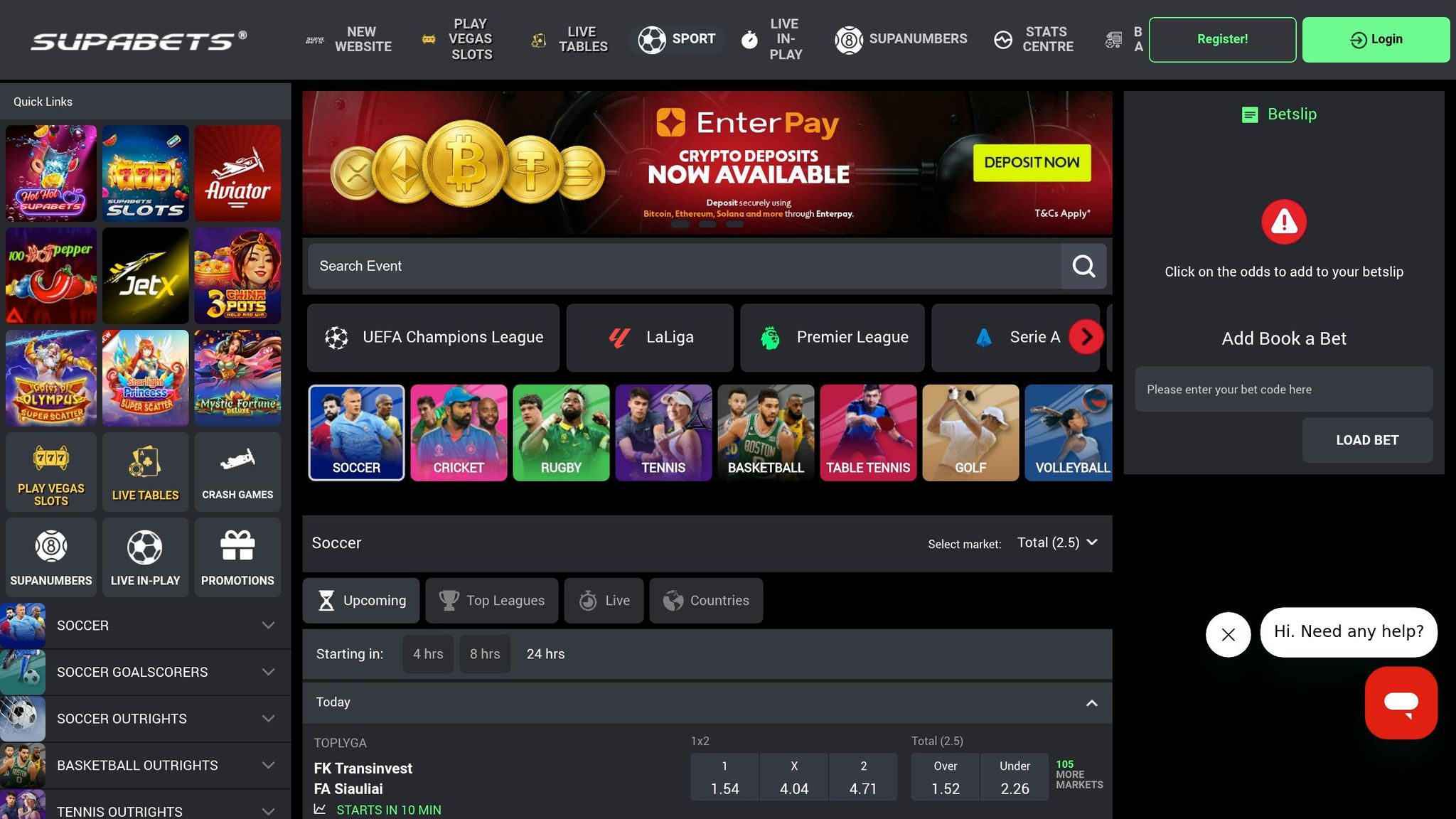
Find the BTTS Market on the Supabets Soccer Page
Once you understand how BTTS settles, the next step is simple: find the GG/NG market on the Supabets soccer page.
Go to https://www.supabets.co.za/sports/soccer, then use the left-hand menu to filter by country or league. Open the match you want to bet on. If the market does not show up straight away, click "More Markets" next to the match to view the full set of betting options.
On Supabets, BTTS appears as GG/NG:
- GG = BTTS Yes
- NG = BTTS No
Pick your option, add it to your bet slip, enter your stake in rand, and tap "Submit" or "Bet Now". The minimum stake is R1.
Once the market is open, standard GG/NG is the basic option. Combined markets add another condition on top of that.
Common BTTS Market Variations
These markets take the standard BTTS bet and add one more requirement.
| BTTS Market Variant | Win Condition | Key Added Requirement |
|---|---|---|
| BTTS and Match Result | Both teams score and the selected team wins | You must also pick the correct match winner |
| BTTS and Over 2.5 Goals | Both teams score and the total match goals are 3 or more | Total goals must be over 2.5 |
| First-Half BTTS | Both teams score in the first half | Second-half goals do not count |
If you are new to BTTS betting, start with the standard GG/NG market first. It is the cleanest way to learn how this bet works before you move to options with extra conditions.
Conclusion: The Main Points to Remember
Use BTTS when the scoring pattern, match context, and price all line up. BTTS settles on the official score after 90 minutes plus stoppage time. Check how each team scores and concedes, make sure the odds match your read of the game, and then open the GG/NG market on the Supabets soccer page when you are ready to place your bet.
FAQs
Can I win BTTS if my team loses?
Yes – you can win a BTTS bet even if your team loses.
This market only looks at one thing: whether both teams score at least one goal. It does not depend on the final result.
So if you backed Yes, your bet still wins as long as both sides find the net – even if your team goes down 1-2 or 2-3.
What happens if a match is abandoned?
If a soccer match is abandoned before 90 minutes, all bets are void unless the result of the bet had already been decided when play stopped.
For Both Teams to Score, if both teams had already scored, Yes bets win and No bets lose. If not, all bets are void.
When is GG better than NG?
GG is often the better shout when you expect an open, high-tempo match and both teams look like they’ve got a goal in them.
NG can be the smarter pick in tighter, more cautious setups. That often includes games where the home side has put together several recent clean sheets, the away side struggles for goals on the road, or the match context – like a cup tie, a key striker being out, or a relegation scrap – points to a lower-scoring contest.