Every bet has a built-in cost, and that cost cuts your return before the match starts. If a market adds up to 104,7% or 106,7% instead of 100%, that extra percentage is the bookmaker’s margin. In simple terms, a 5% margin means about R5 lost per R100 staked over time.
Here’s what I’d want to know straight away:
- Margins sit inside the odds – you do not pay them as a separate fee.
- You can work them out yourself by converting odds into implied probability and adding them together.
- Higher margins mean lower payouts and worse long-term results.
- Accumulators hit harder because each leg adds more cost.
- Simple markets like match winner, 1X2, and totals are often easier to check.
- Steady staking matters because margin and poor stake control are a bad mix.
A quick example: if two outcomes are both priced at 1,91, the combined implied probability is about 104,7%. That extra 4,7% is the bookmaker’s edge. That is the price of betting into that market.
If I’m betting on PSL or Premier League matches, I should treat odds like a price tag, not just a number. Check the overround, keep multiples short, and do not assume big odds mean good value.
What bookmaker margins are and how to calculate them
From decimal odds to implied probability
To spot the margin, start by turning each price into an implied probability.
The formula is simple: 1 ÷ odds × 100.
So if an outcome is priced at 2,00, the implied probability is 1 ÷ 2,00 × 100 = 50%. At 3,00, it becomes 33,3%. At 1,50, it works out to 66,7%. In plain English, the lower the odds, the higher the implied probability.
Once you’ve done that for each outcome, add the implied probabilities together to get the market total.
That’s where the margin shows up.
Two-way and three-way market examples
A two-way market, like a tennis match winner, is the easiest place to see this in action. Say Player A is priced at 1,85 and Player B at 1,95. Convert both prices:
- Player A: 1 ÷ 1,85 × 100 = 54,1%
- Player B: 1 ÷ 1,95 × 100 = 51,3%
- Total: 105,4% → that is the market’s margin.
A football 1X2 market has three outcomes: home win, draw, or away win. Using a PSL fixture as an example:
| Outcome | Odds | Implied Probability |
|---|---|---|
| Home Win | 2,10 | 47,6% |
| Draw | 3,20 | 31,3% |
| Away Win | 3,60 | 27,8% |
| Total | 106,7% |
The total is 106,7%, which means the bookmaker has built in a 6,7% margin on that market.
Margin vs house edge
A sportsbook margin and a casino house edge both give the operator a long-term mathematical advantage. But they don’t work in the same way.
In sports betting, the margin is out in the open. You can work it out yourself from the decimal odds, just like in the examples above. It also shifts from one market to another, and from one sport to the next.
Casino-style products build the edge into the game itself. Sports betting shows it in the odds. That’s exactly why it makes sense to check margins before you place a bet.
sbb-itb-00c3b18
How bookmakers operate and profit every time | bettingexpert academy

How margins reduce payouts and long-term returns
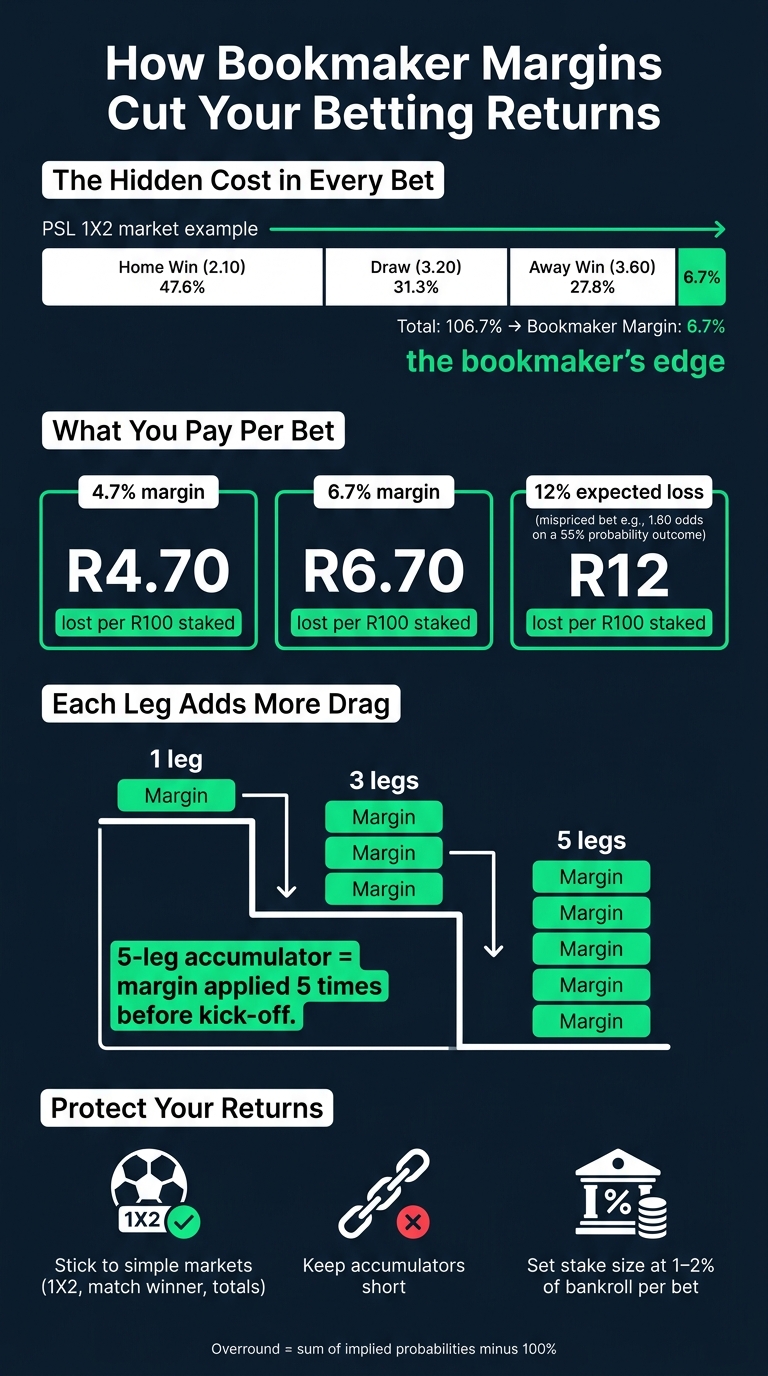
How Bookmaker Margins Cut Your Betting Returns
Why higher margins mean lower value per bet
Higher margins cut the price you get. Put simply, each bet pays less than fair value. At a 4,7% margin, every R100 staked carries about R4,70 in built-in cost.
Once the price drops below fair value, your return gets worse. For example, a bet priced at 1,60 on an outcome with a genuine 55% win probability carries an expected loss of 12%. In plain terms, you’d lose about R12 for every R100 staked over time.
How the hidden cost adds up over time
Margins act like a built-in commission on every bet you place, whether that wager wins or loses on the day. One bet might not feel like much. But stack that up over hundreds of bets, and the bookmaker’s edge starts to do its work.
That’s why punters who keep betting into the same margin again and again tend to feel the damage over the long run. The cost isn’t always obvious in the moment, but it shows up in your results over time.
Why accumulators and long-shot bets feel the effect more
This hit gets even harder on multi-leg bets. A five-leg accumulator multiplies the margin across each leg, so the total cost climbs fast. The more legs you add, the more value gets shaved off before the first match even kicks off.
Long-shot and exotic markets usually come with higher margins than mainstream soccer markets. So yes, the big odds can look tempting. But the built-in cost is often much steeper.
A simple way to limit that drag:
- Keep accumulators shorter
- Choose markets with care
- Be extra cautious with long-shot and exotic bets
That is why the next step is spotting where margins sit in the markets you actually use.
How to apply margin awareness on Supabets markets

How to check margins on common sports markets
Put the overround to work on the prices you actually see. Before you place a stake on any Supabets market, check the numbers with the implied-probability method.
Here’s the basic idea:
- Convert each outcome’s odds into implied probability.
- Add those probabilities together.
- Subtract 100 to get the overround.
If the total lands well above 100%, that market is pricey. And because in-play odds can move in seconds, it’s smart to check the total again right before you bet.
That same price check also makes one thing clear: sports and casino-style products don’t work in quite the same way.
Sports betting vs casino-style products: where the edge appears
Sports odds include a variable overround in the price. Casino-style products work off a fixed house edge instead.
In plain terms, sports betting is all about the price on that specific market. With casino-style products, the edge stays fixed.
Combining margin awareness with bankroll discipline
Once you can read the price, the next step is controlling your stake. Start with stake sizing. Set one unit at 1–2% of your bankroll, then size your bet based on how sure you are about the selection. That way, one bad result won’t do major damage, even when the overround is against you.
It also helps to stick to simpler markets, such as:
- match winner
- 1X2
- totals
These markets tend to have lower margins and are easier to check.
Don’t chase losses. A bad run doesn’t mean the margin has suddenly changed. It’s just variance doing what variance does. Upping your stake to win it back ignores the maths behind the house edge, and that usually ends badly. Keep the same discipline on every bet.
Conclusion: How margin awareness helps protect your returns
The margin sits inside every price before you stake a rand. Once you see that, odds stop looking like plain numbers. They start looking like a price tag with a built-in cost.
That small shift changes how you judge every bet on Supabets. You look at the overround before putting money down. You lean toward simpler markets, where the margin is often lower. And you think twice before adding one more leg to an accumulator, because every extra leg stacks the cost on top of the last one.
Margin awareness matters even more when you pair it with steady staking. If you know what a market is costing you, it’s easier to keep your expectations in check, not only for one bet, but across hundreds over time. And over the long run, that cost has a direct effect on your returns.
Know the margin, respect the price, protect your returns.
Key points to remember
- An overround above 100% is the bookmaker’s margin – the higher it goes, the less value that market gives you.
- Higher margins reduce value on every rand staked.
- Accumulator bets amplify the effect – each extra leg multiplies the house edge rather than simply adding to it.
- Margin awareness helps you see what you are paying – convert decimal odds to implied probability, add them up, and the cost becomes clear.
- Simple markets and steady staking limit long-term drag.
FAQs
What is a good margin to bet into?
There is no good margin for the bettor. Bookmakers build a margin, or overround, into every market to lock in long-term profit, and in South Africa this usually sits between 5% and 8%.
That margin works like a silent tax on every wager. So the goal isn’t to look for a good margin. It’s to spot value where the implied probability doesn’t match the true probability.
Do lower odds always mean worse value?
No. Lower odds do not always mean worse value.
Value comes down to one thing: whether the bookmaker’s odds are better than the true chance of that result happening.
A shorter price often just means the selection is a strong favourite. But that doesn’t automatically make it a poor bet. If you think that team is more likely to win than the odds imply, the bet can still offer value.
How much do accumulators really cost?
Accumulators usually cost more than single bets because the bookmaker takes a margin on each leg. And with accumulators, that margin stacks up.
In South Africa, that built-in margin is often around 5% to 8% per leg.
Here’s where it starts to bite: a 5% margin across four legs can lead to a combined house edge of about 18.5%. So while the payout can look much bigger, the maths is working harder against you.