If I want to read momentum in live betting, I don’t start with the score. I start with pressure stats. A team can be behind and still control the match. In most cases, the first clues are shots on target, dangerous attacks, corners, and where play is happening, not just possession.
Here’s the short version:
- Scorelines can mislead. A 1–0 lead does not always mean that team is on top.
- Possession alone is weak. A losing side often sees more of the ball because the other team sits back.
- Stat runs matter more than single moments. One corner means little. A 10-minute spell with corners, shots on target, and pressure means more.
- Chance quality beats shot volume. Ten weak shots are less useful than two good chances.
- Game state matters. Teams play differently when ahead, behind, or down to 10 men.
- Some markets fit momentum reads better. Next Goal, Over/Under, Handicap, and Team to Win the Rest of the Match are the main ones.
- Rules matter. I need a pre-set trigger, a stake limit in R, and the discipline to pass if the price has already moved.
A few numbers in the piece stand out: Supabets’ Live Channel covers 15,000+ live matches per month across 16 sports. That gives punters a lot of live data – but data only helps if I read it in context.
My takeaway is simple: I look for 5–10 minute pressure sequences, compare them to my pre-match view, and only bet when both the stats and the price make sense.
Below, the article breaks that process into a clear match-day routine.
SoccerScanner Full Tutorial: Dominate Live Football Trading with Real-Time Data

sbb-itb-00c3b18
The Live Stats That Best Signal a Momentum Shift
Some live stats give you an early read on a swing in the match. Others can send you the wrong way if you read them in isolation. Start with pressure, chance quality and discipline.
Possession, Territory and Dangerous Attacks
Possession is the stat people notice first on a live tracker. It’s also one of the easiest to get wrong. A side that’s 1–0 down will often end up with more of the ball, not because it has taken over, but because the team in front has dropped deeper to protect the lead.
That’s why where the ball is being won matters more than how long a team keeps it. Teams that are behind often pad their possession numbers, so final-third entries carry more weight than raw possession. If attacks in the opposition half keep building for one team, that usually tells you the other side is being forced back and losing ground.
Shots, Shots on Target and Chance Quality
Shot count on its own is weak evidence. A team can rack up plenty of attempts and still offer very little threat if most of those efforts are hopeful shots from distance. Shots on target gives you a better filter. It cuts some of the noise and shows which side is making the goalkeeper work.
Even better is Expected Goals (xG), which looks at how dangerous each chance was. Shot volume can flatter to deceive; shots on target and xG show whether pressure is turning into chances that matter. If a team keeps producing high-quality openings, that points to a real shift in control, not just busy play. That’s the signal worth lining up against the live market.
Corners, Cards and Other Turning-Point Stats
Corners can point to steady attacking pressure. One corner by itself doesn’t tell you much. A run of corners in a short spell is different. It often shows that one team is forcing repeated clearances and spending long stretches in the final third. That matters when you’re looking at Race to X Corners markets.
Cards tell a different story. A yellow card can hint at a team losing its grip or stopping attacks with tactical fouls. A red card is much bigger. It changes shape, numbers and control straight away. When that happens, markets like Full-Time Result and Asian Handicap need a fresh look. One settlement detail matters here: cards shown to managers or players on the bench usually don’t count towards card total markets.
These stats mean the most when they show up together with growing pressure and better chances.
How to Read Momentum Shifts in Real Time
Set a Baseline Before and Early in the Match
Once you know which stats matter, you need a baseline before kick-off. Start with recent form, home-and-away splits, and key absences. Then use the first 10 minutes to fine-tune your read. Watch who presses, who drops deep, and where possession is won back.
That early read matters more than many people think. If a side that usually controls matches is struggling to play out from its own half, that’s a clear deviation. One adjustment matters a lot here: game state. A team that goes behind will often see its possession climb because the other side is sitting deep, not because it has taken over the match. So don’t judge live numbers in a vacuum. Compare them with your pre-match view, not just with what the other team is doing right then. That helps you spot moments when the market has moved before the stats have.
After the baseline is in place, read the match in sequences rather than isolated moments.
Look for Stat Sequences, Not One-Off Events
Momentum usually shows up as a run of pressure stats, not one random flashpoint. A single corner or one shot on target doesn’t tell you much on its own. What matters is a cluster of corners, shots on target, and dangerous attacks across a 10-minute spell.
That kind of run suggests one team is pinning the other back and doing it again and again. The deeper numbers help here too. In particular, shot quality and dangerous attacks give you a better sense of which side is putting the other under proper pressure. It’s a bit like reading traffic: one car speeding past means little, but a stream of cars tells you the road is busy.
Tell the Difference Between Real Control and a Hot Streak
Not every burst of pressure means the game has turned. A short spell only starts to mean something when territory, corners, and chance quality back it up. If a team looks lively for five minutes but its expected goals (xG) stays low and its dangerous attack count hasn’t moved, that’s probably just noise rather than a proper swing.
On the other hand, if shot quality is climbing at the same time as territory and corners, the shift is more likely to be real. That’s the key check. Put the spell against the team’s pre-match baseline, because early spikes often fade. Only then should you act on the live market.
A Practical Live-Stats Process for Smarter Bets
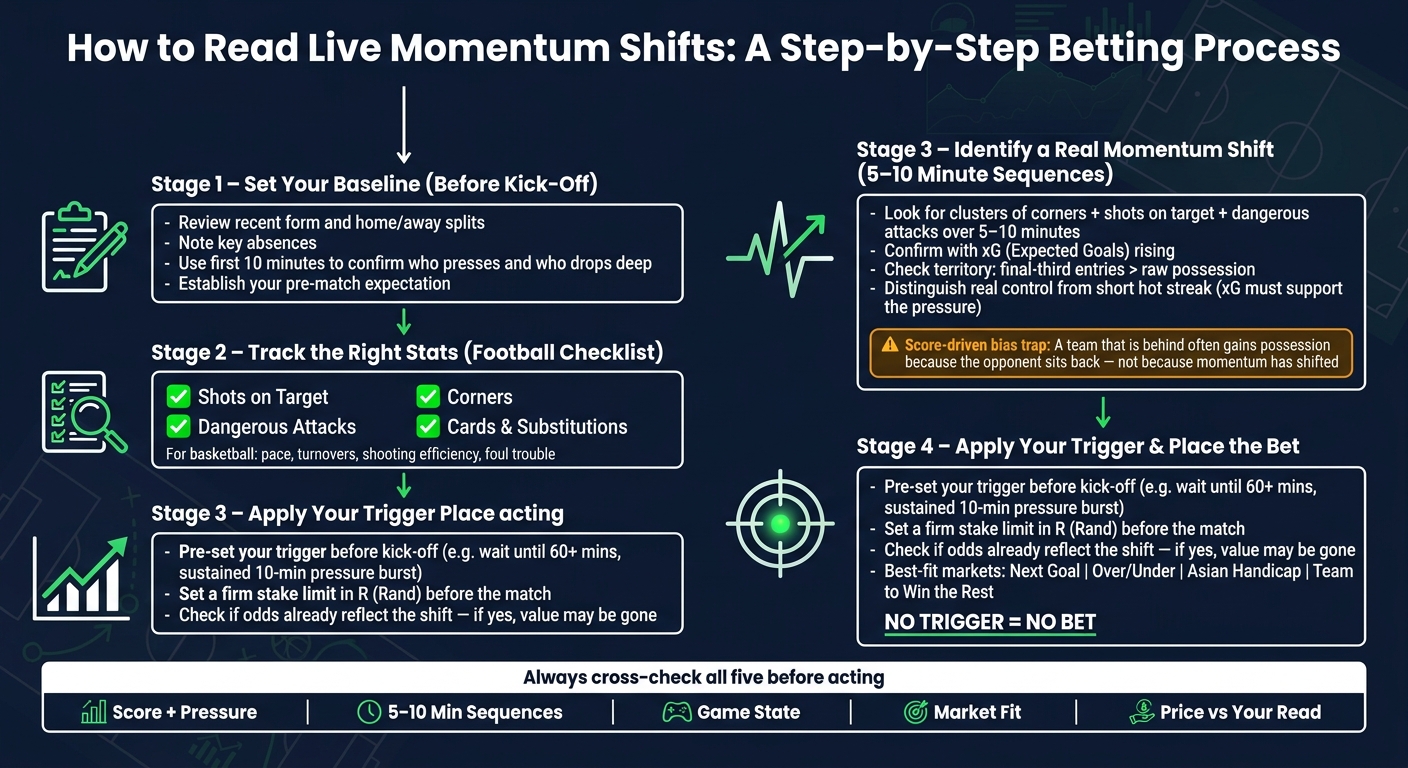
How to Read Live Momentum Shifts: A Step-by-Step Betting Process
Build a Short Stat Checklist for Each Sport
Once you spot a momentum shift, the next job is simple: decide if it’s worth backing.
That’s where a short checklist helps. You want a process you can run through fast, without getting lost in too many numbers. If you track everything, your read slows down.
For football, stick to the main signals:
- Shots on target
- Corners
- Dangerous attacks
- Cards and substitutions
Cards matter because they can change the state of a match fast.
For faster sports like basketball, the checklist changes a bit. Put your attention on pace, turnovers, shooting efficiency, and foul trouble. Those stats tell you a lot about who’s in control and whether that control is likely to hold.
Set Personal Triggers Before Placing a Live Bet
A checklist only works if you turn it into a clear rule before the match starts.
Set that rule before kick-off. Don’t make it up in the heat of the moment. For football, you might decide to wait until after 60 minutes and only step in if one team shows a sustained burst of corners and dangerous attacks across 10 minutes.
Keep your staking in Rand (R), and set a firm limit before the game starts. No trigger, no bet.
That one rule can save you from chasing action just because the match feels busy.
Use Live Trackers and Match Centres Efficiently
Use trackers to check whether the pressure trend is still building or starting to fade.
The best approach is to use live odds, stats, and visual match centres together. That gives you a better read on whether the pressure is real or just a brief spike. Supabets uses Betradar‘s live betting solution, giving access to over 15 000 live matches per month across 16 different sports.
Use the visual layer as a check, not a substitute, for your shortlist of stats. In plain terms: watch for the pattern, confirm it in the match centre, then measure it against your staking rule.
Limits, Risks and the Key Takeaway
Even a solid live read needs a reality check.
Why Momentum-Based Betting Can Still Go Wrong
Live stats can point you in the wrong direction. Feeds can lag, definitions can differ, and score-driven pressure can look like momentum when it isn’t. Feeds may also be revised later, and mixed definitions can skew the read.
Score-driven bias is another common trap. When a team is behind, it will often get more of the ball because the side in front has dropped into a low block to protect the lead. On paper, that pressure can seem like momentum. In practice, it may just be the score shaping the numbers. And those short spells of strong stats? They can be outliers. It’s smarter to check them against the longer pattern before you act.
That’s why price discipline matters just as much as the stats.
How to Use Stats With Discipline
The checklist and triggers covered earlier only help if you stick to them when the heat is on. If the odds already reflect the shift, there may be little value left. One of the best habits is to track the price you took against the closing odds. Over time, that tells you whether your live-stat reads are beating the market or whether it just feels that way.
What to Watch Live: A Quick Recap
Live stats improve the read, not the outcome. Use the same signals you tracked earlier, then check them against the price.
| What to track | Why it matters |
|---|---|
| Score + pressure | Score alone can miss who is actually controlling the match |
| 5–10 minute sequences | One short burst can be noise; longer patterns matter more |
| Game state | Teams that are behind will often skew possession and territory |
| Market fit | Use the signals that match the market and the game situation |
| Price vs your read | Strong stats don’t help if the odds have already moved |
Confirm the shift, respect your trigger, and treat every live read as a filter, not a verdict.
FAQs
How do I spot real momentum live?
Focus on the actual rhythm of play, not the league table before kick-off. Live stats can show whether a team is building real pressure or just knocking the ball around without much threat. Shots on target are one of the clearest signs that attacking momentum is starting to build.
It also helps to watch for momentum shifts. Travel can take a toll on coastal teams playing in Johannesburg or Pretoria, and substitutions can change pressing intensity in a flash. Once you spot those changes, line them up with the right in-play market on Supabets.
Which live stats matter most in football?
In football, the live stats that matter most are goals scored, goals conceded, clean sheets, and shots on target. They give you a quick read on the match. You can see if a team is piling on pressure or looking shaky at the back.
Shot data can also show a swing in momentum before the scoreline changes. That’s why it’s worth watching closely on Supabets. But numbers don’t tell the whole story. You still need to factor in things like travel fatigue, altitude, and team news.
When should I avoid a live momentum bet?
Avoid a live momentum bet when your call comes from emotion or team loyalty instead of hard data.
The same goes if you haven’t checked recent form, injury news, or possible squad rotation. Those factors can shift a match fast, and if you skip them, you’re betting half-blind.
Home advantage can help, sure, but it’s not magic. It matters far less at a neutral venue, during a poor run of form, or in a stadium where the crowd doesn’t have much sway over the game.
Stats can point you in the right direction. They just can’t promise the result.