I hedge live bets only when the match has clearly changed, the live price still works, and my exposure feels too big for my bankroll. That is the short answer.
If I had to boil it down, I’d use these rules:
- Hedge after a real match shift like a red card, key injury, or a late swing in control.
- Don’t hedge every wobble. One scrappy chance or a short spell of pressure is not enough.
- Use the live odds first, not emotion. If the price is gone, the hedge may no longer be worth it.
- Know the maths before you click.
- Equal-profit hedge: divide total return by live odds
- Stake-back hedge: divide original stake by live odds – 1
- Partial hedges often make more sense than full cover, especially if you still want upside.
- Late-game and final-leg acca spots are often the clearest hedge moments.
- Cash out is simple, but manual hedging can pay more.
A few numbers stand out. If a position grows beyond 3% of bankroll, a hedge can make more sense. In final-leg accas, a full hedge can lock in around 28% to 45% of the top payout. And with futures or two-outcome spots, hedging can protect about 40% to 70% of the return.
I’d keep one filter in mind: match change, price, bankroll. If those three line up, hedging is usually worth a look.
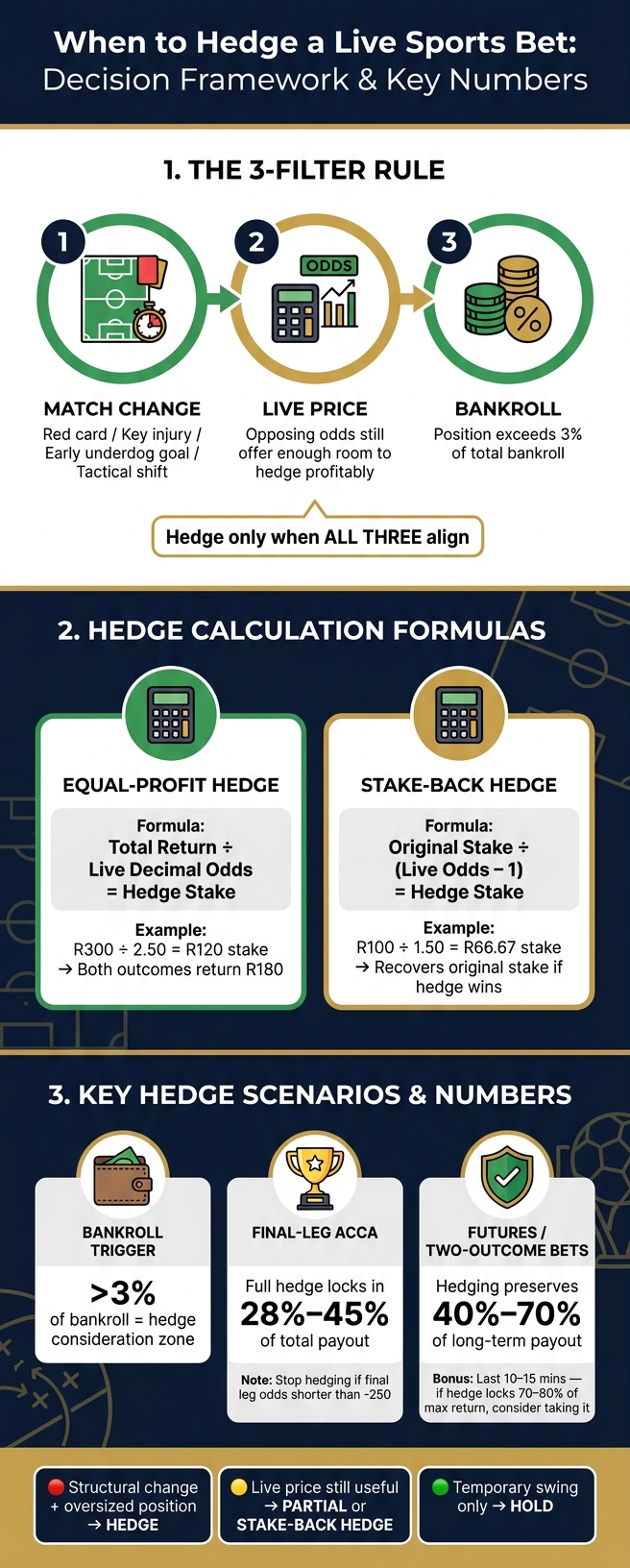
Live Sports Betting Hedge Decision Framework
How to Make Money Sports Betting | Beginner’s Guide to Hedging Bets | Hedge to Guarantee Profit
sbb-itb-00c3b18
When to hedge: the clearest live signals to watch
Not every live swing is a reason to hedge. You hedge when the match has changed enough that your first read no longer fits the risk.
Game-state changes that can flip a bet
Some in-game events hit much harder than others. A red card, a key injury to a star player, or an underdog scoring early can swing the balance of a match in a big way. Those are material changes that can wipe out the logic behind your first position.
Tactical shifts matter as well. If a coach throws on a striker for a defender, that side is chasing the game. So if your pre-match bet depended on a cautious, low-scoring setup, that one change can break the whole case for the bet. Early goals can also distort prices for a short spell, especially on the team that just conceded, which may open a brief hedge window.
Time-based moments when a hedge becomes more practical
Timing matters a lot in live betting. In football, once the match gets past the 75th minute, there’s less time left for chaos, but the prices can move fast. In basketball, the last few minutes of a close game are full of swing points. One possession can turn everything on its head.
Live markets can also move sharply or get suspended during high-pressure moments like VAR checks, penalties, or dangerous free kicks. If you already think a late hedge may be needed, it often makes sense to act before those moments land.
Odds movement and personal risk limits
A sharp move in live odds is often the clearest practical trigger. If the market has moved hard in your favour, your first stake now makes up a bigger share of your total exposure. That can get uncomfortable in a hurry. A handy rule of thumb: think about hedging when the original position is more than 3% of your bankroll.
"If the original 5-unit position represents more than 3% of the bankroll, the variance reduction is more valuable than the residual edge on a position that is too big for the bankroll." – Jake Sullivan, Senior Sports Analyst
A stake-back hedge is the simplest middle ground. You place enough on the other side to win back your first stake, while still keeping some upside open.
Once one of these triggers shows up, the next step is working out the hedge size and picking the right live market.
How to place a hedge during live play
Use the live numbers before the market shifts again. The aim is simple: cut your downside while the price still gives you a neat way out. After that, it comes down to two things – the hedge size and the market you use.
Check your original stake, current odds, and target outcome
Start with the basics: your original stake, your possible return, and what you want the hedge to do.
For an equal-profit hedge, divide your total return by the live decimal odds.. Say you backed one side with R100 at 3.00. That gives you a possible return of R300. If the live odds on the other side are now 2.50, your hedge stake is:
R300 ÷ 2.50 = R120.00
That means either result returns R180.00.
If your goal is just to get your stake back and leave some upside in play, use the stake-back hedge. Divide your original stake by live decimal odds minus 1. So with R100 and live odds of 2.50, the maths looks like this:
R100 ÷ 1.50 = R66.67.
That smaller hedge gets your stake back if the hedge lands, while still leaving part of the first bet alive.
Pick the hedge market that fits the new match picture
The match state should guide your choice. In live betting, the best hedge market is usually the one that covers the risk right in front of you.
- Leading team – a Double Chance bet on the opponent gives you cover for both a draw and a loss in one move.
- Goals market under pressure – if you backed Under 2.5 and the game suddenly looks open, a live Over 2.5 flips your position.
- Handicap mismatch – if your team is ahead by more than the first spread, you can take the other side at the new live spread and, in some spots, give yourself a shot at winning both bets.
This is where live hedging gets practical. You aren’t just reacting to odds on a screen. You’re matching the hedge to what the game now looks like.
Calculate the hedge before placing the bet
Do the maths before you open the bet slip. That’s not just good discipline – it matters more in-play.
Live odds often come with a short acceptance delay, which means the price can move before the bookmaker confirms the bet. On top of that, markets can suspend with no warning during goals, VAR checks, or penalties. One second the price is there; the next second it’s gone.
So if you’ve decided to hedge, have the stake ready first. Then place it while the market is still open.
The clearest cases tend to be the ones where the live match picture has changed in a clear way.
The clearest scenarios for hedging in live sports betting
Once the live trigger is clear, hedge only when protecting value matters more than chasing the full payout.
When a pre-match bet no longer fits the live match
A pre-match bet can go off track fast when the match changes in a big way. Hedge when the live state clearly goes against your original read.
Don’t react to one scrappy or lucky goal. Hedge only when the underdog is actually dictating the game.
A stake-back hedge works well in this spot. The aim isn’t to lock in the same profit on both sides. It’s to get your original stake back if the match keeps moving against you, while still keeping the first bet alive as open upside.
When a multi-leg accumulator reaches the final live leg
This is where accumulator hedging tends to matter most. You’ve built a multi-leg acca, every leg has come in, and now one last result stands between you and a big payout. At that point, the choice is simple: is the guaranteed return worth more than the risk of leaving with nothing?
A full hedge on the final leg can lock in 28% to 45% of the total potential payout, depending on the live odds on offer. In most cases, hedging stops making sense when the surviving leg’s live price is shorter than -250, because the amount you can lock in may be too small to justify the move.
Hedge straight after the penultimate leg settles.
When futures or late-game outcomes come down to two outcomes
The same thinking applies when the bet has narrowed to one decisive result. Tournament bets and season-long futures create a useful hedge spot when your original pick reaches the final match and only two outcomes remain. In that setup, hedging can preserve 40% to 70% of the long-term payout while removing the risk of losing everything on 90 minutes of football.
You can use that same logic in the last 10 to 15 minutes of a match, when the outcome has boiled down to “holds on” or “concedes”. If the current hedge offer locks in 70% to 80% of the maximum potential return, and the upside left depends on one random moment, taking the locked return is often the more rational move.
Conclusion: Hedge with a plan, not from panic
Hedging is about arithmetic, not emotion. Set your rules before kickoff, then use them only if the live match changes the picture. The point of a hedge is simple: protect your downside when the live game no longer lines up with your original bet.
A good way to tell the difference between a real change and a brief wobble is to look for something concrete. A red card, a key injury, or the stronger team finally breaking through can all change the match in a meaningful way. A short spell of pressure usually doesn’t. Hedge when the game has genuinely changed, not when momentum just feels a bit uncomfortable.
Price and bankroll matter too. Hedge when the opposing price still gives you enough room to make the move worthwhile. If the price has already gone too short, leave it. And keep your stake size under control. If your position has become too big next to your bankroll, that’s a good reason to act. If your edge is only partly gone, a stake-back or partial hedge often makes more sense than trying to force full cover.
If you want one last filter, use this order: match change, price, bankroll. In most cases, these are the spots that justify a hedge:
- Structural change and an oversized position: hedge.
- Temporary swing only: hold.
- Live price still useful: partial or stake-back hedge.
The hard part is staying disciplined enough to separate a real shift from a passing wobble. Set your thresholds before the match starts: your bankroll limits, your price limits, and the game-state triggers that would justify a hedge. Then stick to them once play begins. On live betting platforms such as Supabets, prices move fast, so your hedging rules should already be in place before the first whistle.
FAQs
How do I know if a match has really changed?
Look past the scoreboard if you want to spot a match that’s starting to turn.
Pay attention to momentum, tactical tweaks, and live stats. Then match that with what you can see on the pitch: sharper pressing, sloppy passes, or one side starting to lose second balls. Those little signs often tell you more than the score does.
It also helps to check whether Expected Goals (xG) lines up with the scoreline. A team might be behind but still creating the better chances, which can point to a game state that the scoreboard doesn’t fully show.
And keep an eye on line movement. If a favourite’s odds drift with no clear on-field reason, that move may say more about market liability than any actual swing in the match.
Should I use a partial or full hedge?
It comes down to your risk tolerance and your goal.
A full hedge locks in the same profit no matter which outcome lands. That strips out variance, but it also means giving up positive expected value. It fits bettors who’d rather bank a fixed return than ride out swings.
A partial hedge trims your risk while leaving some upside on the table. It’s often a solid middle ground if you still believe in your original bet, but want a bit of cover in case things go the other way.
When is cash out better than manual hedging?
Manual hedging is usually the better play than cash out. Why? Cash-out options often bake in extra commission, which can trim the true value of your position by 5% to 10%.
A manual hedge gives you more control. You can use it to lock in profit or smooth out variance on a big position, provided the hedge itself doesn’t come with heavy juice or a negative expected value.