If I ignore price, I can pick winners and still lose money. That’s the whole point of expected value, or EV: it tells me whether a bet is likely to make or lose money over many bets, not whether today’s pick will win.
Here’s the short version:
- EV checks the price, not just the team
- A bet can win today and still be a bad bet
- A bet can lose today and still be the right bet
- Bookmakers build in a margin, often around 5% to 7%
- That margin can drain a bankroll bit by bit
- Accumulators make that problem worse
- I can test a bet with a simple sum: (my probability × odds) − 1
- If the answer is above 0, the bet may be worth taking
- If it’s below 0, I’m paying too much for the risk
- Even with a good edge, I still need small stakes, like 1% to 3% of bankroll
A simple example shows how this works. If I stake R100 at odds of 2.50, and I think the true chance is 45%, the EV is positive. That means the price may be in my favour over time. But if I keep betting at poor prices, even a strong win rate won’t save me.
The big lesson is simple: I don’t need to ask only “Will this team win?” I also need to ask “Are these odds worth it?”.
How to Calculate Expected Value (+EV vs -EV Explained)
sbb-itb-00c3b18
Why most betting strategies fail over time
Most bettors lose money for one simple reason: they ignore price. Popular teams often come with shorter odds, which means the market can price them below their true value. Over time, that gap turns into steady losses.
That’s also why win rate on its own doesn’t tell you much. A bettor can win 60% of their bets and still lose money if they keep taking prices that are too short for the risk involved. What matters more is average return per bet, not just how often a selection comes in.
Why winning often can still mean losing money
Win rate is a weaker measure than average return. You can stack up plenty of wins and still go backwards if each bet carries a small price disadvantage. Those small misses don’t scream at you straight away. They build quietly, then show up later in the bankroll.
How bookmaker margins create negative EV
Every betting market includes a built-in margin, often called the overround. It works by pushing the total implied probability above 100%. That extra slice is the bookmaker’s edge.
In South Africa, bookmakers often build a 5% to 8% overround into 1X2 markets, and Supabets usually sits around 5% to 7% on most sports markets.
Here’s what that looks like in a PSL match. If Kaizer Chiefs are priced at 2.10, the draw at 3.40, and Orlando Pirates at 3.80, the implied probabilities come out to 47.6%, 29.4%, and 26.3%. Added together, that gives 103.3%. The extra 3.3% is the house margin.
A R100 stake might make that margin seem minor. It isn’t. The edge applies to every bet, every market, every day. Accumulators make the problem worse. A standard 5% margin on each leg of a four-fold bet compounds into a 21.55% disadvantage for the bettor.
That’s why EV matters. It tells you whether the price still leaves any room for profit. Put simply, EV is the check you use before staking to see if the margin has already eaten the edge.
What expected value means in sports and casino betting
Expected value (EV) is the average amount you can expect to win or lose per bet if you placed the same wager hundreds or thousands of times under the same conditions.
That’s the key idea: EV is about the long run, not what happens on one ticket.
A bet with positive EV can still lose in the short term. And a poor bet can still win once. In casino games, EV is built into the game rules. In sports betting, it comes from the gap between your estimate of the outcome and the odds on offer. That’s why EV is the next thing to check after spotting bookmaker margin.
A simple EV test is:
(Your Estimated Probability × Decimal Odds) − 1
If the result is above zero, the bet has value. If it’s below zero, the price is too short for the chance on offer. This formula works directly with decimal odds, which keeps things nice and simple.
How to convert decimal odds into implied probability
Decimal odds already contain an implied probability. To find it, divide 1 by the decimal odds.
So if the odds are 2.50, the implied probability is 40%:
1 ÷ 2.50 = 0.40
That means the bookmaker is pricing the outcome as if it has a 40% chance of happening, with their margin built in.
| Decimal Odds | Implied Probability | Calculation |
|---|---|---|
| 1.50 | 66.7% | 1 ÷ 1.50 |
| 2.00 | 50.0% | 1 ÷ 2.00 |
| 2.50 | 40.0% | 1 ÷ 2.50 |
| 4.00 | 25.0% | 1 ÷ 4.00 |
From there, compare that implied probability with your own estimate. If your number is higher than the bookmaker’s implied figure, the bet may be +EV.
That edge doesn’t always show up straight away. It tends to matter more over a bigger sample, once variance starts to even out.
How expected value shapes long-term betting results
Once you can spot EV, the next step is seeing what it does over time. In the short run, results are driven mostly by variance, which is just luck showing up in different clothes. A bad bet can win for a while, and that can fool people into thinking the plan is working. It isn’t proof. The true edge only starts to show in a large sample, often 500 to 1 000 bets .
Positive EV improves your average return across many similar bets.
A simple example makes this easier to grasp. At 1.90 odds on a 50% outcome, the bet is about −5% EV. Put plainly, that’s an average loss of R5 for every R100 staked. If you place 1 000 bets at R100 each, your expected loss comes to R5 000.
That loss won’t always arrive in a straight line. Variance can cover it up for days or even weeks. You might hit a good run and feel ahead. But if you keep making negative EV bets, the maths tends to catch up over time, and the losses usually start to show.
Negative EV, variance, and the house edge
A small negative edge can chip away at your bankroll without making much noise. The overround built into standard markets means most bets start with a built-in disadvantage the moment you place them. In the short term, variance can blur that picture. Over 6–12 months, though, the drain often becomes hard to miss.
Where positive EV can appear on Supabets

Positive EV shows up when your estimate of the true chance is better than what the odds suggest. On Supabets, that can happen in pre-match markets for less efficient leagues, or during live in-play betting when odds briefly lag behind what’s happening on the field.
Think of it like seeing a price tag that hasn’t been updated yet. The result can still go against you, of course, but the price may be in your favour. That’s why EV checks matter before every wager, not after the result.
How to apply EV checks before betting on Supabets
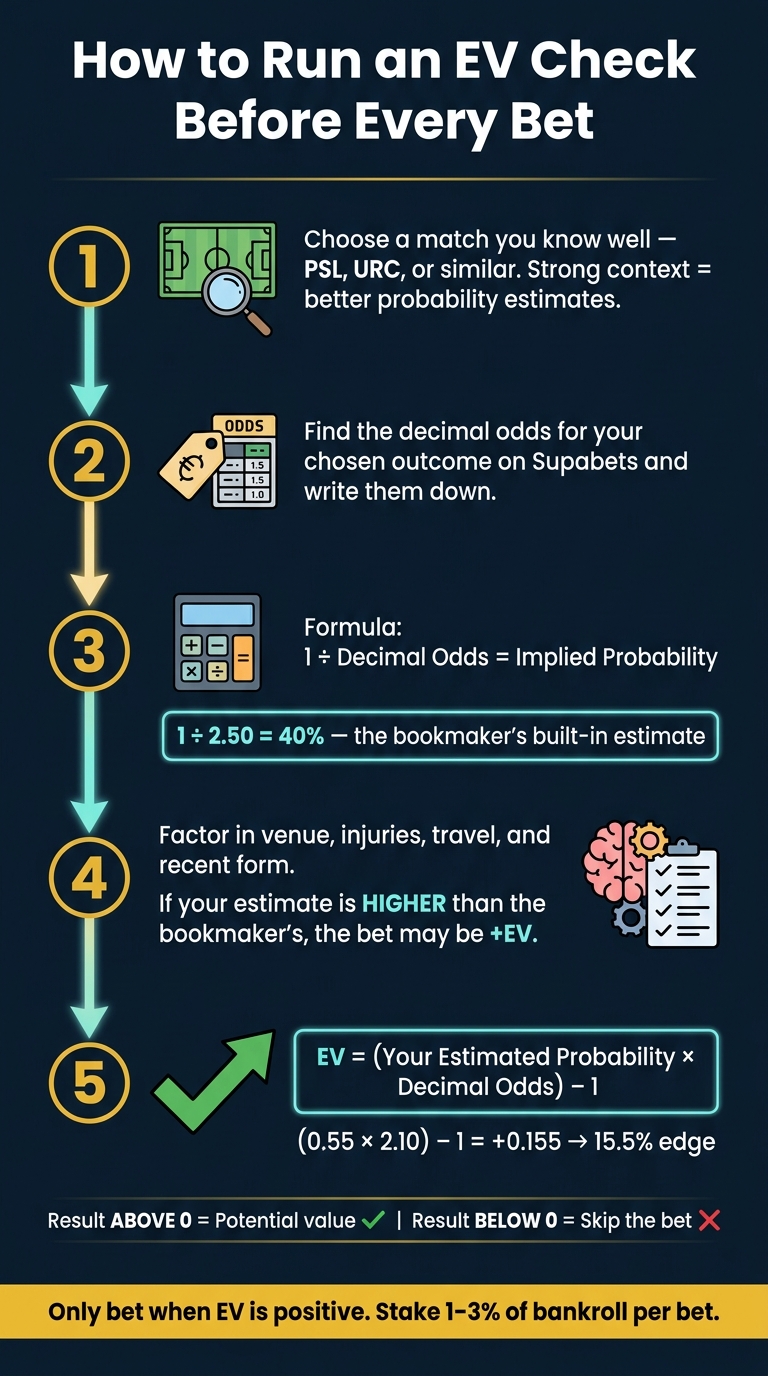
How to Run an EV Check Before Every Bet
The next step is using EV before every wager, not just knowing how it works on paper. Understanding EV and applying it are two different things. The good news? Once you do it a few times, it becomes second nature.
A step-by-step EV check before placing a bet
Before you confirm any wager on Supabets, run through this sequence:
- Pick your market: Start with a match you know well, like a PSL or URC fixture. If you know the teams, form, and context, your probability estimate has something solid behind it.
- Note the decimal odds: Find the decimal odds for your chosen outcome on Supabets and keep them in front of you while you work.
- Convert to implied probability: This shows the bookmaker’s price in percentage terms. Odds of 2.50 mean an implied probability of 40% because
1 ÷ 2.50 = 0.40. - Estimate the true probability yourself: This is the part that matters most. Factor in venue, travel, injuries, and recent form. If your estimate comes out higher than the bookmaker’s implied figure, the bet may be +EV.
- Apply the formula and bet only if the result is positive: Use
EV = (Your Estimated Probability × Decimal Odds) − 1. If you estimate a 55% chance and the odds are 2.10, the result is(0.55 × 2.10) − 1 = +0.155– a 15.5% edge. If the answer is zero or less, there’s no value.
Once a bet passes the EV check, the next call is stake size.
Negative EV habits compared to EV-based choices
Most losing patterns start the same way: the bettor skips the check and bets on instinct. That’s where things go sideways. Here’s what that often looks like in practice.
| Negative EV Habit | EV-Based Choice |
|---|---|
| Chasing losses after a bad run | Stick to pre-committed bankroll rules |
| Backing favourites out of loyalty | Check whether the odds reflect the true probability |
| Taking longshots for excitement | Bet only when the EV formula returns a positive result |
| Ignoring closing odds | Track whether your odds beat the closing line over time |
How EV applies differently to sports bets and casino games
Sports markets and casino games don’t work the same way, and that matters.
In sports betting, prices can be off. This tends to happen more often in less-watched leagues, where markets may not be priced as tightly. On some PSL fixtures, for example, a bettor who has done the homework may come up with a probability estimate that’s closer to the mark than the bookmaker’s model. That’s where positive EV can show up.
Casino games are different. The same EV idea still applies, but the setup changes. Slots, crash games, live tables, and other casino products have a house edge built into the game itself. They’re made to pay back less than they take in, and that house edge stays fixed.
A positive-EV bet still needs the right stake to protect long-term returns.
Bankroll control: using EV to guide staking discipline
Once you’ve found value, stake size becomes the thing that decides whether your edge can outlast variance. A bet can be +EV on paper and still fail in practice if your bankroll takes too much strain too early. Put plainly: your edge only counts if your bankroll stays alive long enough to use it.
Staking methods that support long-term EV
The simplest way to protect a +EV edge is to keep each stake small compared with your bankroll.
| Staking Method | Bet Amount | % of Bankroll | Risk Level | Variance Control |
|---|---|---|---|---|
| Flat Staking | R50 | 2.5% | Low | High protection; slower growth |
| Fractional Kelly (Quarter-Kelly) | R50 | 2.5% | Medium | Balanced; scales with edge and bankroll |
| Aggressive (Full Kelly) | R200 | 10% | Very High | Higher chance of bankroll loss |
Examples are based on a R2 000 bankroll.
Smaller stakes cut the risk of ruin and give positive EV time to compound.
Fractional Kelly staking, often Half-Kelly or Quarter-Kelly, is a common way to lower volatility while still aiming for long-term growth. Quarter-Kelly uses 25% of the full Kelly stake. It grows more slowly than Full Kelly, but it gives your edge more breathing room. For recreational bettors, flat staking at 1–3% per bet is the most practical place to start.
Key takeaways for South African bettors
Check EV before every bet, then stake 1–2% per unit so your edge can survive variance.
FAQs
How do I estimate true probability?
Estimating true probability is the hardest part of working out expected value. Why? Because it depends on your own judgement, not just the bookmaker’s prices.
Start with the basics. Look at team form, injury news, head-to-head results, and situational factors before you even glance at the market. That gives you your own view first, instead of letting the odds do the thinking for you.
One common approach is to use sharp closing lines, strip out the vig, and then compare that implied probability with the odds on offer from Supabets.
How many bets before EV matters?
There’s no magic number here. Short-term results can swing all over the place, and variance has a big say in that.
A sample of around 50 bets tells you almost nothing. Once you get to 500 bets, you can start to see whether you have a real edge.
If you want a result that lines up more closely with your mathematical expectation, most pros track hundreds or even thousands of bets. That’s the part that matters: stay disciplined, keep good records, and don’t judge your method by a few wins or losses.
Can a +EV bet still lose often?
Yes. A positive expected value (+EV) bet can still lose a lot in the short term. Expected value tells you about long-term profit, not what will happen on one bet.
Variance is the reason. Even when you have a clear maths edge, you can still hit losing runs. In most cases, +EV profit only starts to show across hundreds of bets, as results start to balance out over time.