Tournament betting is fast-paced and unpredictable, making it different from regular sports betting. With formats like single-elimination and round-robin, every match carries high stakes. Understanding odds, betting types, and strategies is key to making smarter decisions.
Key takeaways:
- Tournament Odds: Focus on outright winners (overall champions) or match odds (individual games).
- Differences from Regular Betting: Tournaments have smaller sample sizes, neutral venues, and higher variance, leading to more upsets.
- Decimal Odds: Common in South Africa, these show total returns, including your stake. Example: R100 at 2.50 odds returns R250.
- Strategies: Research team form, spot value bets, and manage your budget (1–3% of your bankroll per bet).
- Live Betting: Odds shift dynamically during matches, offering opportunities for quick, informed bets.
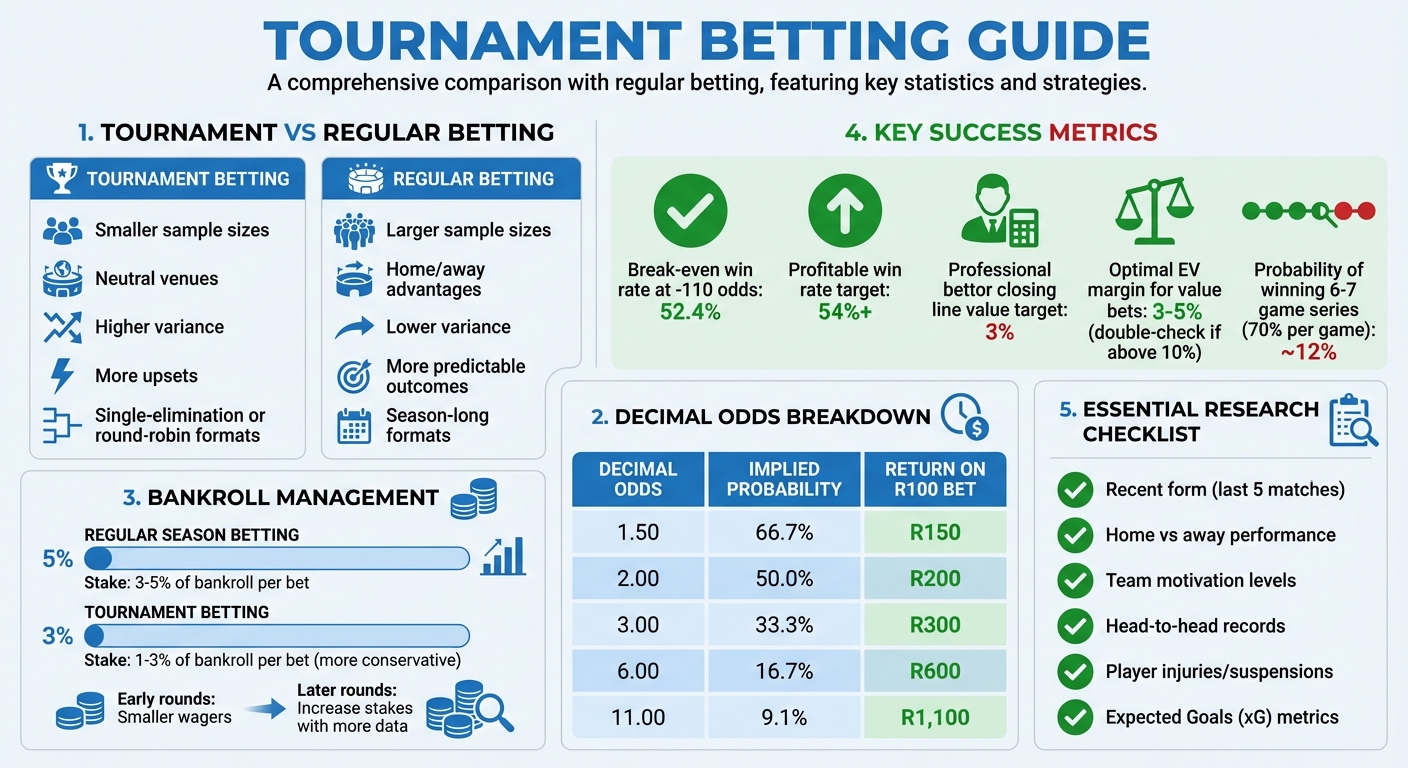
Tournament Betting vs Regular Betting: Key Differences and Strategies
Types of Tournament Betting Odds
Once you’ve got the hang of tournament betting basics, it’s time to understand how odds impact your potential returns. In South Africa, decimal odds are the most common format you’ll encounter. They’re user-friendly and make calculating payouts straightforward. Each type of bet offers its own strategies and opportunities.
Decimal Odds Explained
Decimal odds dominate South African betting platforms like Supabets due to their simplicity. The number displayed shows your total return for every R1 wagered, including your original stake. Calculating your payout is easy: multiply your stake by the decimal odds. For instance, placing R100 on a team with odds of 2.50 would give you a total return of R250.
Here’s a quick breakdown of how decimal odds link to implied probability and returns:
| Decimal Odds | Implied Probability | Total Return on R100 Bet |
|---|---|---|
| 1.50 | 66.7% | R150 |
| 2.00 | 50.0% | R200 |
| 3.00 | 33.3% | R300 |
| 6.00 | 16.7% | R600 |
| 11.00 | 9.1% | R1,100 |
One thing to note: bookmakers include a margin – often called the "vig" or "juice" – to ensure their profitability. For example, even if an event is a true 50/50 split, the odds may be listed as 1.91 instead of 2.00. To break even at these odds, you’d need to win 52.4% of your bets. Recognising this margin helps you spot when odds offer genuine value.
Next up, let’s dive into outright winner betting, a popular choice for tournament enthusiasts.
Outright Winner Betting
Outright winner bets, sometimes referred to as "futures", focus on predicting the overall champion of a tournament rather than individual match winners. These bets are especially popular on platforms like Supabets because they keep you engaged throughout the entire event, from the first match to the final.
The odds for outright winners reflect each team’s perceived chances before the tournament begins. For example, in the 2024 NCAA Final Four, the decimal odds were as follows: UConn (1.50), Purdue (3.00), Alabama (17.00), and NC State (19.00). A R10 bet on NC State would have returned R190 if they had won. Outright betting is a great way to back an underdog early, with the potential for significant returns if they progress far. However, keep in mind that these bets are only settled after the tournament concludes, so your money will be tied up for the duration. Plan your budget accordingly.
Now, let’s look at how handicap betting can level the playing field in mismatched games.
Handicap Betting for Mismatched Opponents
In tournaments, especially during the early stages, it’s common to see strong teams face weaker ones. Handicap betting, also known as point spread betting, adjusts for this imbalance by giving the favourite a deficit or the underdog a head start. For example, if a team is listed at -5.5, they need to win by 6 points or more for your bet to succeed. On the flip side, if you back the underdog at +5.5, they can lose by up to 5 points and your bet still wins.
This type of betting makes uneven matchups more engaging and can highlight opportunities where the market underestimates an underdog’s ability to perform well. However, if the final score margin matches the handicap exactly, the bet is considered a "push", and your stake is refunded. Handicap betting is particularly exciting during knockout tournaments, where mismatches are frequent but surprises can still happen.
sbb-itb-00c3b18
Tournament Betting Strategies
Understanding odds is just the starting point; having a solid strategy is what turns knowledge into potential winnings. In high-stakes tournaments where every match matters, sticking to a disciplined approach can make all the difference. These strategies build on your understanding of odds to help you make smarter bets throughout the event.
How to Research Tournament Form and Statistics
Before placing any bets, take the time to study recent team performance and relevant statistics. Start by reviewing the last five matches to get a sense of each team’s momentum. Pay close attention to how teams perform at home versus away – some teams thrive in front of their home crowd but struggle on the road. Motivation is another key factor. Teams fighting for titles or qualification spots often approach games with heightened intensity, which can influence outcomes.
Dive deeper into head-to-head records to spot any tactical advantages one team might have over another. Player-specific data is equally important – injuries, suspensions, or even fatigue can significantly impact a team’s performance. To get these insights, use platforms like LiveScore, Flashscore, SofaScore, or WhoScored. These tools provide detailed stats and live updates, while advanced metrics like Expected Goals (xG) can help you determine whether a team is outperforming or underperforming their actual potential.
"Successful soccer betting isn’t about luck; it’s about preparation." – LiveScore Desk
Make it a habit to check recent form, home/away statistics, motivation levels, injuries, head-to-head matchups, and player data before placing your bets. This methodical approach is essential for making informed decisions.
Once your research is complete, the next step is identifying odds that offer genuine value.
Finding Value in Tournament Odds
The key to long-term betting success lies in value betting. A value bet occurs when the odds provided by bookmakers are higher than the true probability of an outcome. To confirm this, use the Expected Value (EV) formula: EV = [Win Probability x Decimal Odds] – 1. Professional bettors aim for EV margins of 3% to 5%, though anything above 10% should be double-checked for accuracy.
Value opportunities often arise for several reasons. Public bias can skew odds, especially for popular teams, creating value on their less-favoured opponents. Acting quickly on breaking news – such as injuries, weather conditions, or last-minute lineup changes – can also lead to mispriced odds before bookmakers adjust. Additionally, smaller leagues or early market openings often present inefficiencies that savvy bettors can exploit.
Line shopping is another crucial step. By comparing odds across multiple bookmakers, you can find the best value for your bet. Even small differences in odds can add up over time. Specialising in niche markets, such as lower-tier leagues or specific bet types like Asian handicaps, can further improve your chances of spotting opportunities. Finally, track your Closing Line Value (CLV) – the odds you secured versus the odds at kickoff – to evaluate how effective your strategy is over time.
"Online betting is a game of probabilities, not certainties. No outcome is ever guaranteed, but studying the numbers gives you an edge." – LiveScore Desk
This data-driven approach to finding value in tournament odds is a cornerstone of successful betting strategies.
How to Manage Your Betting Budget
Effective budget management is crucial for tournament betting. Start by setting strict limits and only wager money you can afford to lose. If you’re new to this, stick to simpler markets like match winners or totals to keep risks manageable. Remember, sportsbooks include a margin in their odds, so you’ll need a calculated edge to overcome it.
Use a fixed staking plan, betting between 1–3% of your total budget per wager. This helps protect your funds during inevitable losing streaks. Avoid the temptation to chase losses by increasing your stakes – this often leads to bigger setbacks. Some experienced bettors use a conservative version of the Kelly Criterion to adjust their stakes based on their perceived edge in a specific bet.
Understanding implied probability is another useful tool. For example, odds of 2.50 imply a 40% chance of winning. If your analysis suggests the team has a 48% chance, you’ve found a value bet. Keep a detailed record of every wager, including stakes, odds, and outcomes. Analysing this data over time will help you refine your strategy. Given the fast-paced nature of tournaments, sticking to a strict budget plan is not just smart – it’s essential.
Live In-Play Betting During Tournaments
Live in-play betting adds an exciting layer to tournament matches, letting you place bets after the game has started. Unlike pre-match betting, where odds are locked in, live betting odds shift constantly as the match unfolds. This fast-paced environment demands quick decisions and sharp observation, offering unique opportunities for those who can keep up. Here’s a closer look at how live betting works and how to make the most of it.
How Live Betting Odds Change During Matches
Odds in live betting change in real time, thanks to a method known as Bayesian updating. This means bookmakers adjust their odds based on the latest developments in the match. Every goal, red card, or injury can instantly alter the odds. For example, if a tournament favourite concedes an early goal, their odds to win will lengthen, while the underdog’s odds will shorten dramatically.
Bookmakers also keep a close eye on sharp money – bets made by professional punters – to fine-tune their odds as the game progresses. Even external factors, like weather, can impact the game. Matches played in heavy rain or strong winds often see disrupted gameplay, with scoring patterns changing significantly. For instance, winds exceeding 30 mph can make long passes and kicks much harder, altering the flow of the game.
"Professional bettors consistently aim for a 3% closing line value. If you can beat the closing line by this margin regularly, you’re likely profitable long-term."
- Robert J. Wood, PhD, Exercise Physiologist, University of Western Australia
By understanding these shifts, you can anticipate changes in odds before bookmakers fully adjust, giving you a potential edge.
Tips for Making Live Betting Decisions
Success in live betting often comes down to speed and awareness. Momentum shifts are key indicators to watch. Teams that suddenly lose steam or, on the flip side, pick up the pace under pressure can create valuable betting opportunities. Similarly, favourites who appear to be saving their energy for a bigger upcoming match may offer value on the live underdog.
Tools like social media platforms (e.g., X, formerly Twitter) can be game-changers. They provide real-time updates on injuries or tactical adjustments, often before these changes are reflected in the odds. This lag creates opportunities for savvy bettors to capitalise on inefficiencies.
Mobile apps are another must-have for live betting. They allow you to act quickly as odds shift, ensuring you lock in favourable prices before they disappear. In the high-speed world of live tournaments, this responsiveness can make all the difference.
Live Betting Features and Tools
Many platforms, like Supabets, offer specialised live betting sections with detailed event calendars and 24-hour schedules to keep you informed about ongoing matches. If you can’t watch the game live, tools like match trackers and real-time stats provide crucial insights into possession, shots on target, and other performance metrics.
These features help you identify inefficient lines, where the odds don’t yet reflect the actual gameplay. Additionally, many platforms include responsible gaming tools to help you set limits and stay disciplined during the adrenaline rush of live betting. Quick settlements also allow you to reinvest your winnings into new bets within the same session, keeping your bankroll active throughout the tournament.
How to Increase Your Tournament Betting Returns
Improving your returns in tournament betting isn’t just about research and strategy – it’s also about smart money management and making the most of promotions. Whether it’s tracking your bets, leveraging bonuses, or avoiding costly mistakes, these tactics can help you maximise your profits.
Taking Advantage of Betting Promotions
Tournament-specific promotions can give your bankroll a noticeable lift when used wisely. Betting platforms like Supabets frequently offer bonuses such as odds boosts, multi-bet enhancements, and money-back specials. To stay informed, check the ‘Promotions’ page regularly, sign up for newsletters, and enable push notifications on your phone.
Multi-bet bonuses are particularly useful during tournaments, offering a percentage boost on your returns when you combine multiple selections. Insurance promotions are another great tool – they refund your stake if one leg of your multi-bet fails or if your outright winner reaches the final but doesn’t take the trophy. However, always read the fine print. Pay attention to wagering requirements and minimum odds criteria. For instance, a seemingly generous bonus might require you to wager it three times at odds of 3.0 or higher before you can withdraw any winnings.
Keeping Records of Your Bets
A simple spreadsheet can be a game-changer. By tracking details like the date, tournament, bet type, odds, stake, and outcome for each wager, you can uncover patterns and refine your strategy over time. This isn’t just about logging wins and losses – it’s about understanding value.
Compare your own probability estimates with the bookmakers’ implied odds. If you consistently find discrepancies where your assessment indicates value, you’re on the right track. Over time, your records will also reveal which tournaments or formats yield the best returns. For instance, to break even at standard -110 odds, you need to win at least 52.4% of your bets. Analysing your records helps you fine-tune your approach and avoid repeating mistakes.
Common Betting Mistakes to Avoid
Even seasoned bettors can make errors that drain their bankroll. One common pitfall is chasing losses, which can lead to rapid depletion of funds. Instead, stick to a disciplined staking plan. Allocate 1–3% of your total bankroll per bet, regardless of recent outcomes. This method, especially when combined with strategies like the Kelly Criterion, can improve your survival rate significantly – by as much as 400%.
Another mistake is letting emotions dictate your bets. Every wager should be treated as a calculated decision based on data, not a gut feeling. Don’t overlook the "vig" – the sportsbook’s built-in margin. Understanding how it influences the true probability of outcomes can help you identify real value. Careful budget management is essential and works hand-in-hand with live betting strategies.
"The key to sustainable betting success lies in treating stake sizing as a percentage of a rolling, conservative bankroll estimate. This approach prevents emotional over-betting after wins or losses and maintains long-term profitability."
- Robert J. Wood, PhD, Exercise Physiologist
Conclusion
Applying the right strategies can make all the difference in tournament betting. Unlike regular-season wagers, tournaments come with higher variance, demanding a more disciplined approach to bankroll management and strategy. Factors like tournament format (single-elimination or round-robin), roster depth, and coaching quality play a major role in shaping your odds of success.
For example, while a team might have a 70% chance of winning a single round, the probability of them clinching a six- or seven-game series drops significantly to just about 12%. This highlights the importance of finding value rather than simply backing favourites. Even a modest 54% success rate can turn profitable if you stick to disciplined unit sizing – typically wagering 1–2% of your bankroll on tournaments, compared to 3–5% for regular-season bets.
To maximise your chances, keep your tournament bankroll separate, track every bet, and adjust your stakes based on uncertainty. Early rounds may call for smaller wagers, while later rounds – when you have more data – can justify increasing your stakes. In large-field events like golf majors, exploring positional bets (e.g., Top-5 or Top-10 finishes) can often yield better returns.
From understanding decimal odds to leveraging live in-play opportunities, every strategy discussed here contributes to smarter betting decisions. Platforms like Supabets offer live betting, exclusive promotions, and a wide range of markets, making it easier to implement these strategies. Ensure your withdrawals are smooth by completing your FICA verification.
Success in tournament betting boils down to patience and sticking to a well-thought-out plan. Avoid letting emotions dictate your choices, trust the numbers, and maintain consistency for better long-term results.
FAQs
How do I convert decimal odds into a win probability?
To figure out the win probability from decimal odds, use this simple formula: divide 1 by the decimal odds and then multiply the result by 100. The outcome is the implied probability shown as a percentage. For instance, if the decimal odds are 2.00, the calculation would be: (1 ÷ 2.00) × 100 = 50%. This approach makes it easier to understand the chances of winning based on the given odds.
When is it better to bet outright winners vs match-by-match?
When you’re confident that a team or player will consistently perform well and take the title, outright betting is the way to go. It’s ideal for tournaments where there’s a clear favourite or the results seem predictable. On the other hand, match-by-match betting is great for honing in on specific games. This method lets you use short-term insights, adapt to current form, and consider match conditions. It also offers more flexibility and lowers long-term risk, especially when the tournament outcome feels uncertain.
How do I know if a live in-play price is value?
To figure out if an in-play betting price offers good value, you need to evaluate whether the odds accurately represent the real likelihood of an event happening. This means taking into account the current match situation and relevant stats. The key is to focus on calculating probabilities rather than simply reacting to what’s just happened in the game. If your analysis shows that the odds being offered are better than the actual chance of the event occurring, then you might have found value.