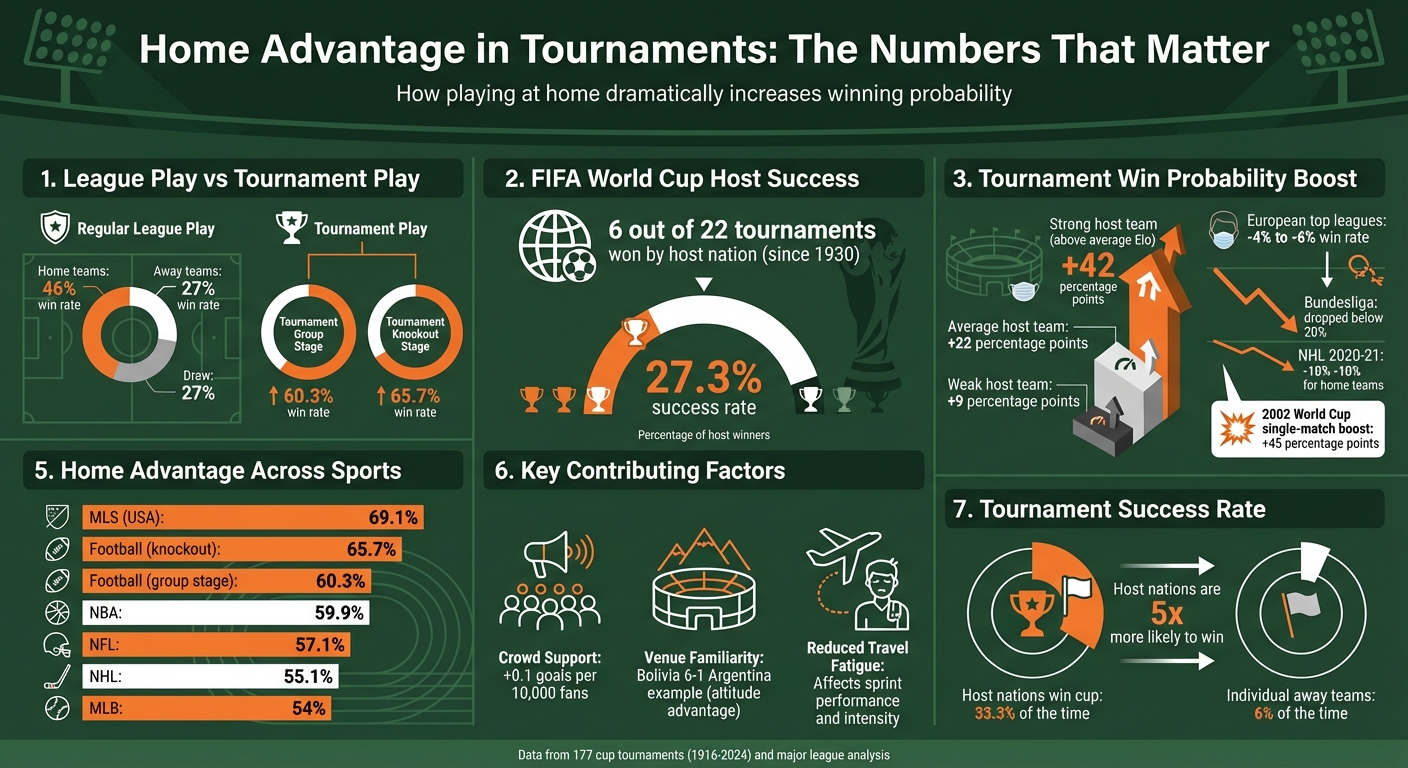
Home advantage significantly boosts a team’s chances in tournaments. In football, home teams win about 46% of matches, while away teams win only 27%. This edge becomes even more pronounced in tournaments, where hosts benefit from familiar venues, supportive crowds, and reduced travel. For example, host nations in FIFA World Cups have won 6 out of 22 tournaments since 1930. On average, hosting increases a team’s tournament win probability by 22 percentage points, and for stronger teams, this can rise to 42 points.
Key factors driving home advantage:
- Crowd support: Boosts morale and can influence referees.
- Venue familiarity: Teams know the pitch and conditions better.
- Reduced travel fatigue: Hosts avoid the strain of long-distance travel.
COVID-19 "ghost games" highlighted the importance of fans, with win rates dropping by 4–6% in empty stadiums. Regional differences also play a role, with travel distances and local conditions (e.g., altitude in Bolivia or vuvuzelas in South Africa) further tipping the scales.
For bettors, understanding home advantage is crucial. Focus on host team strength, crowd influence, and specific tournament conditions to make informed decisions. Platforms like Supabets offer tools to leverage these insights, such as live betting and cash-out options.
Home Advantage Statistics in Football Tournaments and League Play
What is Home Advantage?
Home advantage refers to the consistent edge teams gain when playing on their home turf compared to competing as the away side. In league play, this might seem like a slight advantage that evens out over a season. But in tournaments – especially high-stakes events like the FIFA World Cup – the impact becomes much more pronounced. The host nation enjoys the privilege of playing all their matches on familiar ground, while opponents face the challenge of adapting to foreign conditions. This advantage can significantly tilt the odds in favour of the home team.
The statistics back this up. Out of the 22 FIFA World Cup tournaments held since 1930, six have been won by the host nation. To understand this better, let’s look at how home advantage has developed over the years.
Home Advantage Patterns Over Time
The concept of home advantage has been evident across different sports and eras. For instance, in major European football leagues, home teams historically win about 46% of matches, while away teams manage only 27%. In the English Premier League, this trend has shifted slightly, with home win rates dropping from 48% in the 1990s to roughly 43% in recent seasons.
This trend isn’t exclusive to football. In ice hockey, during the 2020–21 NHL season, home teams experienced a 10% drop in win rates when games were played without fans due to COVID-19 restrictions. The absence of spectators clearly affected performance, highlighting the role of external factors in home advantage.
Why Home Advantage Exists
Several key factors contribute to home advantage: crowd support, familiarity with the venue, and reduced travel fatigue.
Crowd support plays a huge role in boosting home players’ morale and can even influence refereeing decisions. Studies of 5,000 English Premier League matches reveal that every additional 10,000 fans in the stadium increases home advantage by 0.1 goals. During the "ghost games" of the COVID-19 era, when stadiums were empty, home win rates in Europe’s top five leagues dropped by 4–6 percentage points. This demonstrates how much a vocal crowd can sway the game.
Venue familiarity gives home teams an edge, as they’re accustomed to the pitch dimensions, turf conditions, and unique features of their stadium. A striking example occurred on 1 April 2009, when Bolivia defeated Argentina 6–1 in a World Cup qualifier in La Paz, played at an altitude of 3,600 metres. The extreme altitude, which Bolivia’s players were used to, proved to be a decisive advantage against Argentina.
Travel fatigue is another critical factor. Away teams often face disrupted sleep schedules and recovery routines, which can lower their intensity and sprint performance. In contrast, home players benefit from sleeping in their own beds and sticking to their usual training schedules. In geographically large leagues, such as South Africa’s Premier Soccer League, the strain of long-distance travel can be particularly taxing on visiting teams.
sbb-itb-00c3b18
The Numbers Behind Home Advantage
Win Rates by Sport
The statistics paint a clear picture: home advantage is a powerful factor across various sports. In football, home teams win 60.3% of group-stage matches in tournaments where draws are possible, and this figure jumps to 65.7% in knockout stages, where a winner must emerge. By comparison, regular league play in top European competitions shows lower home win rates – ranging from around 43% in Ligue 1 to roughly 48% in the English Premier League.
Other sports also show notable home advantages. In basketball, NBA teams win 59.9% of regular-season games, while NFL teams secure victories 57.1% of the time when playing at home. Baseball and ice hockey, however, have more modest advantages: MLB teams win 54% of their games at home, and NHL teams win 55.1%.
For South African bettors, rugby provides some fascinating insights. Like football, rugby demonstrates a strong home advantage in tournaments, likely due to the sport’s physical demands and the toll of travel on visiting teams. Cricket, while showing a smaller home edge in single matches, reveals clear trends over the course of multi-match series. These differences highlight how tournaments can significantly amplify the impact of playing at home.
Why Tournaments Amplify Home Advantage
Tournament formats take the home advantage seen in regular matches and amplify it. This happens due to what’s known as compound probability. Essentially, a strong home team benefits from playing on familiar turf in every round it advances. Each knockout victory means another home match, creating a snowball effect that doesn’t occur in league play.
The numbers back this up. On average, host nations enjoy a 22-percentage-point boost in tournament win probability. For teams with above-average strength (measured by Elo ratings), this jumps to 42 percentage points. A striking example comes from the 2002 FIFA World Cup, where playing at home increased a team’s single-match win probability by 45 percentage points. Across 177 cup tournaments held between 1916 and 2024, home teams won the title 33.3% of the time, compared to just 6% for individual away teams – making host nations over five times more likely to claim victory.
"The stronger the HT [home team], the larger is its expected HA for tournament victory." – Adriaan Kalwij, Utrecht University School of Economics
How Fans and External Factors Affect Home Advantage
What Empty Stadiums Revealed During COVID-19
The pandemic gave sports fans and analysts a rare opportunity to study home advantage in a completely new way. With empty stadiums across Europe’s top leagues, home win rates took a noticeable dip – falling by 4% to 6% without fans in attendance. The Bundesliga experienced the sharpest drop, with home win rates sinking to below 20% during the so-called "ghost game" period. Similarly, in the NHL’s 2020–21 season, home teams saw their win rates drop by 10%, while road teams performed better, with a 7% increase in victories.
One of the biggest shifts came in referee behaviour. Without the crowd’s influence, disciplinary actions against away teams decreased significantly, and the home teams’ advantage in penalty awards was reduced. Daniel Memmert of the German Sport University Cologne highlighted:
We found that spectators do not have a direct influence on the outcome of a match, but what is happening on the pitch is different.
Referees, no longer swayed by the roar (or jeers) of the crowd, made more balanced decisions. Researcher Fabian Wunderlich suggested:
As there is the referee bias, referees should be aware that this actually exists and maybe there’s a possibility for increased training for the referees.
The absence of fans didn’t just impact referees – it also affected the players. Home teams recorded fewer shots on goal and showed less pressing intensity when their supporters weren’t there to cheer them on. The psychological boost from a packed stadium and the pressure it puts on visiting teams clearly adds a few percentage points to a home side’s chances of winning.
These findings confirm that home advantage isn’t a one-size-fits-all phenomenon. Other factors, including regional influences, play a significant role in shaping match outcomes.
How Home Advantage Differs by Region
While fans are a key part of home advantage, geography and local conditions also make a difference. For example, in Major League Soccer in the US, home teams win 69.1% of matches, compared to 60% in leagues across Asia and Africa. In Europe, Spanish La Liga teams enjoy a stronger home advantage than their English Premier League counterparts. This is partly due to longer travel distances and the intense summer heat in southern Spain.
South Africa offers its own set of challenges for visiting teams. The vast distances between cities like Johannesburg, Cape Town, and Durban result in significant travel fatigue. Add to that the distinctive sound of vuvuzelas, which energises the home crowd while making it harder for opponents to communicate on the pitch. These unique elements make South African stadiums particularly tough for visiting teams.
Such regional differences are essential to consider, especially for those analysing tournament matches or placing bets. Understanding how home advantage varies by location can provide critical insights when teams face off on unfamiliar turf.
How to Use Home Advantage in Your Betting Strategy
Finding Matches Where Home Advantage Matters Most
Before placing a bet, take a closer look at the host team’s overall strength. Research from Utrecht University highlights that during an average cup tournament hosted by a single nation, the home team’s chances of winning increase by 22 percentage points. If the host team boasts a higher Elo rating – one standard deviation above the average – that advantage jumps to 42 percentage points. On the flip side, for weaker host teams, the boost drops to just 9 percentage points.
This means you shouldn’t automatically back a host team just because they’re playing on home turf. Instead, focus on the home vs. away Expected Goals (xG) differential. For example, if a team has a home xG of 0.6 compared to a league average of 0.35, it suggests a strong “fortress” effect. In tournaments like AFCON, away teams often face challenges like crossing several time zones, which can impact their sprint performance and pressing intensity, further tipping the scales in favour of the home side.
Once you’ve assessed the host team’s strength, think about how tournament-specific factors can amplify these advantages.
Accounting for Tournament Pressure
Tournament pressure often intensifies home advantage, particularly in knockout stages where the stakes are higher with each round.
The atmosphere in the stadium can also play a massive role. Packed, high-energy venues – like those filled with the unmistakable buzz of vuvuzelas in South Africa – create an environment that can sway referee decisions. Studies show that crowd noise can reduce fouls called against home teams while leading to quicker penalties for visiting sides. As ProSoccerTips explains:
Home advantage does not decide matches. It shifts probabilities. The rest is execution.
When betting on tournament games, it’s crucial to weigh both the host team’s strength and the intensity of their crowd support. These factors can make a big difference, especially in high-stakes matches.
Making the Most of Supabets Features

Supabets offers tools that can help you put home advantage insights into action during live games. Their live in-play betting feature allows you to track key momentum indicators like possession, shots on target, and fouls. For example, if you notice a trend of marginal fouls being called in favour of the home team, this could signal strong crowd influence and a potential live betting opportunity.
The Cash Out feature is another way to manage your bets effectively. If a host team takes the lead but starts showing signs of fatigue or defensive lapses during a knockout round, you can lock in partial profits before the tide turns. Additionally, checking the Discover Page can help you see where other players are finding value in live bets focused on home teams. For outright tournament bets, consider allocating 80% of your stake on the home team reaching the final and 20% on them winning the tournament outright.
Conclusion
Home advantage in tournaments goes far beyond simply knowing the pitch; it significantly impacts match outcomes. For example, in major European leagues, home teams win about 46% of matches, compared to just 27% for away teams. In tournament settings, this advantage becomes even more pronounced. On average, host nations see a boost of 22 percentage points in win probability, with strong teams enjoying up to a 42-percentage-point increase. In contrast, weaker hosts might only gain a modest 9-percentage-point lift.
But here’s the thing: home advantage isn’t a one-size-fits-all concept. Factors like team strength, crowd energy, travel demands, and even referee biases all play a role. The COVID-19 era "ghost games", where matches were played without fans, showed us how much the absence of a crowd affects home win rates. Even without fans, though, pitch familiarity and reduced travel still gave home teams a slight edge.
When betting on tournaments, it’s smart to think in terms of compound probability. A strong host nation benefits from its home advantage across multiple knockout rounds, dramatically increasing its odds of winning the trophy. To spot teams with a true home edge, compare their home expected goals (xG) against their away performance over a couple of seasons.
With this knowledge, you can make smarter bets. Supabets’ live in-play betting tools and risk-mitigation features let you adapt as matches progress. By tracking momentum and relying on stats instead of guesswork, you can bet with more confidence.
FAQs
How big is home advantage in knockout matches?
Home advantage in knockout matches often plays a major role, with home teams emerging victorious in over 50% of cases. This edge can shape performance and results, although its effect tends to differ based on the competition and unique conditions.
What matters more: the crowd, travel, or the venue?
The venue plays a key role in shaping outcomes, as teams gain an edge from being familiar with their home ground and feeling at ease in a known environment. While factors like crowd support and the exhaustion from travel can have some effect, these are less influential compared to the benefits that the venue itself offers.
How can I price home advantage into my bets?
To factor home advantage into your betting decisions, start by recognising the statistical boost teams often enjoy on their home turf. For example, in football, home teams typically win around 45-50% of matches. This edge comes from several elements: the energy from home crowd support, familiarity with the pitch, and the absence of travel-related fatigue.
It’s also essential to adjust for differences across leagues and evolving trends. For instance, during matches played without spectators, the home advantage noticeably diminished. Digging deeper, consider nuances like potential referee bias and how specific teams perform at home compared to away games. These insights can help you fine-tune your betting models and make more informed choices.